


CXC Home | Search | Help | Image Use Policy | Latest Images | Privacy | Accessibility | Glossary | Q&A
1
Chandra X-ray Image of
ESO 137-001 and Tail in Abell 3627
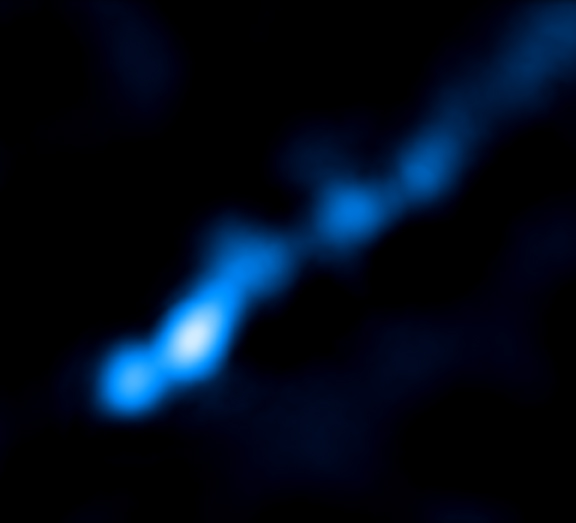
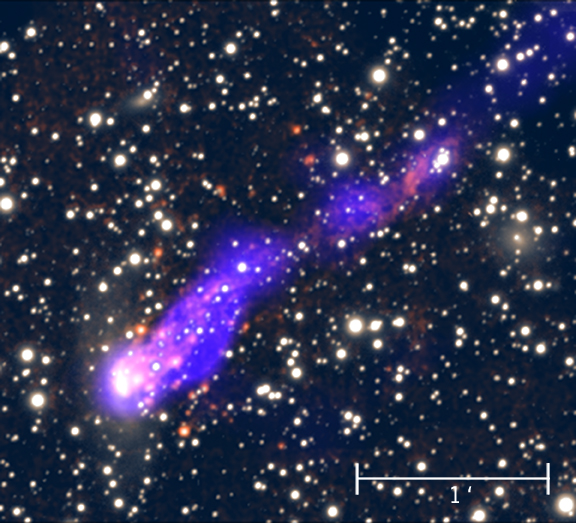
The comet-like tail behind the galaxy ESO 137-001 is clearly shown in this Chandra X-ray Observatory image. The 70,000 light year long tail was created as gas was stripped from ESO 137-001 while it plunges toward the center of Abell 3627, a giant cluster of galaxies. Cool gas from the galaxy - only seen in optical images - is mixed in with hot gas from the cluster as seen in X-rays.
(Credit: X-ray: NASA/CXC/MSU/M. Sun et al.; Optical: SOAR (MSU/NOAO/UNC/CNPq-Brazil)/M.Sun et al.)
The comet-like tail behind the galaxy ESO 137-001 is clearly shown in this Chandra X-ray Observatory image. The 70,000 light year long tail was created as gas was stripped from ESO 137-001 while it plunges toward the center of Abell 3627, a giant cluster of galaxies. Cool gas from the galaxy - only seen in optical images - is mixed in with hot gas from the cluster as seen in X-rays.
(Credit: X-ray: NASA/CXC/MSU/M. Sun et al.; Optical: SOAR (MSU/NOAO/UNC/CNPq-Brazil)/M.Sun et al.)
2
H-alpha Image of ESO 137-001 and Tail in Abell 3627
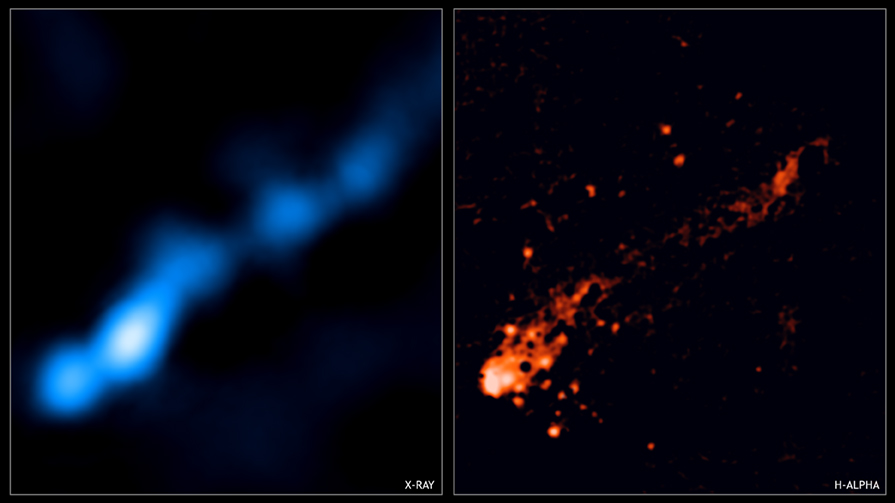
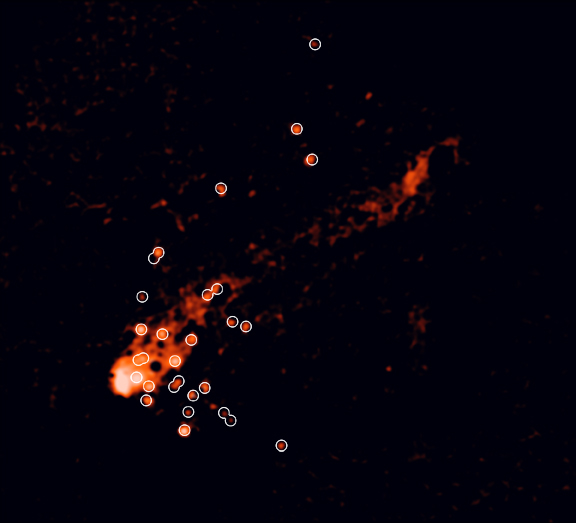
This optical image of hydrogen line-emission obtained by the Southern Astrophysical Research (SOAR) telescope shows the galaxy ESO 137-001 and its long tail. The white circles show 29 regions of ionized hydrogen that are being lit up by newly formed stars. These regions if star formation are all downstream of the galaxy, located in or near the tail. It is believed that the stars formed within the last 10 million years or so.
(Credit: SOAR (MSU/NOAO/UNC/CNPq-Brazil)/M.Sun et al.)
This optical image of hydrogen line-emission obtained by the Southern Astrophysical Research (SOAR) telescope shows the galaxy ESO 137-001 and its long tail. The white circles show 29 regions of ionized hydrogen that are being lit up by newly formed stars. These regions if star formation are all downstream of the galaxy, located in or near the tail. It is believed that the stars formed within the last 10 million years or so.
(Credit: SOAR (MSU/NOAO/UNC/CNPq-Brazil)/M.Sun et al.)
3
XMM-Newton X-ray Image of Abell 3627
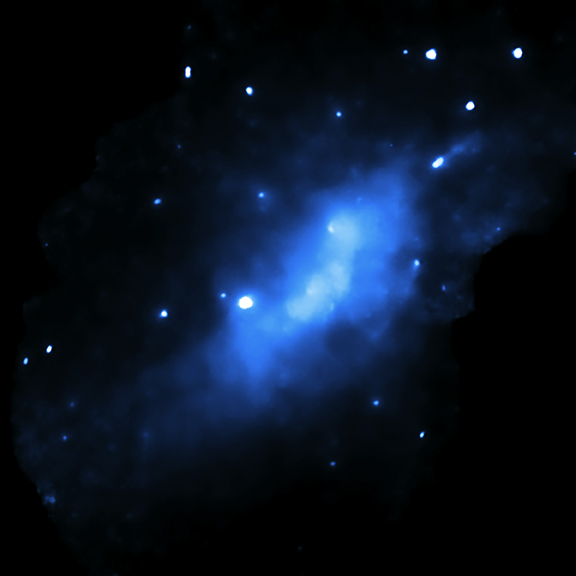
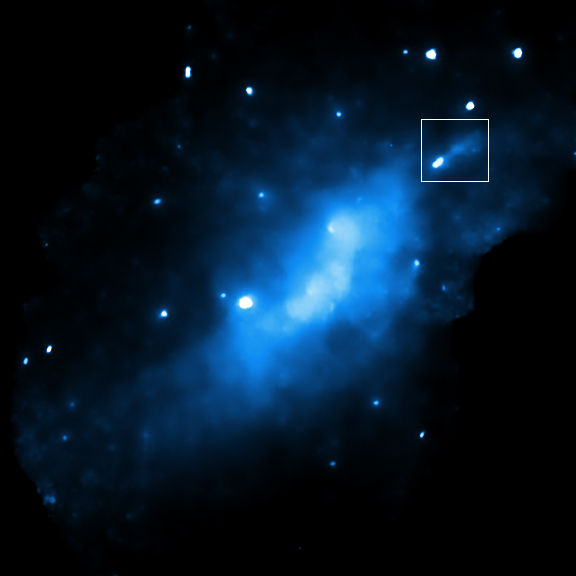
This is an X-ray image of the galaxy cluster Abell 3627 obtained with the European Space Agency's XMM-Newton. The galaxy ESO 137-001 is plunging towards the center of the cluster, as shown by the direction of its tail (see the box which shows the field in the composite image). The X-ray emission is from multimillion degree gas that is pervading the cluster.
(Credit: XMM credit: ESA/MSU/M.Sun et al)
This is an X-ray image of the galaxy cluster Abell 3627 obtained with the European Space Agency's XMM-Newton. The galaxy ESO 137-001 is plunging towards the center of the cluster, as shown by the direction of its tail (see the box which shows the field in the composite image). The X-ray emission is from multimillion degree gas that is pervading the cluster.
(Credit: XMM credit: ESA/MSU/M.Sun et al)
4
Optical Image of ESO 137-001 in Abell 3627
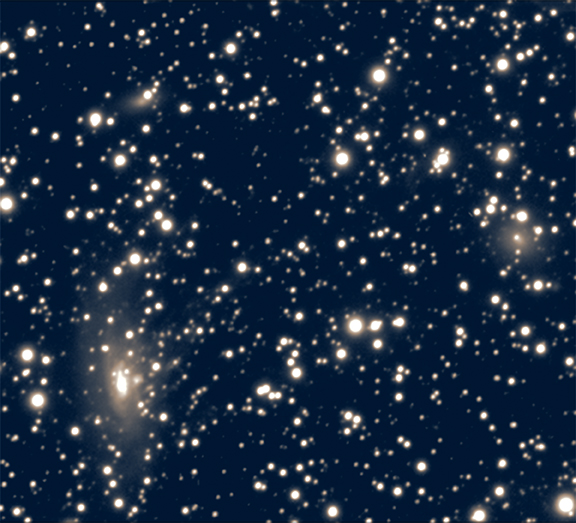
An optical image from the SOAR telescope of ESO 137-001 - located in the lower left of the image - and nearby field. The tail is not visible in this image. A couple of other galaxies in the image are visible, but nearly all of the optical sources are foreground stars located in our galaxy.
(Credit: SOAR (MSU/NOAO/UNC/CNPq-Brazil)/M.Sun et al.)
An optical image from the SOAR telescope of ESO 137-001 - located in the lower left of the image - and nearby field. The tail is not visible in this image. A couple of other galaxies in the image are visible, but nearly all of the optical sources are foreground stars located in our galaxy.
(Credit: SOAR (MSU/NOAO/UNC/CNPq-Brazil)/M.Sun et al.)
Return to Abell 3627 (20 September 07)


Revised: June 07, 2022