





CXC Home | Search | Help | Image Use Policy | Latest Images | Privacy | Accessibility | Glossary | Q&A
Download Image
More Information
More Images
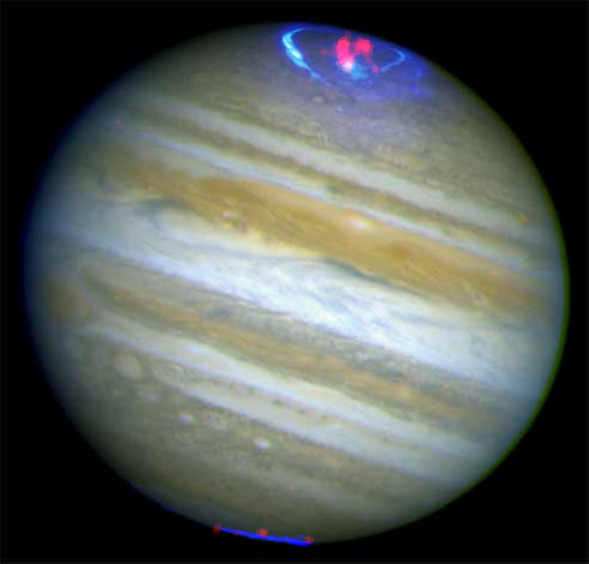
X-ray/UV/Optical Composite
(Credit: X-ray: NASA/SWRI/
R.Gladstone et al., UV: NASA/HST/J.Clarke et al., Optical: NASA/HST/R.Beebe et al.)
R.Gladstone et al., UV: NASA/HST/J.Clarke et al., Optical: NASA/HST/R.Beebe et al.)
More Releases


Related Images
Jupiter:
Jupiter Hot Spot Makes Trouble For Theory

Jupiter Hot Spot Makes Trouble For Theory
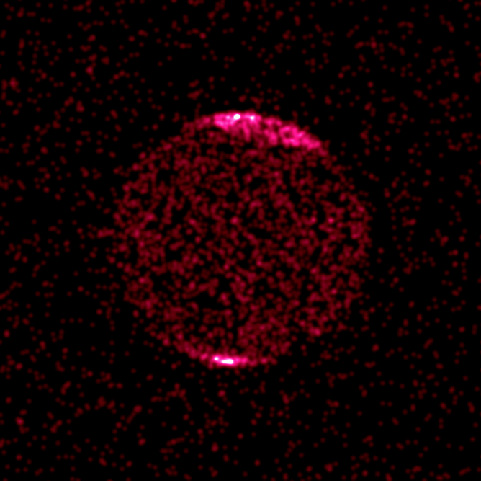
This image of Jupiter shows concentrations of auroral X-rays near the north and south magnetic poles. While Chandra observed Jupiter for its entire 10-hour rotation, the northern auroral X-rays were discovered to be due to a single 'hot spot' that pulsates with a period of 45 minutes, similar to high-latitude radio pulsations previously detected by NASA's Galileo and Cassini spacecraft.
Although there had been prior detections of X-rays from Jupiter with other X-ray telescopes, no one expected that the sources of the X-rays would be located so near the poles. The X-rays are thought to be produced by energetic oxygen and sulfur ions that are trapped in Jupiter's magnetic field and crash into its atmosphere. Before Chandra's observations, the favored theory held that the ions were mostly coming from regions close to the orbit of Jupiter's moon, Io.
Chandra's ability to pinpoint the source of the X-rays has cast serious doubt on this model. Ions coming from near Io's orbit cannot reach the observed high latitudes. The energetic ions responsible for the X-rays must come from much further away than previously believed.
One possibility is that particles flowing out from the Sun are captured in the outer regions of Jupiter's magnetic field, then accelerated and directed toward its magnetic pole. Once captured, the ions would bounce back and forth in the magnetic field, from Jupiter's north pole to south pole in an oscillating motion that could explain the pulsations.
|
||||||||||||||||||||||||
Visual Description:
In 2002, Chandra captured an X-ray image of the planet Jupiter. The planet itself appears as a dark magenta speckled circular object in the center of the image, on a black background. The X-ray image of Jupiter shows concentrations of bright auroral X-rays near the north and south magnetic poles. While Chandra observed Jupiter for its entire 10-hour rotation, the northern auroral X-rays were discovered to be due to a single 'hot spot' that pulsates with a period of 45 minutes, similar to high-latitude radio pulsations previously detected by NASA's Galileo and Cassini spacecraft.


Revised: October 07, 2026