

CXC Home | Search | Help | Image Use Policy | Latest Images | Privacy | Accessibility | Glossary | Q&A
February 27, 2002
RELEASE: 02-34
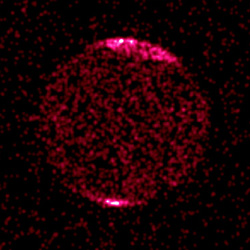
A pulsating hot spot of X-rays has been discovered in the polar regions of Jupiter's upper atmosphere by NASA's Chandra X-ray Observatory. Previous theories cannot explain either the pulsations or the location of the hot spot, prompting scientists to search for a new process to produce Jupiter's X-rays.
"The location of the X-ray hot spot effectively retires the existing explanation for Jupiter's X-ray emission, leaving us very unsure of its origin," said Randy Gladstone, of the Southwest Research Institute in San Antonio and lead author of a paper on the results in the Feb.28, 2002 issue of the journal Nature. "The source of ions that produce the X-rays must be a lot farther away from Jupiter than previously believed."
Chandra observed Jupiter for 10 hours on Dec. 18, 2000, when NASA's Cassini spacecraft was flying by Jupiter on its way to Saturn. The X-ray observations revealed that most of the auroral X-rays come from a pulsating hot spot that appears at a fixed location near the north magnetic pole of Jupiter.
Bright infrared and ultraviolet emissions have also been detected from this region in the past. The X-rays were observed to pulsate with a period of 45 minutes, similar to the period of high-latitude radio pulsations detected by NASA's Galileo and Cassini spacecraft.
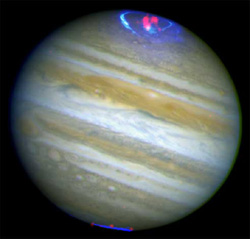
X-ray/UV/Optical Composite
Credit: X-ray: NASA/SWRI/R.Gladstone et al.
UV: NASA/HST/J.Clarke et al.
Optical: NASA/HST/R.Beebe et al.
An aurora of X-ray light near Jupiter's polar regions had been detected by previous satellites. However, scientists were unable to determine the exact location of the X-rays. The accepted theory held that the X-rays were produced by energetic oxygen and sulfur ions that became excited as they ran into hydrogen and helium in Jupiter's atmosphere. Oxygen and sulfur ions (originally from Jupiter's moon Io) are energized while circulating around Jupiter's enormous magnetosphere. And, some - the purported X-ray producers - get dumped into Jupiter's atmosphere when they return to the region of Io's orbit.
Chandra's ability to accurately determine the location of the X-rays proved this model incorrect, as ions from regions of Jupiter's magnetic field near Io cannot reach the high Jovian latitudes where most of the X-rays were observed.
This result has its own problems. At the large distances required for the source of the ions - at least 30 times the radius of Jupiter - spacecraft measurements have shown that there are not nearly enough energetic oxygen and sulfur ions to account for the observed X-ray emission.
One possibility is that heavy ions among the particles flowing out from the Sun as the solar wind are captured in the outer regions of Jupiter's magnetic field, then accelerated and directed toward its magnetic pole. Once captured, the ions would bounce back and forth in the magnetic field from pole to pole in an oscillating motion that might explain the pulsations.
The High Resolution Camera used for the Chandra observations was built by the Smithsonian Astrophysical Observatory in Cambridge, Mass. NASA's Marshall Space Flight Center in Huntsville, Ala., manages the Chandra program, and TRW, Inc., Redondo Beach, Calif., is the prime contractor. The Smithsonian's Chandra X-ray Center controls science and flight operations from Cambridge, Mass.
MEDIA CONTACTS
Dolores Beasley
Headquarters, Washington
Phone: 202/358-1753
Steve Roy
Marshall Space Flight Center, Huntsville, AL
Phone: 256-544-6535
Megan Watzke
Chandra X-ray Observatory Center, CfA, Cambridge, MA
Phone: 617-496-7998


Revised: March 07, 2008