





CXC Home | Search | Help | Image Use Policy | Latest Images | Privacy | Accessibility | Glossary | Q&A
Download Image
More Information
More Images
More Releases
Related Images
Saturn:
X-rays from Saturn Pose Puzzles

X-rays from Saturn Pose Puzzles
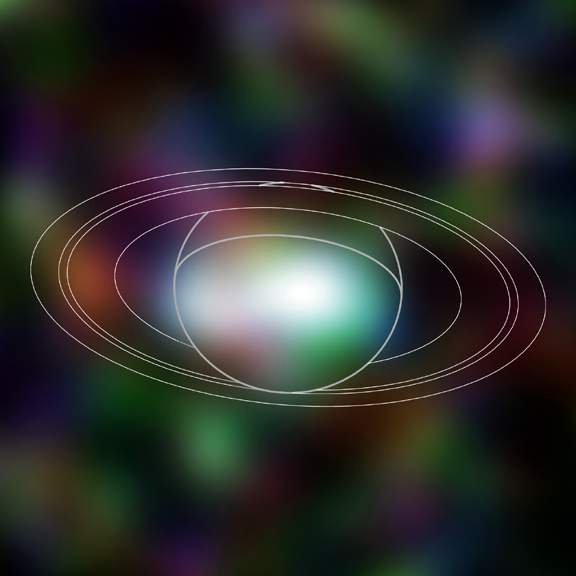
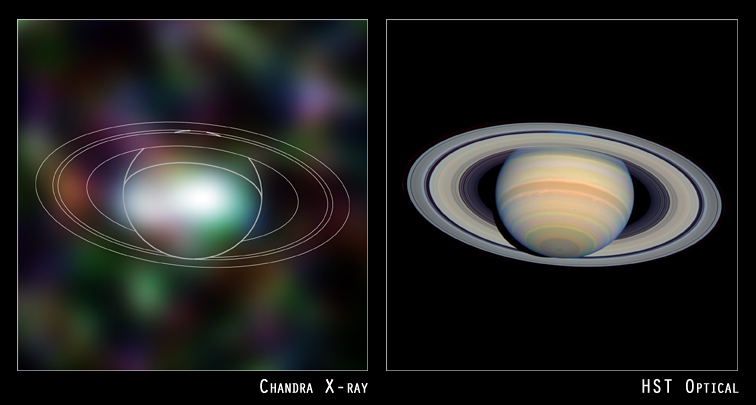
Chandra's image of Saturn held some surprises for the observers.First, Saturn's 90 megawatts of X-radiation is concentrated near the equator. This is different from a similar gaseous giant planet, Jupiter, where the most intense X-rays are associated with the strong magnetic field near its poles.
Saturn's X-ray spectrum, or the distribution of its X-rays according to energy, was found to be similar to that of X-rays from the Sun. This indicates that Saturn's X-radiation is due to the reflection of solar X-rays by Saturn's atmosphere. The intensity of these reflected X-rays was unexpectedly strong.
Further observations should help clarify the nature of Saturn's X-radiation, and determine whether Saturn's magnetic polar regions ever flare up in X-rays, as do Jupiter's. The features outside of Saturn's disk in the X-ray image are instrumental artifacts or "noise".
The optical image of Saturn is also due to the reflection of light from the Sun - visible wavelength light in this case - but the optical and X-ray images obviously have dramatic differences. The optical image is much brighter, and shows the beautiful ring structures, which were not detected in X-rays. This is because the Sun emits about a million times more power in visible light than in X-rays, and X-rays reflect much less efficiently from Saturn's atmosphere and rings.
|
||||||||||||||||||||||||||||
Visual Description:
This two panel image shows Saturn. At left, the Chandra X-ray Observatory image of the planet Saturn consists of soft purple, green, blue and pink hues. It resembles a nebula in space but with a white outline of Saturn over it to showcase where the planet is. In the center of the X-ray image, there is a bright white area where emissions peak. On the right is a classic optical image of Saturn from Hubble colored in warm creams and greys with the planet and spectacular ring structure visible. Chandra's image of Saturn shows that its X-radiation is concentrated along the equator (white peak). The X-radiation is due to the reflection of solar X-rays by Saturn's atmosphere. The optical image of Saturn is also due to the reflection of light from the Sun – visible wavelength light in this case – but the two images obviously have dramatic differences. The optical image is much brighter and shows the beautiful ring structures, which were not detected in X-rays. These differences occur because the Sun emits about a million times more power in visible light than in X-rays, and X-rays reflect much less efficiently from Saturn's atmosphere and rings.


Revised: September 08, 2025