



CXC Home | Search | Help | Image Use Policy | Latest Images | Privacy | Accessibility | Glossary | Q&A
1
X-ray/UV/Optical Composite
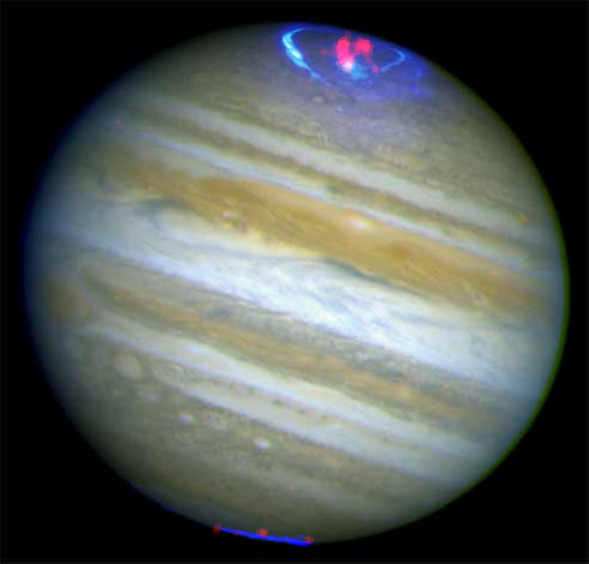
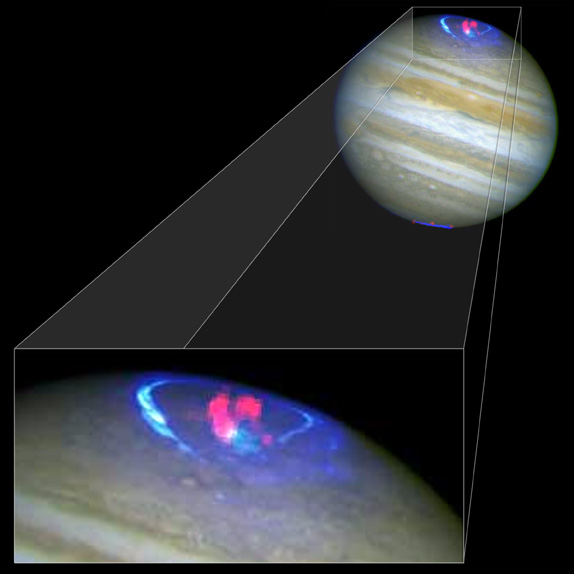
This composite image displays X-ray data from Chandra (magenta) and ultraviolet data Hubble Space Telescope (blue) overlaid on an optical image of Jupiter. While Chandra observed Jupiter for an entire 10-hour rotation period on December 18, 2000, this image shows a 'snapshot' of a single 45-minute X-ray pulse.
(Credit: X-ray: NASA/SWRI/R.Gladstone et al., UV: NASA/HST/J.Clarke et al., Optical: NASA/HST/R.Beebe et al.)
This composite image displays X-ray data from Chandra (magenta) and ultraviolet data Hubble Space Telescope (blue) overlaid on an optical image of Jupiter. While Chandra observed Jupiter for an entire 10-hour rotation period on December 18, 2000, this image shows a 'snapshot' of a single 45-minute X-ray pulse.
(Credit: X-ray: NASA/SWRI/R.Gladstone et al., UV: NASA/HST/J.Clarke et al., Optical: NASA/HST/R.Beebe et al.)
2
3
4
Chandra image of Jupiter in
Alternate Color Scheme
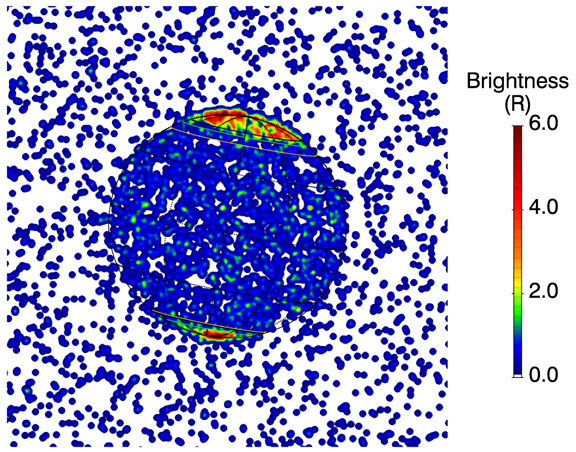
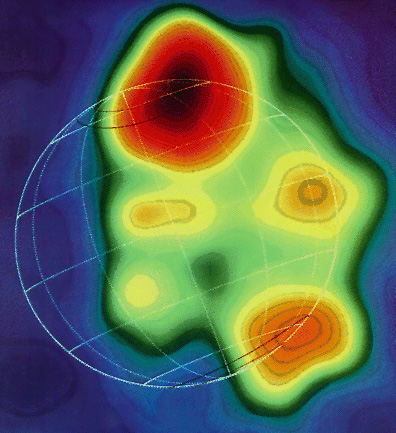
This Chandra image shows X-ray intensity in the units of rayleighs. The observation lasted 10 hours, which was obtained on December 18, 2000, and each X-ray photon has been smeared by double the 0.4 arcsecond full-width half-maximum point-spread-function of the High Resolution Camera.
(Credit: NASA/SWRI/G.R.Gladstone et al.)
This Chandra image shows X-ray intensity in the units of rayleighs. The observation lasted 10 hours, which was obtained on December 18, 2000, and each X-ray photon has been smeared by double the 0.4 arcsecond full-width half-maximum point-spread-function of the High Resolution Camera.
(Credit: NASA/SWRI/G.R.Gladstone et al.)
5
6
Return to Jupiter (27 Feb 02)


Revised: July 09, 2008