




CXC Home | Search | Help | Image Use Policy | Latest Images | Privacy | Accessibility | Glossary | Q&A
Download Image
More Information
More Images
Animation & Video
More Releases

Related Images


Vela Pulsar (Wide-Field View):
Wide-Angle View Of Vela Pulsar

Wide-Angle View Of Vela Pulsar
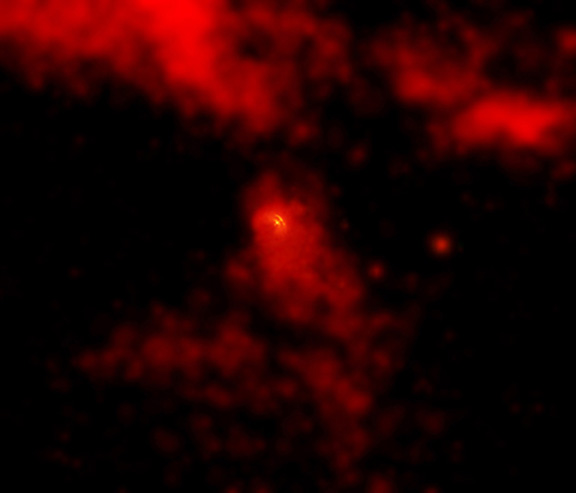
In this wide-angle view, the Vela pulsar and its pulsar wind nebula are seen against a background of clouds, or filaments, of multi-million degree Celsius gas. These clouds are part of a huge sphere of hot expanding gas produced by the supernova explosion associated with the creation of the Vela pulsar about 10,000 years ago. As the ejecta from the explosion expanded into space and collided with the surrounding interstellar gas, shock waves were formed and heated the gas and ejecta to millions of degrees. The sphere of hot gas is about 100 light years across, 15 times larger than the region shown in this image, and is expanding at a speed of about 400,000 km/hr.
The Vela pulsar, located in the center of the image (yellow), is considered to be one of Chandra’s most tantalizing images to date. It reveals a striking, almost unbelievable, structure consisting of bright rings and jets of matter. Such structures indicate that mighty ordering forces must be at work amidst the chaos of the aftermath of a supernova explosion. Forces can harness the energy of thousands of suns and transform that energy into a tornado of high-energy particles that astronomers refer to as a "pulsar wind nebula."
The supernova that produced the Vela pulsar and supernova remnant must have appeared extraordinarily bright on Earth, some 50 times brighter than Venus. Since no records of the event are known to exist, one can only imagine what Neolithic people must have thought of it.
|
||||||||||||||||||||||||
Visual Description:
The image is a wide-field view of the Vela Pulsar, which is a neutron star in the constellation Vela. Neutron stars are some of the densest objects in the universe, with masses similar to that of the sun but only about 10 miles (16 kilometers) in diameter. The overall color of the image is predominantly red and orange, with black areas of background scattered across the frame. In this wide-angle view, the Vela pulsar and its pulsar wind nebula are seen against a background of clouds, or filaments, of multi-million degree Celsius gas. These clouds are part of a huge sphere of hot expanding gas produced by the supernova explosion associated with the creation of the Vela pulsar about 10,000 years ago. As the ejecta from the explosion expanded into space and collided with the surrounding interstellar gas, shock waves were formed and heated the gas and ejecta to millions of degrees. The sphere of hot gas is about 100 light years across, 15 times larger than the region shown in this image, and is expanding at a speed of about 400,000 km/hr. The Vela pulsar reveals a striking, almost unbelievable, structure consisting of bright rings and jets of matter. Such structures indicate that mighty ordering forces must be at work amidst the chaos of the aftermath of a supernova explosion. Forces can harness the energy of thousands of suns and transform that energy into a tornado of high-energy particles that astronomers refer to as a "pulsar wind nebula." Comparing this object image to familiar everyday objects, the Vela Pulsar could be likened to a lighthouse that emits a beam of light through space.


Revised: October 21, 2026