Tracing the Structure of Cosmic Power Grids

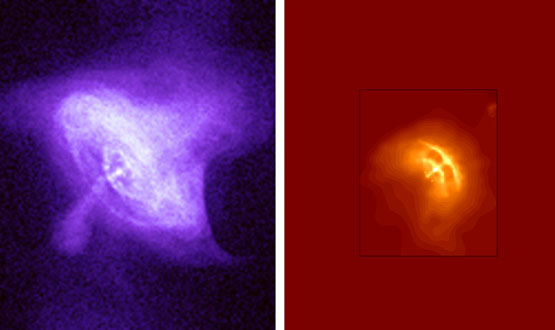
Chandra images of the Crab Nebula (left) and Vela (right) pulsar wind nebulas. The images have been scaled so that the ring structures will be in the right proportion to their actual size. The inner Crab ring is 1 light year in
diameter; in Vela it is 0.1 light year
(Credit: NASA/CXC/SAO; Right: NASA/PSU/G.Pavlov et al.) |
May 29, 2001 :: The Crab Nebula and the Vela Pulsar are two of Chandra's most tantalizing images. They reveal striking, almost
unbelievable, structures consisting of bright rings and jets of matter. Such structures indicate that mighty ordering forces must be at work amidst the chaos of the aftermath of a supernova explosion. Forces can harness the energy of thousands of Suns
and transform that energy into a tornado of high-energy particles that is called a "pulsar wind nebula."
If we could purchase and deliver one quadrillionth of the power output of one of these neutron stars, California's -- the entire world's for that matter -- energy woes would be over with plenty of gigawatts to spare.

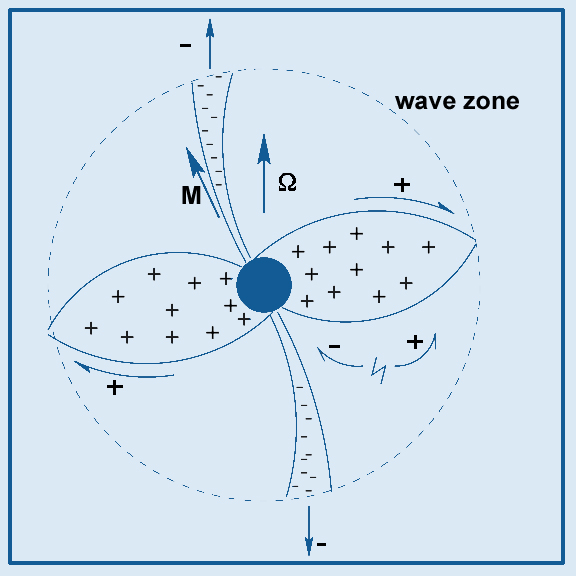
A generic pulsar model showing polar caps, and equatorial belts of particles. The particles are driven away by the intense waves that form near the equator some distance away from the neutron star. The magnetic axis (M) and the spin
axis (Omega) are not aligned.
(Credit: F.Michel) |
For about three decades, astronomers have known that a highly magnetized, rapidly rotating neutron star or pulsar is the source of the power in both the Crab and Vela pulsar wind nebulas. Now Chandra's keen vision has given them the
kind of detailed information they will need to understand how the energy gets transmitted from the pulsar to nebula. As astronomer Jeff Hester of Arizona State University said, "It's like finding the transmission lines between the power plant and the light bulb."
A neutron star is formed by the extreme conditions created in a supernova. When a massive star explodes, most of the star is flung into space, but the core of the star is compressed to form a rapidly rotating -- 30 times and 11 times per second for the
Crab and Vela pulsars respectively -- dense ball of neutrons that is 12 miles in diameter. The collapse and rapid rotation of the neutron star cause it to become highly magnetized.

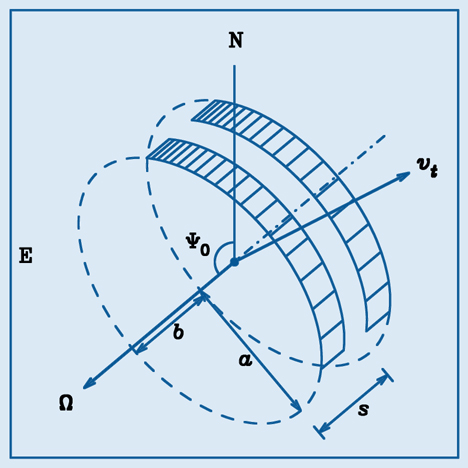
An idealized geometry for the Vela X-ray image. The two bright arcs are assumed to lie on the front surface of the equatorial wind. The spin axis (omega) and the direction of motion of the pulsar (v) are shown, along with the axes
of the projected ellipses (a and b), the separation of the rings (s) and the angle between the spin axis and north (Psi).
(D.Helfand et al. 2001, Astrophys.J.) |
A magnetized, rapidly rotating neutron star is an extremely efficient generator of voltages a million times greater than those of lightning bolts. These voltages create a blizzard of electrons and anti-matter electrons, or
positrons.
Computer simulations show that magnetic spirals created near the poles of a neutron star can focus the flow and produce jets. Particles near the equator will be flung outward at near the speed of light by electromagnetic-centrifugal forces. As this wind
of particles streams away from the pulsar, it builds up a magnetized cloud of high-energy particles that extends over several light years. These particles spiral around the magnetic field lines and radiate by the synchrotron process to produce the
observed pulsar wind nebula.
The rings in the Chandra images are thought to represent shock waves formed where the pressure in the wind of high-energy particles rushing away from the neutron star drops to that of the surrounding nebula. Columbia University astronomers David
Helfand, Eric Gotthelf, and Jules Halpern have applied this general model to reconstruct the geometry of the flow (see the figure below). The shock waves appear as two rings that straddle the equator symmetrically.

Chandra image of central part of the Vela pulsar wind nebula of 2000 April 30 (top) and 2000 Nov 30 (bottom). In the bottom panel, the white contours correspond to the contours in the top panel, while the blue contours demonstrate
the changes in thenebula over the 7 month interval. The brightest spot is the Vela pulsar.
(NASA/P.S.U./G.Pavlov et al.) |
The double-hooped structure could be an actual feature of the flow, or it may be an indication of the strength of the magnetic field. The intensity of synchrotron radiation depends strongly on the magnetic field, so the dark space
between the rings may be due to a very low magnetic field at the equator.
Monitoring of both the Crab and Vela pulsar wind nebulas shows that their appearance changes with time at both optical and X-ray wavelengths. A recent change observed by Chandra in the Vela nebula appears to be connected to the occurrence of a "glitch"
or change in the rotation speed of the neutron star, which presumably released a burst of energy that was carried outward at near the speed of light by the pulsar wind.

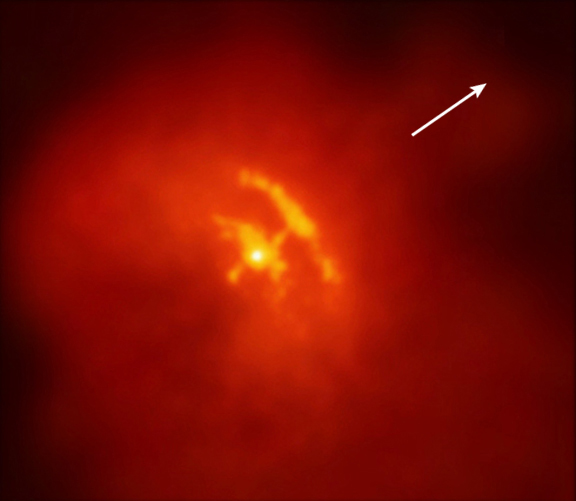
Vela pulsar closeup with arrow showing motion
(Credit: NASA/CXC) |
The Crab and Vela pulsar wind nebulas both show a swept-back shape that resembles a comet. This structure is thought to be due to the proper motion of the neutron star as it moves through space at speeds of a few hundred thousand kilometers per hour.
This may seem fast, but it is rather slow compared to many other pulsars. The motion of pulsars is thought to be due to kicks given by an unbalanced explosion process that occurs when a neutron star is created.

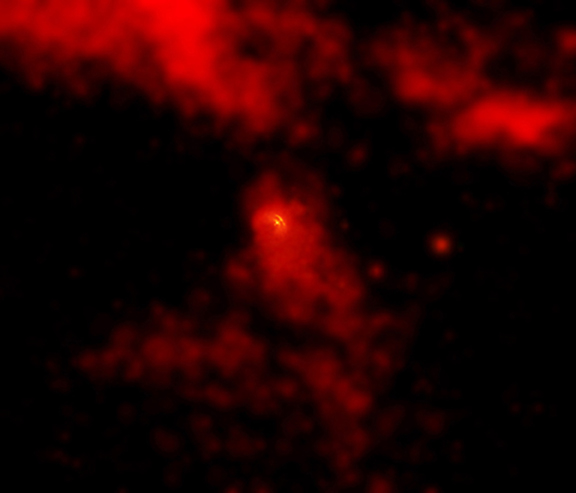
Vela pulsar wind nebula against the background of the much larger Vela supernova remnant.
(Credit: NASA/CXC) |
Helfand and colleagues speculate that the slower motion of the Crab and Vela neutron stars is connected to the rapid rotation of both these objects. In that event the "natal kicks" might have been averaged out to yield a low velocity
along the axis of rotation. Whatever the cause, as the Crab and Vela neutron stars glide through interstellar space, they provide us with an awesome spectacle of power and light.
Reference:
- D. Helfand et al 2001, Astrophys. J.
Return to Chandra Chronicles
Highlights and Feature Stories from the Chandra Project
Archived reports of past Chandra Chronicles
Receive the Chandra Digest
Updated: March 27, 2008