

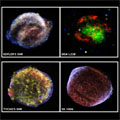
1. Comparison of Type Ia Supernovas
QuicktimeMPEG This sequence compares the Chandra image of DEM L238 with the Chandra image of 3 Type Ia supernova remnants located in the Milky Way. The X-ray emission for Kepler's remnant contains a bright central region similar to DEM L238, while the X-ray emission for Tycho's remnant and SN 1006 are generally much more uniform. These results suggest that the stars that exploded and caused the DEM L238 and Kepler supernova remnants were much younger than the stars that produced the Tycho and SN 1006 remnants.
[Runtime: 0.20]
(NASA/CXC)
Related Chandra Images:
QuicktimeMPEG This sequence compares the Chandra image of DEM L238 with the Chandra image of 3 Type Ia supernova remnants located in the Milky Way. The X-ray emission for Kepler's remnant contains a bright central region similar to DEM L238, while the X-ray emission for Tycho's remnant and SN 1006 are generally much more uniform. These results suggest that the stars that exploded and caused the DEM L238 and Kepler supernova remnants were much younger than the stars that produced the Tycho and SN 1006 remnants.
[Runtime: 0.20]
(NASA/CXC)
Related Chandra Images:
- Photo Album: DEM L238 and DEM L249
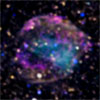
2. Images of DEM L238 and DEM L249
QuicktimeMPEG The sequence shows an optical image and then a composite of Chandra X-ray data (blue) and optical data (white) of DEM L238 and DEM L249, two supernova remnants in the Large Magellanic Cloud. The view then shows how DEM L238 appears in the three bands of X-ray emission (low-energy X-rays in red, medium energies in green and high energies in blue). The central region of DEM L238 is green which indicates that it is rich in iron, identifying it as a Type Ia supernova that came from the explosion of a much younger star than expected.
[Runtime: 0.12]
(X-ray: NASA/CXC/NCSU/K.Borkowski; Optical: NOAO/CTIO/MCELS)
Related Chandra Images:
QuicktimeMPEG The sequence shows an optical image and then a composite of Chandra X-ray data (blue) and optical data (white) of DEM L238 and DEM L249, two supernova remnants in the Large Magellanic Cloud. The view then shows how DEM L238 appears in the three bands of X-ray emission (low-energy X-rays in red, medium energies in green and high energies in blue). The central region of DEM L238 is green which indicates that it is rich in iron, identifying it as a Type Ia supernova that came from the explosion of a much younger star than expected.
[Runtime: 0.12]
(X-ray: NASA/CXC/NCSU/K.Borkowski; Optical: NOAO/CTIO/MCELS)
Related Chandra Images:
- Photo Album: DEM L238 and DEM L249
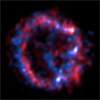
3. Chandra X-ray Image and Animation of E0102-72.3
QuicktimeMPEG This motion graphic combines images of the supernova remnant E0102 with an animation of a three dimensional model for this object. It begins with the Chandra X-ray image of E0102, then dissolves to a so-called "velocity map" that shows material moving away from us (in red) and towards us (in blue). A cylinder-shaped model for E0102 is then shown, along with two smaller, faster moving regions. The model then dissolves back into the velocity map and the Chandra data.
[Runtime: 0:02]
(NASA/STScI/G.Bacon; X-ray: NASA/CXC/MIT/D.Dewey et al. & NASA/CXC/SAO/J.DePasquale)
Related Chandra Images:
QuicktimeMPEG This motion graphic combines images of the supernova remnant E0102 with an animation of a three dimensional model for this object. It begins with the Chandra X-ray image of E0102, then dissolves to a so-called "velocity map" that shows material moving away from us (in red) and towards us (in blue). A cylinder-shaped model for E0102 is then shown, along with two smaller, faster moving regions. The model then dissolves back into the velocity map and the Chandra data.
[Runtime: 0:02]
(NASA/STScI/G.Bacon; X-ray: NASA/CXC/MIT/D.Dewey et al. & NASA/CXC/SAO/J.DePasquale)
Related Chandra Images:
- Photo Album: E0102-72.3
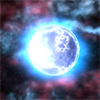
4. 3-D Fly-Through of Cassiopeia A
QuicktimeMPEG With closed-captions (at YouTube)
Broadcast:
This visualization shows a fly-through of Cas A based on the 3-D representation constructed from Chandra and Spitzer data. It begins with an artists rendition of the neutron star previously detected by Chandra. Next, new features unseen in traditional 2-D data sets are visible, including details of how the parent star exploded. The green region is mostly iron observed in X-rays; the yellow region is mostly argon and silicon seen in X-rays, optical and infared; the red region is cooler debris seen in the infared and the blue region is the outer blast wave, most prominent in X-rays.
[Runtime: 0:53]
(Visualization: NASA/CXC/D.Berry; Model: NASA/CXC/MIT/T.Delaney et al.)
Related Chandra Images:
QuicktimeMPEG With closed-captions (at YouTube)
Broadcast:
- QuickTime movie (uncompressed)
- D1 (0.9 pixel aspect ratio)
- 720x486
- 29.97 fps
- file size = (1.5 GB)
This visualization shows a fly-through of Cas A based on the 3-D representation constructed from Chandra and Spitzer data. It begins with an artists rendition of the neutron star previously detected by Chandra. Next, new features unseen in traditional 2-D data sets are visible, including details of how the parent star exploded. The green region is mostly iron observed in X-rays; the yellow region is mostly argon and silicon seen in X-rays, optical and infared; the red region is cooler debris seen in the infared and the blue region is the outer blast wave, most prominent in X-rays.
[Runtime: 0:53]
(Visualization: NASA/CXC/D.Berry; Model: NASA/CXC/MIT/T.Delaney et al.)
Related Chandra Images:
- Photo Album: Cassiopeia A
5. 3-D Representation of Cassiopeia A
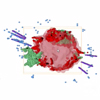
QuicktimeMPEG This result shows Cassiopeia A (Cas A) coming alive through the third dimension of space. Utilizing a technique borrowed from medical imaging, astronomers now have a way to travel through the heart of Cas A using data from NASA's Chandra and Spitzer telescopes. The different colors shown here correspond to different elements in the debris from the supernova explosion. This ground-breaking visualization of Cas A was made possible through a collaboration with the Astronomical Medicine project based at Harvard.
[Runtime: 0:36]
(NASA/CXC/MIT/T.Delaney et al.)
Related Chandra Images:
QuicktimeMPEG This result shows Cassiopeia A (Cas A) coming alive through the third dimension of space. Utilizing a technique borrowed from medical imaging, astronomers now have a way to travel through the heart of Cas A using data from NASA's Chandra and Spitzer telescopes. The different colors shown here correspond to different elements in the debris from the supernova explosion. This ground-breaking visualization of Cas A was made possible through a collaboration with the Astronomical Medicine project based at Harvard.
[Runtime: 0:36]
(NASA/CXC/MIT/T.Delaney et al.)
Related Chandra Images:
- Photo Album: Cassiopeia A
6. 3-D Visualization of Cassiopeia A
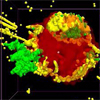
QuicktimeMPEG A research team has released a unique look of the supernova remnant Cassiopeia A (Cas A). By combining data from Chandra, the Spitzer Space Telescope, and ground- based optical observations, astronomers have been able to construct the first three-dimensional fly-through of a supernova remnant. This visualization (shown here as a still image) was made possible by importing the data into a medical imaging program that has been adapted for astronomical use. The green region shown in the image is mostly iron observed in X-rays; the yellow region is mostly argon and silicon seen in X-rays, optical and infared and the red region is cooler debris seen in the infared. The positions of these points in three-dimensional space were found by using the Doppler effect and simple assumptions about the supernova explosion.
[Runtime: 0:07]
(NASA/CXC/MIT/T.Delaney et al.)
Related Chandra Images:
QuicktimeMPEG A research team has released a unique look of the supernova remnant Cassiopeia A (Cas A). By combining data from Chandra, the Spitzer Space Telescope, and ground- based optical observations, astronomers have been able to construct the first three-dimensional fly-through of a supernova remnant. This visualization (shown here as a still image) was made possible by importing the data into a medical imaging program that has been adapted for astronomical use. The green region shown in the image is mostly iron observed in X-rays; the yellow region is mostly argon and silicon seen in X-rays, optical and infared and the red region is cooler debris seen in the infared. The positions of these points in three-dimensional space were found by using the Doppler effect and simple assumptions about the supernova explosion.
[Runtime: 0:07]
(NASA/CXC/MIT/T.Delaney et al.)
Related Chandra Images:
- Photo Album: Cassiopeia A

7. Animation of a Supernova Explosion
QuicktimeMPEG Broadcast:
This artist's animation shows the basics of a supernova explosion like the one that created Cas A. When a massive star runs out of fuel, it collapses onto itself and its remains are then expelled into the surrounding space. This expanding debris field is very hot and thus glows brightly in X-rays, which are detected by telescopes like Chandra. At the end of the animation, the view dissolves into an image of Cas A created from Chandra data.
[Runtime: 00:26]
(NASA/CXC/A.Hobart)
Related Chandra Images:
QuicktimeMPEG Broadcast:
- QuickTime movie (uncompressed)
- D1 (0.9 pixel aspect ratio)
- 720x486
- 29.97 fps
- file size = (810.9 MB)
This artist's animation shows the basics of a supernova explosion like the one that created Cas A. When a massive star runs out of fuel, it collapses onto itself and its remains are then expelled into the surrounding space. This expanding debris field is very hot and thus glows brightly in X-rays, which are detected by telescopes like Chandra. At the end of the animation, the view dissolves into an image of Cas A created from Chandra data.
[Runtime: 00:26]
(NASA/CXC/A.Hobart)
Related Chandra Images:
- Photo Album: Cassiopeia A
- Photo Album: Cassiopeia A
8. Brief Time-lapse Movie of Cassiopeia A
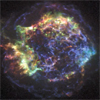
QuicktimeMPEG This brief movie of X-ray data from Chandra of Cas A was made by combining observations taken in January 2000, February 2002, February 2004, and December 2007. In these images, the lowest-energy X-rays Chandra detects are shown in red, intermediate energies in green, and the highest energies in blue. Scientists have used the movie to measure the expansion velocity of the leading edge of the explosion's outer blast wave (shown in blue). The researchers find that the velocity is 11 million miles per hour, which is significantly slower than expected for an explosion with the energy estimated to have been released in Cas A.
[Runtime: 00:20]
(NASA/CXC/SAO/D.Patnaude et al.)
Related Chandra Images:
QuicktimeMPEG This brief movie of X-ray data from Chandra of Cas A was made by combining observations taken in January 2000, February 2002, February 2004, and December 2007. In these images, the lowest-energy X-rays Chandra detects are shown in red, intermediate energies in green, and the highest energies in blue. Scientists have used the movie to measure the expansion velocity of the leading edge of the explosion's outer blast wave (shown in blue). The researchers find that the velocity is 11 million miles per hour, which is significantly slower than expected for an explosion with the energy estimated to have been released in Cas A.
[Runtime: 00:20]
(NASA/CXC/SAO/D.Patnaude et al.)
Related Chandra Images:
- Photo Album: Cassiopeia A
9. Movie of Chandra Images Evolving Over Time
QuicktimeMPEG Broadcast:
This movie has been created from a series of X-ray observations from Chandra of Cassiopeia A (Cas A) over eight years. It begins with a full-field view of Cas A, cycling through the movie several times. The camera then zooms into three different areas of Cas A where evolution of different features can been seen. This movie - the first of its kind for a supernova remnant - reveals new details about the supernova explosion and its remnant seen today.
[Runtime: 2:00]
(NASA/CXC/SAO/D.Patnaude et al.)
Related Chandra Images:
QuicktimeMPEG Broadcast:
- QuickTime movie (uncompressed)
- D1 (0.9 pixel aspect ratio)
- 720x486
- 29.97 fps
- file size = (3.5 GB)
This movie has been created from a series of X-ray observations from Chandra of Cassiopeia A (Cas A) over eight years. It begins with a full-field view of Cas A, cycling through the movie several times. The camera then zooms into three different areas of Cas A where evolution of different features can been seen. This movie - the first of its kind for a supernova remnant - reveals new details about the supernova explosion and its remnant seen today.
[Runtime: 2:00]
(NASA/CXC/SAO/D.Patnaude et al.)
Related Chandra Images:
- Photo Album: Cassiopeia A
10. Animation of G1.9+0.3
QuicktimeMPEG Broadcast:
This animation begins with a view of the Milky Way from above the plane of the galaxy, where the Galactic center and bulge is unobscured by dust and gas. The viewer then travels towards the center of the Galaxy and zooms into the bright, crowded central bulge of the Milky Way, where a supernova explosion occurs. The ejecta from the explosion rushes outwards where it interacts with the gas surrounding the explosion, causing the formation of a supernova remnant which shines brightly in X-rays and radio waves. This is the scenario scientists envision occurred with G1.9+0.3
[Runtime: 0.23]
(NASA/CXC/A. Hobart)
Related Chandra Images:
QuicktimeMPEG Broadcast:
- QuickTime movie (uncompressed)
- D1 (0.9 pixel aspect ratio)
- 720x486
- 29.97 fps
- file size = (708.8 MB)
This animation begins with a view of the Milky Way from above the plane of the galaxy, where the Galactic center and bulge is unobscured by dust and gas. The viewer then travels towards the center of the Galaxy and zooms into the bright, crowded central bulge of the Milky Way, where a supernova explosion occurs. The ejecta from the explosion rushes outwards where it interacts with the gas surrounding the explosion, causing the formation of a supernova remnant which shines brightly in X-rays and radio waves. This is the scenario scientists envision occurred with G1.9+0.3
[Runtime: 0.23]
(NASA/CXC/A. Hobart)
Related Chandra Images:
- Photo Album: G1.9+0.3




Revised: March 24, 2023