

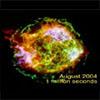
1. Three Chandra Views of Cassiopeia A
QuicktimeMPEG Broadcast:
This sequence shows three different sets Chandra observations of Cassiopeia A. The first image is Chandra's "First Light" image, which was released in August 1999 as the observatory's first major science image. This 5,000-second-long observation then dissolves into another image created from Chandra that contained data from 50,000 seconds of X-ray data released in 2002. Finally, the new one-million-second observation of Cassiopeia A is seen, revealing spectacular new detail and complexity to the supernova remnant.
[Runtime: 0:16]
(NASA/CXC/GSFC/U.Hwang et al.)
Related Chandra Images:
QuicktimeMPEG Broadcast:
- QuickTime movie (uncompressed)
- D1 (0.9 pixel aspect ratio)
- 720x486
- 29.97 fps
- file size = (360.4 MB)
This sequence shows three different sets Chandra observations of Cassiopeia A. The first image is Chandra's "First Light" image, which was released in August 1999 as the observatory's first major science image. This 5,000-second-long observation then dissolves into another image created from Chandra that contained data from 50,000 seconds of X-ray data released in 2002. Finally, the new one-million-second observation of Cassiopeia A is seen, revealing spectacular new detail and complexity to the supernova remnant.
[Runtime: 0:16]
(NASA/CXC/GSFC/U.Hwang et al.)
Related Chandra Images:
- Photo Album: Cassiopeia A
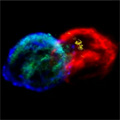
2. Kepler's SNR: Views from Chandra, Hubble & Spitzer
QuicktimeMPEG Broadcast:
The composite image of Kepler's Supernova Remnant splits into its three components: blue & green for the Chandra X-ray Observatory, yellow for the Hubble Space Telescope, and red for the Spitzer Space Telescope. Each observatory's full image is then shown side-by-side for comparison, beginning with Chandra, then Hubble, and finally Spitzer.
[Runtime: 0:27]
(NASA/JPL/Caltech/R.Hurt)
Related Chandra Images:
QuicktimeMPEG Broadcast:
- QuickTime movie (uncompressed)
- D1 (0.9 pixel aspect ratio)
- 720x486
- 29.97 fps
- file size = (45.7 MB)
The composite image of Kepler's Supernova Remnant splits into its three components: blue & green for the Chandra X-ray Observatory, yellow for the Hubble Space Telescope, and red for the Spitzer Space Telescope. Each observatory's full image is then shown side-by-side for comparison, beginning with Chandra, then Hubble, and finally Spitzer.
[Runtime: 0:27]
(NASA/JPL/Caltech/R.Hurt)
Related Chandra Images:
- Photo Album: Kepler's Supernova Remnant
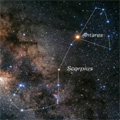
3. Zoom into Kepler's Supernova Remnant
QuicktimeMPEG This zoom-in begins in the Scorpius constellation and pushes through deeper and narrower telescopic fields to reach a composite of images of Kepler's Supernova Remnant, from NASA's Chandra X-ray Observatory, Hubble Space Telescope, and Spitzer Space Telescope.
[Runtime: 0:21]
(NASA/ESA/STScI)
Related Chandra Images:
QuicktimeMPEG This zoom-in begins in the Scorpius constellation and pushes through deeper and narrower telescopic fields to reach a composite of images of Kepler's Supernova Remnant, from NASA's Chandra X-ray Observatory, Hubble Space Telescope, and Spitzer Space Telescope.
[Runtime: 0:21]
(NASA/ESA/STScI)
Related Chandra Images:
- Photo Album: Kepler's Supernova Remnant
4. Best of Chandra Images: Supernovas & Pulsars
QuicktimeMPEG Broadcast:
Chandra has provided spectacular examples of the remnants of one of the most dramatic events in the cosmos: supernovas that signal the end of massive stars. This video presents some of the best Chandra observations of supernovas.
[Runtime: 1:05]
(Animation: NASA/CXC/A.Hobart)
QuicktimeMPEG Broadcast:
- QuickTime movie (uncompressed)
- D1 (0.9 pixel aspect ratio)
- 720x486
- 29.97 fps
- file size = (1.9 GB)
Chandra has provided spectacular examples of the remnants of one of the most dramatic events in the cosmos: supernovas that signal the end of massive stars. This video presents some of the best Chandra observations of supernovas.
[Runtime: 1:05]
(Animation: NASA/CXC/A.Hobart)
5. Chandra Timelapse Movie of SN 1987A
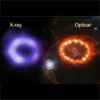
QuicktimeMPEG This sequence shows how the X-ray emission from Supernova 1987A (known as SN 1987A) has brightened from 1999 to 2005. The X-rays are produced when a shock wave from the supernova collides with the cooler, outer layers shed before the star exploded. As the shock wave plows deeper into the cool cloud the ring should become larger and much brighter in both optical and X-ray light.
[Runtime: 0:47]
(X-ray Images: NASA/CXC/PSU/S.Park & D.Burrows. Optical Image: NASA/STScI/CfA/P.Challis et al.)
Related Chandra Images:
QuicktimeMPEG This sequence shows how the X-ray emission from Supernova 1987A (known as SN 1987A) has brightened from 1999 to 2005. The X-rays are produced when a shock wave from the supernova collides with the cooler, outer layers shed before the star exploded. As the shock wave plows deeper into the cool cloud the ring should become larger and much brighter in both optical and X-ray light.
[Runtime: 0:47]
(X-ray Images: NASA/CXC/PSU/S.Park & D.Burrows. Optical Image: NASA/STScI/CfA/P.Challis et al.)
Related Chandra Images:
- Photo Album: Supernova 1987A
6. Sequence of images of J0617 in IC 443
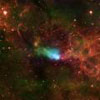
QuicktimeMPEG Beginning with a wide-field view of the supernova remnant IC 443, this sequence moves into a closer look at the neutron star embedded within known as J0617. The images show these objects in X-rays (blue), radio (green), and optical (red). The location and orientation of J0617's wake are mysterious for astronomers who would have expected it to be aligned toward the center of IC 443.
[Runtime: 0:32]
(Chandra X-ray: NASA/CXC/B.Gaensler et al; ROSAT X-ray: NASA/ROSAT/Asaoka & Aschenbach; Radio Wide: NRC/DRAO/D.Leahy; Radio Detail: NRAO/VLA; Optical: DSS)
Related Chandra Images:
QuicktimeMPEG Beginning with a wide-field view of the supernova remnant IC 443, this sequence moves into a closer look at the neutron star embedded within known as J0617. The images show these objects in X-rays (blue), radio (green), and optical (red). The location and orientation of J0617's wake are mysterious for astronomers who would have expected it to be aligned toward the center of IC 443.
[Runtime: 0:32]
(Chandra X-ray: NASA/CXC/B.Gaensler et al; ROSAT X-ray: NASA/ROSAT/Asaoka & Aschenbach; Radio Wide: NRC/DRAO/D.Leahy; Radio Detail: NRAO/VLA; Optical: DSS)
Related Chandra Images:
- Photo Album: J0617 in IC 443
7. Animation of a Massive Star Explosion
QuicktimeMPEG Broadcast:
When a massive star explodes, it creates a shell of hot gas that glows brightly in X-rays. This animation shows this process and depicts the stellar debris that Chandra is able to observe, revealing the dynamics of the explosion.
[Runtime: 0:15]
(Animation: NASA/CXC/A.Hobart)
Related Chandra Images:
QuicktimeMPEG Broadcast:
- QuickTime movie (uncompressed)
- D1 (0.9 pixel aspect ratio)
- 720x486
- 29.97 fps
- file size = (423.1 MB)
When a massive star explodes, it creates a shell of hot gas that glows brightly in X-rays. This animation shows this process and depicts the stellar debris that Chandra is able to observe, revealing the dynamics of the explosion.
[Runtime: 0:15]
(Animation: NASA/CXC/A.Hobart)
Related Chandra Images:
- Photo Album: SNR 0519-69.0
8. RCW 86 Zoom Animation
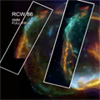
QuicktimeMPEG Recent observations have uncovered evidence that helps to confirm the identification of the remains of one of the earliest stellar explosions recorded by humans. The new study, using data from NASA's Chandra X-ray Observatory and European Space Agency's XMM-Newton Observatory, shows that the supernova remnant RCW 86 is likely a supernova observed by Chinese astronomers in 185 A.D.
[Runtime: 0:15]
(Chandra: NASA/CXC/Univ. of Utrecht/J.Vink et al. XMM-Newton: ESA/Univ. of Utrecht/J.Vink et al.)
Related Chandra Images:
QuicktimeMPEG Recent observations have uncovered evidence that helps to confirm the identification of the remains of one of the earliest stellar explosions recorded by humans. The new study, using data from NASA's Chandra X-ray Observatory and European Space Agency's XMM-Newton Observatory, shows that the supernova remnant RCW 86 is likely a supernova observed by Chinese astronomers in 185 A.D.
[Runtime: 0:15]
(Chandra: NASA/CXC/Univ. of Utrecht/J.Vink et al. XMM-Newton: ESA/Univ. of Utrecht/J.Vink et al.)
Related Chandra Images:
- Photo Album: RCW 86
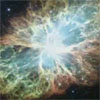
9. Animation and Composite Image of Crab Nebula
QuicktimeMPEG This sequence begins with an artist's animation of the explosion that produced the Crab Nebula, now an expanding debris field of extremely high-energy particles created from the death of a massive star. The view then fades into an image of the Crab composed of data from Chandra (light blue), Hubble (green and dark blue), and Spitzer (red).
[Runtime: 0:18]
(Animation: ESA/Hubble/M. Kornmesser & L. L. Christensen Image: X-ray: NASA/CXC/ASU/J.Hester et al.; Optical: NASA/ESA/ASU/J.Hester & A.Loll; Infrared: NASA/JPL-Caltech/Univ. Minn./R.Gehrz)
Related Chandra Images:
QuicktimeMPEG This sequence begins with an artist's animation of the explosion that produced the Crab Nebula, now an expanding debris field of extremely high-energy particles created from the death of a massive star. The view then fades into an image of the Crab composed of data from Chandra (light blue), Hubble (green and dark blue), and Spitzer (red).
[Runtime: 0:18]
(Animation: ESA/Hubble/M. Kornmesser & L. L. Christensen Image: X-ray: NASA/CXC/ASU/J.Hester et al.; Optical: NASA/ESA/ASU/J.Hester & A.Loll; Infrared: NASA/JPL-Caltech/Univ. Minn./R.Gehrz)
Related Chandra Images:
- Photo Album: Crab Nebula




Revised: March 24, 2023