

CXC Home | Search | Help | Image Use Policy | Latest Images | Privacy | Accessibility | Glossary | Q&A
1. Tour of Abell 3411 and Abell 3412
QuicktimeMPEG Audio Only
There are many extraordinary things in the Universe. For example, astronomers have found many examples of supermassive black holes erupting in powerful outbursts that can stretch for millions of miles. They have also seen galaxy clusters — the largest structures in the Universe held together by gravity — smash into one another, releasing amazing amounts of energy.
For the first time, however, astronomers have found out what happens when two of these spectacular events join forces. Abell 3411 and Abell 3412 are a pair of colliding galaxy clusters located about 2 billion light years from Earth. By combining X-rays from Chandra with data from other telescopes, astronomers were able to probe what was really happening in this remarkable system.
They found evidence that supermassive black holes have erupted within the merging clusters. At least one of these black hole eruptions has produced a tightly-wound, rotating magnetic funnel, which in turn has created a jet of high-speed and energetic particles.
These pumped up particles have then been swept up in the collision between Abell 3411 and Abell 3412, creating a cosmic double whammy. The result of all of this? The creation of a stupendous particle accelerator that produces energies far above anything that could ever be created here on Earth.
[Runtime: 02:19]
(NASA/CXC/A. Hobart)
Related Chandra Images:
QuicktimeMPEG Audio Only
- Audio (1.4 MB)
There are many extraordinary things in the Universe. For example, astronomers have found many examples of supermassive black holes erupting in powerful outbursts that can stretch for millions of miles. They have also seen galaxy clusters — the largest structures in the Universe held together by gravity — smash into one another, releasing amazing amounts of energy.
For the first time, however, astronomers have found out what happens when two of these spectacular events join forces. Abell 3411 and Abell 3412 are a pair of colliding galaxy clusters located about 2 billion light years from Earth. By combining X-rays from Chandra with data from other telescopes, astronomers were able to probe what was really happening in this remarkable system.
They found evidence that supermassive black holes have erupted within the merging clusters. At least one of these black hole eruptions has produced a tightly-wound, rotating magnetic funnel, which in turn has created a jet of high-speed and energetic particles.
These pumped up particles have then been swept up in the collision between Abell 3411 and Abell 3412, creating a cosmic double whammy. The result of all of this? The creation of a stupendous particle accelerator that produces energies far above anything that could ever be created here on Earth.
[Runtime: 02:19]
(NASA/CXC/A. Hobart)
Related Chandra Images:
- Photo Album: Abell 3411 and 3412
2. Tour of CDF-S Transient
QuicktimeMPEG Audio Only
The mysterious source that scientists discovered has remarkable properties. Prior to October 2014, this source was not detected in X-rays, but then it erupted and became at least a factor of 1,000 brighter over a few hours. After about a day, the source had faded completely below the sensitivity of Chandra.
While scientists think this source likely comes from some sort of destructive event, its properties do match any known phenomenon. This means this source may be of a variety that scientists have never seen before.
The researchers do, however, have some ideas of what this source could be. Two of the three main possibilities to explain the X-ray source involve gamma-ray bursts, some of the most powerful explosions in the Universe. However, unusual properties are needed for such a burst to explain the source's behavior. A third possibility is that a medium-sized black hole shredded a white dwarf star.
While they still don't have the final answers, researchers are still working hard to make progress. By combing the archives of Chandra and XMM-Newton data, they hope to find another object that has similar properties to the one they discovered. They also plan to continue to use Chandra to obtain new observations to help solve this high-energy puzzle.
[Runtime: 02:44]
(NASA/CXC/A. Hobart)
Related Chandra Images:
QuicktimeMPEG Audio Only
- Audio (1.8 MB)
The mysterious source that scientists discovered has remarkable properties. Prior to October 2014, this source was not detected in X-rays, but then it erupted and became at least a factor of 1,000 brighter over a few hours. After about a day, the source had faded completely below the sensitivity of Chandra.
While scientists think this source likely comes from some sort of destructive event, its properties do match any known phenomenon. This means this source may be of a variety that scientists have never seen before.
The researchers do, however, have some ideas of what this source could be. Two of the three main possibilities to explain the X-ray source involve gamma-ray bursts, some of the most powerful explosions in the Universe. However, unusual properties are needed for such a burst to explain the source's behavior. A third possibility is that a medium-sized black hole shredded a white dwarf star.
While they still don't have the final answers, researchers are still working hard to make progress. By combing the archives of Chandra and XMM-Newton data, they hope to find another object that has similar properties to the one they discovered. They also plan to continue to use Chandra to obtain new observations to help solve this high-energy puzzle.
[Runtime: 02:44]
(NASA/CXC/A. Hobart)
Related Chandra Images:
- Photo Album: CDF-S Transient

3. Tour of Chandra Deep Field South
QuicktimeMPEG Audio Only
What happens when astronomers use Chandra to take a long look at the same patch of sky? That's the question the project known as the Chandra Deep Field-South is designed to answer. Since Chandra was launched in 1999, the telescope has repeatedly observed the same region. Today, the observing time spent looking at this region totals over 7 million seconds. That's more than 81 days!
There are many things that astronomers can learn by using Chandra to make this ultra-deep X-ray image. Perhaps first among them is what is happening with black holes in the early Universe. For example, the latest Deep Field image lets astronomers explore ideas about how supermassive black holes grew about one to two billion years after the Big Bang. Using these data, researchers showed that these black holes in the early Universe grow mostly in bursts, rather than via the slow accumulation of matter.
The researchers also detected X-rays from massive galaxies at distances up to about 12.5 billion light years from Earth. Most of the X-ray emission from the most distant galaxies likely comes from large collections of stellar-mass black holes within the galaxies. These black holes are formed from the collapse of massive stars and typically weigh a few to a few dozen times the mass of the Sun.
By combining the Chandra Deep Field with observations from other telescopes including Hubble, scientists can continue to probe some of the most important questions in astrophysics.
[Runtime: 02:29]
(NASA/CXC/A. Hobart)
Related Chandra Images:
QuicktimeMPEG Audio Only
- Audio (1.6 MB)
What happens when astronomers use Chandra to take a long look at the same patch of sky? That's the question the project known as the Chandra Deep Field-South is designed to answer. Since Chandra was launched in 1999, the telescope has repeatedly observed the same region. Today, the observing time spent looking at this region totals over 7 million seconds. That's more than 81 days!
There are many things that astronomers can learn by using Chandra to make this ultra-deep X-ray image. Perhaps first among them is what is happening with black holes in the early Universe. For example, the latest Deep Field image lets astronomers explore ideas about how supermassive black holes grew about one to two billion years after the Big Bang. Using these data, researchers showed that these black holes in the early Universe grow mostly in bursts, rather than via the slow accumulation of matter.
The researchers also detected X-rays from massive galaxies at distances up to about 12.5 billion light years from Earth. Most of the X-ray emission from the most distant galaxies likely comes from large collections of stellar-mass black holes within the galaxies. These black holes are formed from the collapse of massive stars and typically weigh a few to a few dozen times the mass of the Sun.
By combining the Chandra Deep Field with observations from other telescopes including Hubble, scientists can continue to probe some of the most important questions in astrophysics.
[Runtime: 02:29]
(NASA/CXC/A. Hobart)
Related Chandra Images:
- Photo Album: Chandra Deep Field South
4. Tour of CXO J101527.2+625911
QuicktimeMPEG Giant black holes are generally stationary objects, sitting at the centers of most galaxies. However, using data from NASA's Chandra X-ray Observatory and other telescopes, astronomers recently hunted down a supermassive black hole that may be on the move.
This candidate renegade black hole, which contains about 160 million times the mass of our Sun, is located in an elliptical galaxy about 3.9 billion light years from Earth. Astronomers found this potentially moving black hole by sifting through X-ray data from Chandra and optical data for thousands of galaxies.
This black hole may have "recoiled," in terminology used by scientists, when two smaller supermassive black holes collided and merged to form an even larger one. When this collision happened, it would have generated gravitational waves that emitted more strongly in one direction than others. The newly formed black hole could have received a kick in the opposite direction of those stronger gravitational waves, driving it out of the galaxy's center.
Astronomers are interested in these moving supermassive black holes because they may reveal more about the rate and direction of spin for these enigmatic objects before they merge.
[Runtime: 02:10]
(NASA/CXC/A. Hobart)
Related Chandra Images:
QuicktimeMPEG Giant black holes are generally stationary objects, sitting at the centers of most galaxies. However, using data from NASA's Chandra X-ray Observatory and other telescopes, astronomers recently hunted down a supermassive black hole that may be on the move.
This candidate renegade black hole, which contains about 160 million times the mass of our Sun, is located in an elliptical galaxy about 3.9 billion light years from Earth. Astronomers found this potentially moving black hole by sifting through X-ray data from Chandra and optical data for thousands of galaxies.
This black hole may have "recoiled," in terminology used by scientists, when two smaller supermassive black holes collided and merged to form an even larger one. When this collision happened, it would have generated gravitational waves that emitted more strongly in one direction than others. The newly formed black hole could have received a kick in the opposite direction of those stronger gravitational waves, driving it out of the galaxy's center.
Astronomers are interested in these moving supermassive black holes because they may reveal more about the rate and direction of spin for these enigmatic objects before they merge.
[Runtime: 02:10]
(NASA/CXC/A. Hobart)
Related Chandra Images:
- Photo Album: CXO J101527.2+625911

5. Tour of NGC 4696
QuicktimeMPEG Audio Only
Astronomers have been studying the Centaurus Cluster using several different telescopes to learn more about this system. Data from the Chandra X-ray Observatory, the Very Large Array, and the Hubble Space Telescope have revealed evidence for multiple outbursts, or eruptions, from the black hole in NGC 4696 that date back millions of years. When these eruptions happen, they send energy and particles outward, affecting things like the chemical composition of the interstellar material as well as the rate of star formation.
By employing a special type of processing of the X-ray data, the astronomers also discovered a sequence of curved features, approximately equally spaced, in the hot gas detected by Chandra. These arcs may be caused by sound waves generated by the black hole's repeated bursts. In a galaxy cluster, the hot gas that fills the cluster enables sound waves — albeit at frequencies far too low for the human hear to detect — to propagate.
Researchers will continue to study the Centaurus Cluster and others like it to learn more about how galaxy clusters and the black holes within them grow and evolve over time.
[Runtime: 03:09]
(NASA/CXC/A. Hobart)
Related Chandra Images:
QuicktimeMPEG Audio Only
- Audio (1.6 MB)
Astronomers have been studying the Centaurus Cluster using several different telescopes to learn more about this system. Data from the Chandra X-ray Observatory, the Very Large Array, and the Hubble Space Telescope have revealed evidence for multiple outbursts, or eruptions, from the black hole in NGC 4696 that date back millions of years. When these eruptions happen, they send energy and particles outward, affecting things like the chemical composition of the interstellar material as well as the rate of star formation.
By employing a special type of processing of the X-ray data, the astronomers also discovered a sequence of curved features, approximately equally spaced, in the hot gas detected by Chandra. These arcs may be caused by sound waves generated by the black hole's repeated bursts. In a galaxy cluster, the hot gas that fills the cluster enables sound waves — albeit at frequencies far too low for the human hear to detect — to propagate.
Researchers will continue to study the Centaurus Cluster and others like it to learn more about how galaxy clusters and the black holes within them grow and evolve over time.
[Runtime: 03:09]
(NASA/CXC/A. Hobart)
Related Chandra Images:
- Photo Album: NGC 4696

6. Tour of Supernova 1987A
QuicktimeMPEG Audio Only
Since its discovery, telescopes around the world and in space have observed Supernova 1987A. This includes NASA's Chandra X-ray Observatory, which has looked at this object repeatedly during its 17 years of science operations.
From 1999 until 2013, Chandra data showed an expanding ring of X-ray emission that had been steadily getting brighter. This was produced by the blast wave from the original explosion that had been bursting through and heating the ring of gas surrounding the supernova.
In the past few years, there have been striking changes in the Chandra data. This provides evidence that the explosion's blast wave has moved beyond the ring into a region with less dense gas. This represents the end of an era for SN 1987A. Since astronomers do not know exactly lies beyond the ring, they will be watching carefully what happens next.
Over the next few thousand years, the expanding shell of hot gas will continue to glow in X rays. Eventually after rumbling across several thousand light years, the shell will disperse. By doing this, the supernova spreads the heavy elements created in the star and possibly triggers the formation of new stars from a cold interstellar cloud. Using data from Chandra and other telescopes, astronomers will continue to learn more about the details of this very important process that is responsible for life as we know it.
[Runtime: 03:09]
(NASA/CXC/A. Hobart)
Related Chandra Images:
QuicktimeMPEG Audio Only
- Audio (2.2 MB)
Since its discovery, telescopes around the world and in space have observed Supernova 1987A. This includes NASA's Chandra X-ray Observatory, which has looked at this object repeatedly during its 17 years of science operations.
From 1999 until 2013, Chandra data showed an expanding ring of X-ray emission that had been steadily getting brighter. This was produced by the blast wave from the original explosion that had been bursting through and heating the ring of gas surrounding the supernova.
In the past few years, there have been striking changes in the Chandra data. This provides evidence that the explosion's blast wave has moved beyond the ring into a region with less dense gas. This represents the end of an era for SN 1987A. Since astronomers do not know exactly lies beyond the ring, they will be watching carefully what happens next.
Over the next few thousand years, the expanding shell of hot gas will continue to glow in X rays. Eventually after rumbling across several thousand light years, the shell will disperse. By doing this, the supernova spreads the heavy elements created in the star and possibly triggers the formation of new stars from a cold interstellar cloud. Using data from Chandra and other telescopes, astronomers will continue to learn more about the details of this very important process that is responsible for life as we know it.
[Runtime: 03:09]
(NASA/CXC/A. Hobart)
Related Chandra Images:
- Photo Album: Supernova 1987A
7. Tour of X9 in 47 Tucanae
QuicktimeMPEG Audio Only
Recently, astronomers have found a particularly interesting binary. This pair has a white dwarf star in orbit around a black hole. While scientists have found this configuration many times before, this binary, known as X9, is special. That's because it has the closest orbit ever seen between a black hole and a companion star.
The X9 system is located in 47 Tucanae, a dense star cluster in the outskirts of the Milky Way. Using NASA's Chandra X-ray Observatory along with data from other telescopes, researchers determined that the white dwarf makes one complete orbit around the black hole in less than a half an hour. This means that the separation between the white dwarf and the black hole is about two and half times the distance between the Earth and the Moon. In cosmic terms, these two objects are extremely close together.
What does this close pairing mean for the objects in X9? The extreme proximity likely spells a bleak future for the white dwarf. Although scientists don't expect the white dwarf to fall into the black hole, they do think so much material will be pulled from the star that it will one day become some sort of exotic planet or even evaporate all together. In the short term, astronomers are going to watch this system very closely, because they don't know exactly how such an extreme system will behave.
[Runtime: 02:25]
(NASA/CXC/A. Hobart)
Related Chandra Images:
QuicktimeMPEG Audio Only
- Audio (2 MB)
Recently, astronomers have found a particularly interesting binary. This pair has a white dwarf star in orbit around a black hole. While scientists have found this configuration many times before, this binary, known as X9, is special. That's because it has the closest orbit ever seen between a black hole and a companion star.
The X9 system is located in 47 Tucanae, a dense star cluster in the outskirts of the Milky Way. Using NASA's Chandra X-ray Observatory along with data from other telescopes, researchers determined that the white dwarf makes one complete orbit around the black hole in less than a half an hour. This means that the separation between the white dwarf and the black hole is about two and half times the distance between the Earth and the Moon. In cosmic terms, these two objects are extremely close together.
What does this close pairing mean for the objects in X9? The extreme proximity likely spells a bleak future for the white dwarf. Although scientists don't expect the white dwarf to fall into the black hole, they do think so much material will be pulled from the star that it will one day become some sort of exotic planet or even evaporate all together. In the short term, astronomers are going to watch this system very closely, because they don't know exactly how such an extreme system will behave.
[Runtime: 02:25]
(NASA/CXC/A. Hobart)
Related Chandra Images:
- Photo Album: 47 Tucanae
8. Tour of XJ1500+0154
QuicktimeMPEG Audio Only
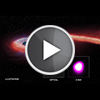
While astronomers have seen multiple examples of TDEs in recent years, a new discovery stands out among the rest. Using data from three X-ray telescopes: Chandra, Swift, and XMM-Newton, researchers have found a TDE that has lasted about ten years, much longer than other events. What could cause this decade-long meal by the black hole? There are a couple of possibilities. The first is that this black hole, located in a galaxy about 1.8 billion light years from Earth, completely shredded the largest star astronomers have known to be destroyed in a TDE. The other, also intriguing, possibility is that in previous TDEs the star wasn't completely ripped apart, but in this event it was. While astronomers continue to study this source and look for others like it, we are reminded just how amazing black holes can be.
[Runtime: 02:29]
(NASA/CXC/A. Hobart)
Related Chandra Images:
QuicktimeMPEG Audio Only
- Audio (1.6 MB)
While astronomers have seen multiple examples of TDEs in recent years, a new discovery stands out among the rest. Using data from three X-ray telescopes: Chandra, Swift, and XMM-Newton, researchers have found a TDE that has lasted about ten years, much longer than other events. What could cause this decade-long meal by the black hole? There are a couple of possibilities. The first is that this black hole, located in a galaxy about 1.8 billion light years from Earth, completely shredded the largest star astronomers have known to be destroyed in a TDE. The other, also intriguing, possibility is that in previous TDEs the star wasn't completely ripped apart, but in this event it was. While astronomers continue to study this source and look for others like it, we are reminded just how amazing black holes can be.
[Runtime: 02:29]
(NASA/CXC/A. Hobart)
Related Chandra Images:
- Photo Album: XJ1500+0154

9. Tour of B3 0727+409
QuicktimeMPEG Audio Only
Astronomers have used NASA's Chandra X-ray Observatory to discover a jet from a very distant supermassive black hole being illuminated by the oldest light in the Universe. This discovery shows that black holes with powerful jets may be more common than previously thought in the first few billion years after the Big Bang.
The light detected from this jet, found in the system known as B3 0727+409, was emitted when the Universe was only 2.7 billion years old, or a fifth of its present age. At this point, the intensity of the cosmic microwave background radiation, the glow left over from the Big Bang, was much greater than it is today.
The significance of the discovery of an X-ray jet in B3 0727+409 is heightened because astronomers essentially stumbled across this jet while observing a galaxy cluster in the field. Historically, such distant jets have been discovered in radio waves first, and then followed up with X-ray observations to look for high-energy emission. If bright X-ray jets can exist with very faint or undetected radio counterparts, it means that there could be many more of them out there because astronomers haven't been systematically looking for them.
Jets in the early Universe such as B3 0727+409 give astronomers a way to probe the growth of black holes at a very early epoch in the cosmos.
[Runtime: 02:25]
(NASA/CXC/A. Hobart)
Related Chandra Images:
QuicktimeMPEG Audio Only
- Audio (1.6 MB)
Astronomers have used NASA's Chandra X-ray Observatory to discover a jet from a very distant supermassive black hole being illuminated by the oldest light in the Universe. This discovery shows that black holes with powerful jets may be more common than previously thought in the first few billion years after the Big Bang.
The light detected from this jet, found in the system known as B3 0727+409, was emitted when the Universe was only 2.7 billion years old, or a fifth of its present age. At this point, the intensity of the cosmic microwave background radiation, the glow left over from the Big Bang, was much greater than it is today.
The significance of the discovery of an X-ray jet in B3 0727+409 is heightened because astronomers essentially stumbled across this jet while observing a galaxy cluster in the field. Historically, such distant jets have been discovered in radio waves first, and then followed up with X-ray observations to look for high-energy emission. If bright X-ray jets can exist with very faint or undetected radio counterparts, it means that there could be many more of them out there because astronomers haven't been systematically looking for them.
Jets in the early Universe such as B3 0727+409 give astronomers a way to probe the growth of black holes at a very early epoch in the cosmos.
[Runtime: 02:25]
(NASA/CXC/A. Hobart)
Related Chandra Images:
- Photo Album: B3 0727+409

10. Tour of Black Hole Seeds
QuicktimeMPEG Audio Only
Astronomers have long tried to determine just how supermassive black holes, those with millions or even billions of times the mass of the Sun in the centers of nearly all large galaxies, first formed. A conundrum arises because some of these supermassive black holes have been found less than a billion years after the Big Bang. How could such giant objects have formed so quickly?
New research using data from three of NASA's Great Observatories - Hubble, Chandra, and Spitzer - may help answer this important question. By developing a sophisticated computer model and new techniques to search large databases, a team of astronomers came up with a novel way to look for some of the Universe's earliest supermassive black holes. Their method targeted objects that matched the properties of one proposed mechanism to form these black holes: direct collapse. In this scenario, supermassive black holes would have formed directly from the collapse of a cloud of gas, producing a black hole of about 10,000 times the mass of the Sun. There is a competing theory where a massive star collapses to produce a black hole of about 10 solar masses, which then packs on weight very quickly to get up to supermassive size.
The new results suggest that at least some of the supermassive black holes in the early Universe formed through this direct collapse method. If these findings are confirmed with other research, it could help astronomers understand how black holes were formed billions of years ago and give more insight into the early Universe itself.
[Runtime: 02:38]
(NASA/CXC/A. Hobart)
Related Chandra Images:
QuicktimeMPEG Audio Only
- Audio (1.7 MB)
Astronomers have long tried to determine just how supermassive black holes, those with millions or even billions of times the mass of the Sun in the centers of nearly all large galaxies, first formed. A conundrum arises because some of these supermassive black holes have been found less than a billion years after the Big Bang. How could such giant objects have formed so quickly?
New research using data from three of NASA's Great Observatories - Hubble, Chandra, and Spitzer - may help answer this important question. By developing a sophisticated computer model and new techniques to search large databases, a team of astronomers came up with a novel way to look for some of the Universe's earliest supermassive black holes. Their method targeted objects that matched the properties of one proposed mechanism to form these black holes: direct collapse. In this scenario, supermassive black holes would have formed directly from the collapse of a cloud of gas, producing a black hole of about 10,000 times the mass of the Sun. There is a competing theory where a massive star collapses to produce a black hole of about 10 solar masses, which then packs on weight very quickly to get up to supermassive size.
The new results suggest that at least some of the supermassive black holes in the early Universe formed through this direct collapse method. If these findings are confirmed with other research, it could help astronomers understand how black holes were formed billions of years ago and give more insight into the early Universe itself.
[Runtime: 02:38]
(NASA/CXC/A. Hobart)
Related Chandra Images:
- Photo Album: GOODS-S 29323


Revised: October 09, 2026