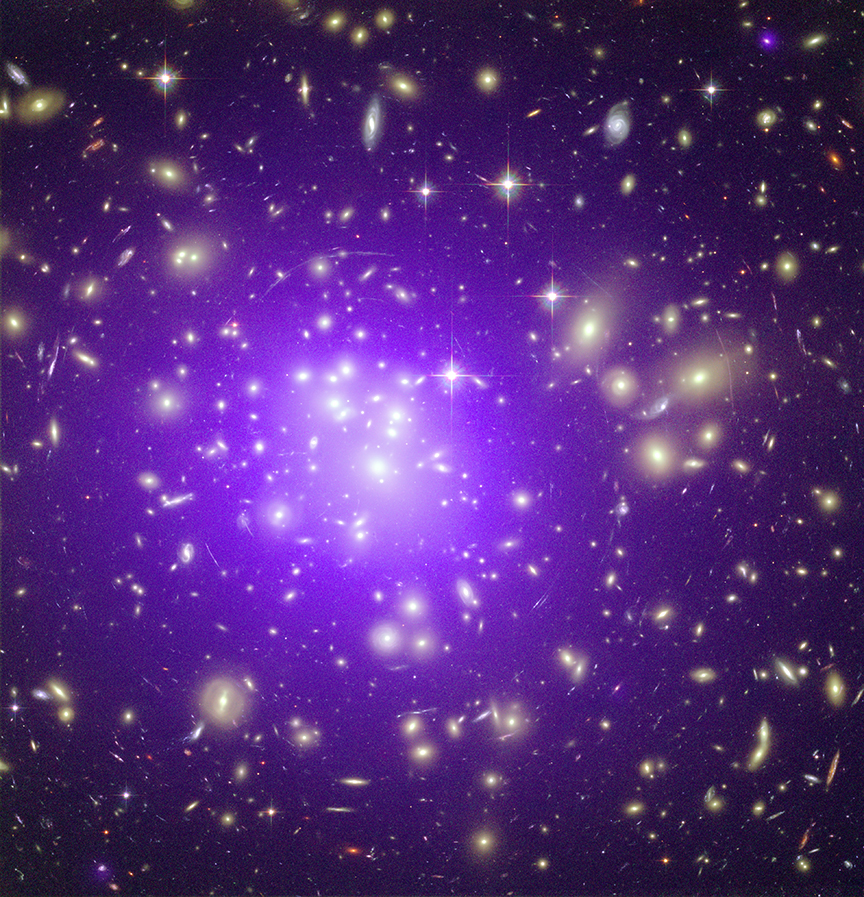
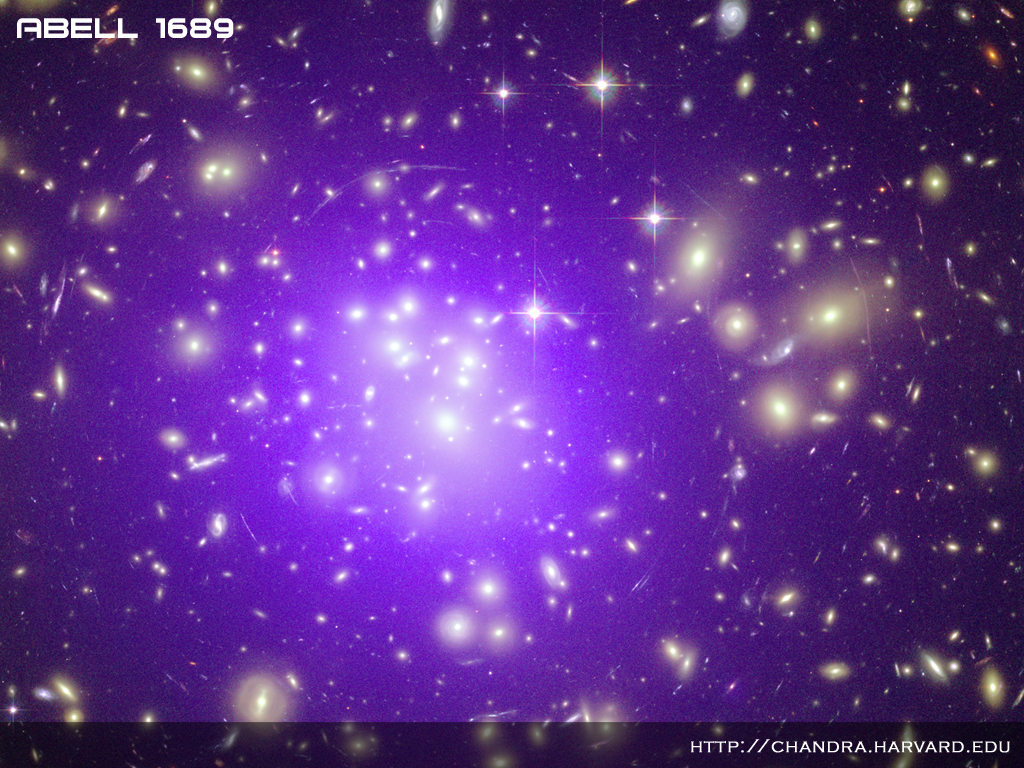
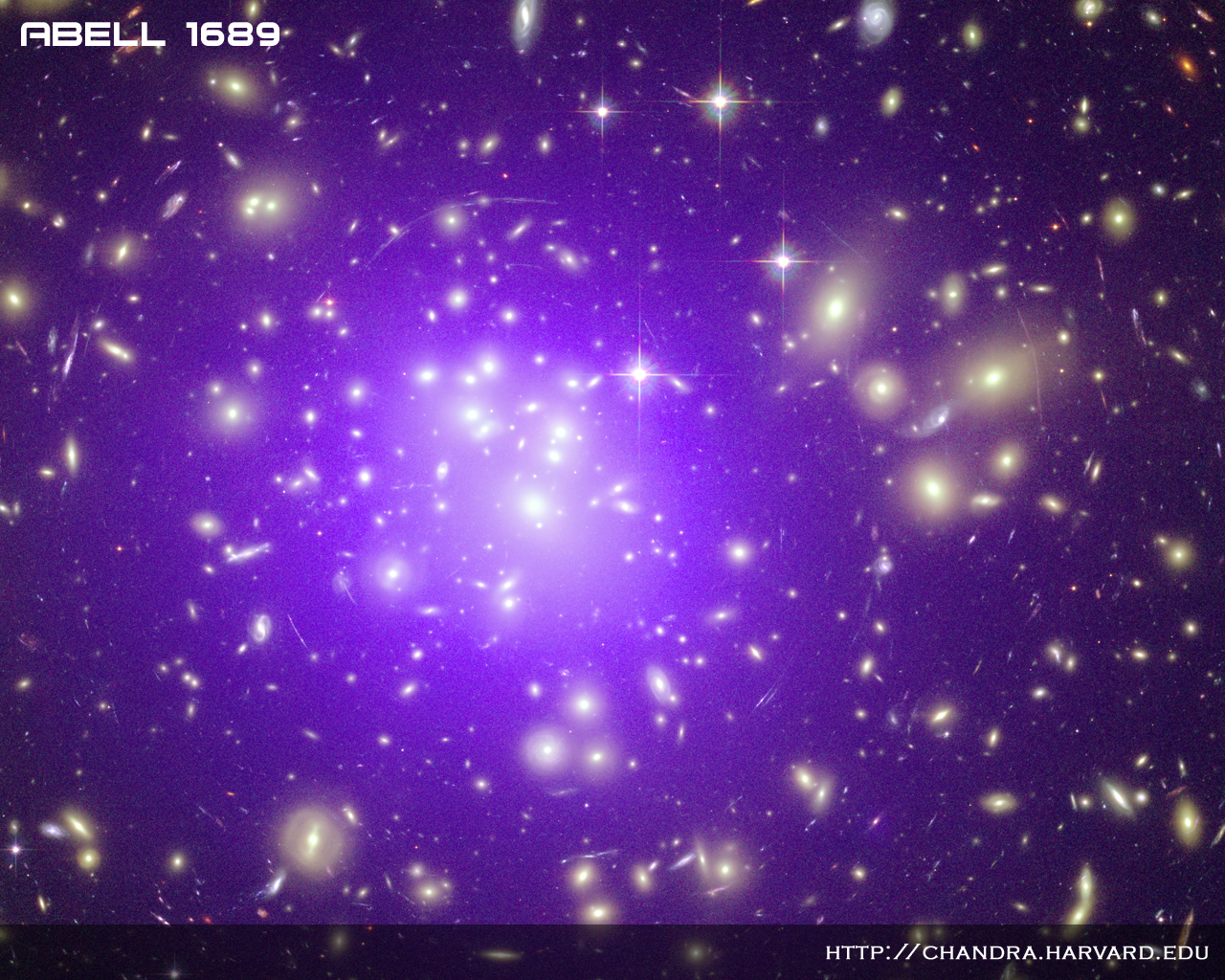
Abell 1689, shown in this composite image, is a massive cluster of
galaxies located about 2.3 billion light years away that shows signs
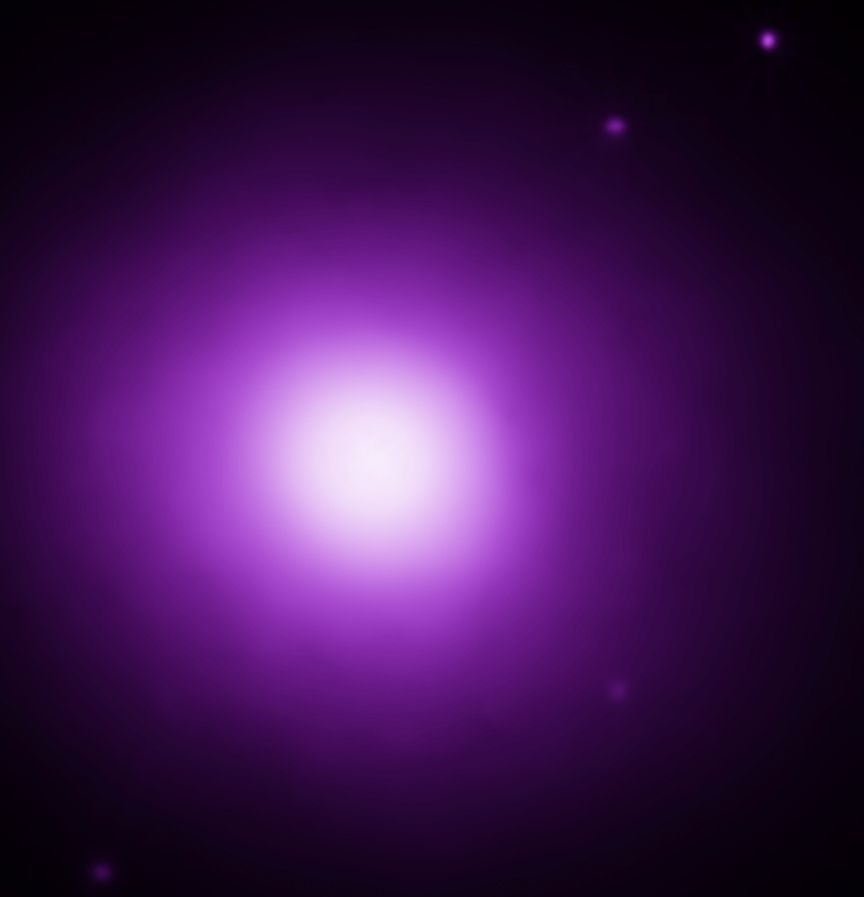
of merging activity. Hundred-million-degree gas detected by NASA's
Chandra X-ray Observatory is shown as purple in this image, while
galaxies from optical data from the Hubble Space Telescope are
colored yellow. The X-ray emission has a smooth appearance, unlike
other merging systems such as the Bullet Cluster or MACS
J0025.4-1222. The temperature pattern across Abell 1689 is more
complicated, however, possibly requiring multiple structures with
different temperatures.
The long arcs in the optical image are caused by gravitational
lensing of background galaxies by matter in the galaxy cluster, the
largest system of such arcs ever found. Further studies of this
cluster are needed to explain the lack of agreement between mass
estimates based on the X-ray data and on the gravitational lensing.
Previous work suggests that filament-like structures of galaxies are
located near Abell 1689 along our line-of-sight to this cluster,
which may bias mass estimates using gravitational lensing.
Visual Description:
The image is a composite of an X-ray and optical view of Abell 1689, a massive cluster of galaxies. The dominant colors in the image are blue-purple and white-gold, with large amounts of bright spots scattered throughout the image like an overly excited holiday decorator has been to work. In the center of the image, there is a bright core of large white sources that stand out from the rest of the galaxy cluster. The cluster looks to be bathed in the bright blue-purple light. Abell 1689 shows signs of merging activity. Hundred-million-degree gas is detected by NASA's Chandra X-ray Observatory (the blue-purple in this image), while galaxies from optical data from the Hubble Space Telescope are colored white-gold. The X-ray emission has a smooth appearance, forming a large sphere across and around the galaxies. Long bright arcs in the optical image are caused by gravitational lensing of background galaxies by matter in the galaxy cluster, the largest system of such arcs ever found at the time of observation
| Fast Facts for Abell 1689: |
| Credit |
X-ray: NASA/CXC/MIT/E.-H Peng et al; Optical: NASA/STScI |
| Release Date |
September 11, 2008 |
| Scale |
Image is 3.2 arcmin across. |
| Category |
Groups & Clusters of Galaxies, Cosmology/Deep Fields/X-ray Background |
| Coordinates (J2000) |
RA 13h 11m 34.20s | Dec +01° 21´ 56.00" |
| Constellation |
Virgo |
| Observation Date |
04/15/2004 - 03/09/2006 with five pointings
|
| Observation Time |
53 hours |
| Obs. ID |
540, 1663, 5004, 6930, 7289
|
| Instrument |
ACIS
|
| Color Code |
X-ray (Purple); Optical (Yellow) |
| Distance Estimate |
About 2.2 billion (z=0.18) light years
|
|