







CXC Home | Search | Help | Image Use Policy | Latest Images | Privacy | Accessibility | Glossary | Q&A
Download Image
More Information
More Images
Animation & Video
More Releases


Related Images
M87:
Chandra Reviews Black Hole Musical: Epic But Off-Key

Chandra Reviews Black Hole Musical: Epic But Off-Key
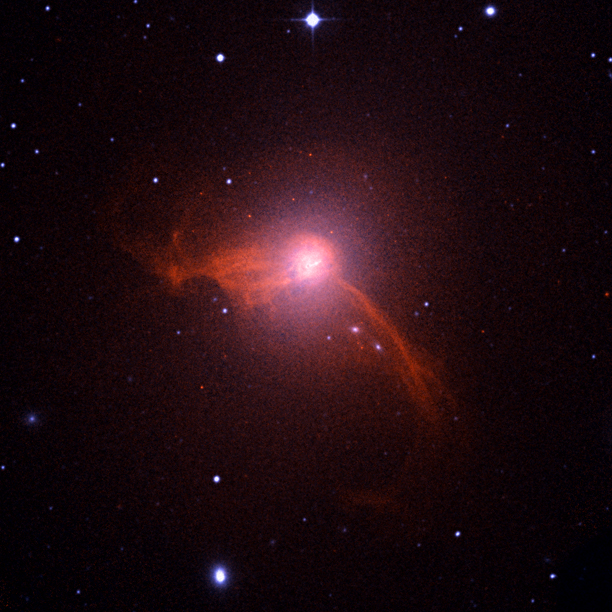
A striking example of the power and effervescence of supermassive black holes is shown in this composite image of the elliptical galaxy M87 in the Virgo Cluster. The features in this image imply that outbursts and deep sounds have been generated by the black hole for eons.
The black hole located in the center of M87 is one of the most massive in the universe. The huge reservoir of hot gas in this cluster is shown in this low energy X-ray image from the Chandra X-ray Observatory (red). An optical image from the Digitized Sky Survey shows stars in M87 in blue.
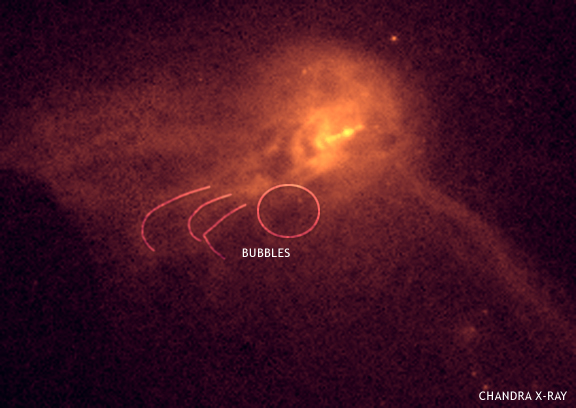
A series of unevenly spaced loops and bubbles are visible in the hot gas below and to the left of the center of M87. These features are produced by small outbursts from close to the black hole about once every 6 million years. The sound waves generated by these outbursts, not visible in this image, will be incredibly deep, about 56 octaves below middle C. Because the outbursts are unevenly spaced the sound will be more like noise from the black hole rather than a harmonious musical performance.
A shock wave -- similar to a sonic boom -- is detected in a separate Chandra image of M87 that shows high energy X-rays. This shock was produced by a powerful outburst from the black hole about 20 million years ago. The properties of the shock, including the change in temperature and density in the gas, are consistent with classical physics. A large bubble in the X-ray gas shows another powerful outburst occurred about 50 million years earlier. The long interval between these two outbursts provides evidence for even deeper sounds, 58 or 59 octaves below middle C.
Other remarkable features are seen in M87 for the first time including narrow filaments of X-ray emission, which may be due to hot gas trapped to magnetic fields. One of these filaments is over 100,000 light years long, and extends below and to the right of the center of M87 in almost a straight line.
|
||||||||||||||||||||||||||||
Visual Description:
A striking example of the power of supermassive black holes is shown in this composite image of the elliptical galaxy M87 in the Virgo Cluster. The galaxy has a pinkish-red hue in the X-ray image, while the optical image reveals the elliptical nature of the galaxy in blue and white, with white at the core. The structure in the X-ray image is like a large filamentary octopus swimming on its side in the blue sea, but with one very strange, very thin long arm jutting out towards 5 o'clock. The features in this image imply that outbursts and deep sounds have been generated by the black hole for eons. The black hole located in the center of M87 is one of the most massive in the universe. The huge reservoir of hot gas in this cluster is shown in the low energy X-ray image from the Chandra X-ray Observatory. The optical image is from the Digitized Sky Survey.


Revised: September 11, 2025