



CXC Home | Search | Help | Image Use Policy | Latest Images | Privacy | Accessibility | Glossary | Q&A
For Release: October, 2006
CXC RELEASE 06-06
A gigantic sonic boom generated by a supermassive black hole has been found with NASA's Chandra X-ray Observatory, along with evidence for a cacophony of deep sound.
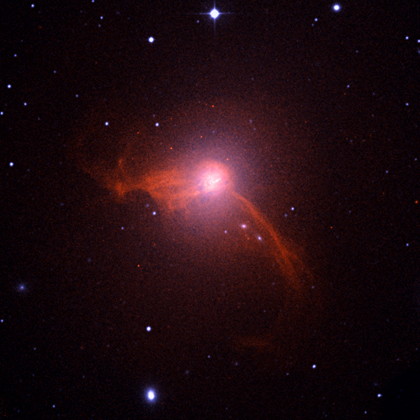
This discovery was made by using data from the longest X-ray observation ever of M87, a nearby giant elliptical galaxy. M87 is centrally located in the Virgo cluster of galaxies and is known to harbor one of the Universe's most massive black holes.
Scientists detected loops and rings in the hot, X-ray emitting gas that permeates the cluster and surrounds the galaxy. These loops provide evidence for periodic eruptions that occurred near the supermassive black hole, and that generate changes in pressure, or pressure waves, in the cluster gas that manifested themselves as sound.
"We can tell that many deep and different sounds have been rumbling through this cluster for most of the lifetime of the Universe," said William Forman of the Harvard-Smithsonian Center for Astrophysics (CfA).
The outbursts in M87, which happen every few million years, prevent the huge reservoir of gas in the cluster from cooling and forming many new stars. Without these outbursts and resultant heating, M87 would not be the elliptical galaxy it is today.
"If this black hole wasn't making all of this noise, M87 could have been a completely different type of galaxy," said team member Paul Nulsen, also of the CfA, "possibly a huge spiral galaxy about 30 times brighter than the Milky Way."
The outbursts result when material falls toward the black hole. While most of the matter is swallowed, some of it was violently ejected in jets. These jets are launched from regions close to the black hole (neither light nor sound can escape from the black hole itself) and push into the cluster's gas, generating cavities and sound which then propagate outwards.
Chandra's M87 observations also give the strongest evidence to date of a shock wave produced by the supermassive black hole, a clear sign of a powerful explosion. This shock wave appears as a nearly circular ring of high-energy X-rays that is 85,000 light years in diameter and centered on the black hole.
Other remarkable features are seen in M87 for the first time including narrow filaments of X-ray emission -- some over 100,000 light years long -- that may be due hot gas trapped by magnetic fields. Also, a large, previously unknown cavity in the hot gas, created by an outburst from the black hole about 70 million years ago, is seen in the X-ray image.
"We can explain some of what we see, like the shock wave, with textbook physics," said team member Christine Jones, also of the CfA. "However, other details, like the filaments we find, leave us scratching our heads."
Sound has been detected from another black hole in the Perseus cluster, which was calculated to have a note some 57 octaves below middle C. However, the sound in M87 appears to be more discordant and complex. A series of unevenly spaced loops in the hot gas gives evidence for small outbursts from the black hole about every 6 million years. These loops imply the presence of sound waves, not visible in the Chandra image, which are about 56 octaves below middle C. The presence of the large cavity and the sonic boom gives evidence for even deeper notes -- 58 or 59 octaves below middle C -- powered by large outbursts.
These new results on M87 were presented at the High-Energy Astrophysics Division meeting being held in San Francisco. NASA's Marshall Space Flight Center, Huntsville, Ala., manages the Chandra program for the agency's Science Mission Directorate. The Smithsonian Astrophysical Observatory controls science and flight operations from the Chandra X-ray Center, Cambridge, Mass.
Additional information and images are available at:
MEDIA CONTACTS
Steve Roy
Marshall Space Flight Center, Huntsville, Ala.
(Phone: 256/544-6535)
Megan Watzke
Chandra X-ray Center, Cambridge, Mass.
(Phone: 617/496-7998)


Revised: March 25, 2008