




CXC Home | Search | Help | Image Use Policy | Latest Images | Privacy | Accessibility | Glossary | Q&A
Download Image
More Information
More Images
Animation & Video
More Releases


Related Images
Westerlund 1:
Neutron Star Discovered Where a Black Hole Was Expected

Neutron Star Discovered Where a Black Hole Was Expected
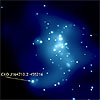
The optical image (left) of Westerlund 1 shows a dense cluster of young stars, several with masses of about 40 suns. Some astronomers speculated that repeated collisions between such massive stars in the cluster might have led to formation of an intermediate-mass black hole, more massive than 100 suns. A search of the cluster with Chandra (right) found no evidence for this type of black hole. Instead they found a neutron star (CXO J164710.2-455216), a discovery which may severely limit the range of stellar masses that lead to the formation of stellar black holes.
The neutron star - a dense whirling ball of neutrons about 12 miles in diameter - revealed itself through periodic X-ray pulsations (every 10.6 seconds). A neutron star is left behind after a massive star completes its evolution and goes supernova. Since extremely massive stars evolve more rapidly than less massive ones, and the progenitor of the neutron star has already exploded as a supernova, its mass must have been greater than 40 solar masses.
If such massive stars produce neutron stars, what types of stars produce stellar black holes? Theoretical calculations indicate that extremely massive stars blow off mass so effectively during their lives that they leave neutron stars when they go supernova. The discovery of the neutron star in Westerlund 1 leaves a small window of initial masses - between about 25 and somewhat less than 40 solar masses - for the formation of black holes from the evolution of single massive stars.
Other factors, such as the star's chemical composition, its rotation rate, or whether it is part of a double star system, may play a role in determining whether a massive star leaves behind a neutron star or a black hole. Further searches of young star clusters are needed to solve the mystery of how stellar black holes are produced.
|
||||||||||||||||||||||||||
Visual Description:
The 2-panel image features a dense cluster of young stars called Westerlund 1 in an optical image on the left and a complementary X-ray image on the right. The main colors present in the image are blue and orange, with the blue color dominating the X-ray side of the image and the orange color dominating the optical side. The shape of the image is slightly crescent shaped though irregular, with many stars visible in both the blue and orange regions, scattered like bright jewels thrown across a shiny black table. In the center of the Chandra X-ray Observatory image, there is a bright spot that stands out from the surrounding stars. The ESO optical image of Westerlund 1 shows a dense cluster of young stars, several with masses of about 40 suns. Some astronomers speculated that repeated collisions between such massive stars in the cluster might have led to formation of an intermediate-mass black hole, more massive than 100 suns. A search of the cluster with Chandra found no evidence for this type of black hole. Instead they found a neutron star, a discovery which may severely limit the range of stellar masses that lead to the formation of stellar black holes. The neutron star is pointed out by an arrow at the bottom left tip of the irregular crescent shape in the X-ray.


Revised: September 11, 2025