


CXC Home | Search | Help | Image Use Policy | Latest Images | Privacy | Accessibility | Glossary | Q&A
Download Image
More Information
More Images
Related Images


UGC 6697 in Abell 1367:
Cluster Galaxy's Location Proves "Just Right" for Star Formation
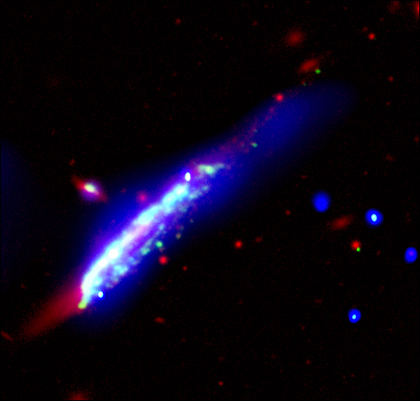
Credit: X-ray: NASA/SAO/CXC/M.Sun et al.; Optical: GOLDMine/G. Gavazzi et al.

Cluster Galaxy's Location Proves "Just Right" for Star Formation
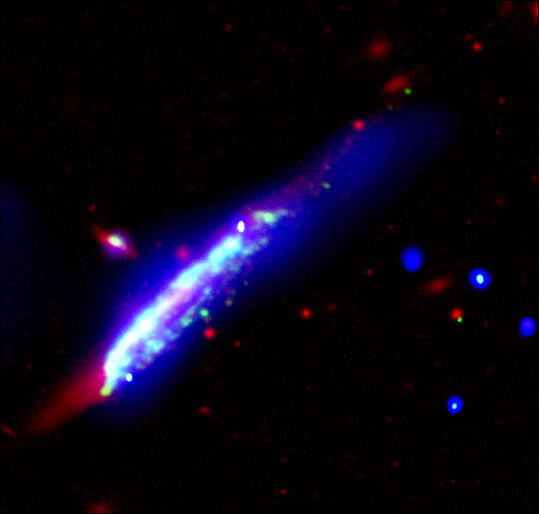
Credit: X-ray: NASA/SAO/CXC/M.Sun et al.; Optical: GOLDMine/G. Gavazzi et al.
Visual Description:
The galaxy UGC 6697, located about 1.5 million light years from the core of the galaxy cluster Abell 1367, is shown here in a composite X-ray (blue)- optical (red & green) image. The Chandra image reveals a sharp edge on the lower left that is inside the optical edge of the galaxy, and a long tail of X-radiation extending to the upper right beyond the optical galaxy. These features suggest that the density of the hot gas that pervades the cluster is just right - not too high or not too low - to trigger a burst of star formation by compressing clouds of cool gas in the galaxy.
As the galaxy plunges toward the center of the cluster at a speed of several million miles per hour, pressure due to this motion through the ambient hot gas compresses cooler gas in the galaxy and pushes it back away from the edge of the galaxy. Massive new stars form in the compressed gas and over the course of 10 million years explode as supernovas. The supernovas heat the gas in the galaxy to produce the X-rays and optical light seen as the bright blue-green glow in the image. The light from stars is shown in red.
The faint blue X-ray tail extending to the upper right in the image is from gas that is being stripped from the galaxy by its interaction with the hot cluster gas. Over time, this stripping process will remove all the gas from the galaxy, so no new bursts of star formation can occur.
This X-ray image provides important new insight as to how a galaxy's location in a cluster can affect the rate at which stars form in the galaxy. In the remote regions of clusters, the density of the hot gas through which the galaxy moves is too low to trigger star formation. In contrast, in the cores of clusters all the cooler gas has been stripped from the galaxies so no new stars can form. Only in special "Goldilocks" regions, not too far and not too close to the cluster core, are conditions "just right" for star formation.
|
||||||||||||||||||||||||||||
Visual Description:
The image of the starburst galaxy UGC 6697 is a composite of both X-ray and optical data. The image shows the galaxy from the side and so it has an elongated shape, resembling a long, bright, slender tube. The colors in the image are predominantly blue, with some red and a hint of green. The texture of the image appears somewhat grainy. The galaxy UGC 6697 is located about 1.5 million light years from the core of the galaxy cluster Abell 1367. The Chandra image (blue) reveals a sharp edge on the lower left that is inside the optical edge of the galaxy, and a long tail of X-radiation extending to the upper right beyond the optical galaxy (red and green). These features suggest that the density of the hot gas that pervades the cluster is just right - not too high or not too low - to trigger a burst of star formation by compressing clouds of cool gas in the galaxy.


Revised: September 11, 2025