





CXC Home | Search | Help | Image Use Policy | Latest Images | Privacy | Accessibility | Glossary | Q&A
Download Image
More Information
More Images
More Releases
Related Images

Saturn:
Saturn's Rings Sparkle with X-rays
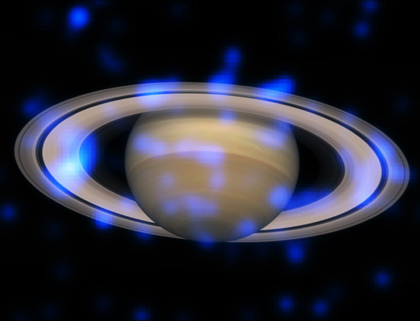
Credit: X-ray: NASA/MSFC/CXC/A.Bhardwaj et al.; Optical: NASA/ESA/STScI/AURA

Saturn's Rings Sparkle with X-rays

Credit: X-ray: NASA/MSFC/CXC/A.Bhardwaj et al.; Optical: NASA/ESA/STScI/AURA
Visual Description:
Chandra images reveal that the rings of Saturn sparkle in X-rays (blue dots in this X-ray/optical composite). The likely source for this radiation is the fluorescence caused by solar X-rays striking oxygen atoms in the water molecules that comprise most of the icy rings.
As the image shows, the X-rays in the ring mostly come from the B ring, which is about 25,000 kilometers wide and is about 40,000 kilometers (25,000 miles) above the surface of Saturn (the bright white inner ring in the optical image). There is some evidence for a concentration of X-rays on the morning side (left side, also called the East ansa) of the rings. One possible explanation for this concentration is that the X-rays are associated with optical features called spokes, which are largely confined to the dense B ring and most often seen on the morning side.
Spokes, which appear as radial shadows in the rings, are due to transient clouds of fine ice-dust particles that are lifted off the ring surface, and typically last an hour or so before disappearing. It has been suggested that the spokes are triggered by meteoroid impacts on the rings, which are more likely in the midnight to early morning hours because during that period the relative speed of the rings through a cloud of meteoroids would be greater.
The higher X-ray brightness on the morning side of the rings could be due to the additional solar fluorescence from the transient ice clouds that produce the spokes. This explanation may also account for other Chandra observations of Saturn, which show that the X-ray brightness of the rings varies significantly from one week to the next.
|
||||||||||||||||||||||
Visual Description:
This composite image of Saturn blends golden optical light with shimmering X-ray highlights, turning the planet’s iconic rings into a jeweled halo. Saturn’s broad, luminous bands, captured in crisp detail from Hubble, are speckled with ethereal blue glimmers where solar X-rays strike oxygen atoms in the icy particles, causing them to fluoresce. The X-rays from the rings as detected by NASA’s Chandra X-ray Observatory mostly come from the B ring, which is about 25,000 kilometers wide and is about 40,000 kilometers (25,000 miles) above the surface of Saturn (a bright white inner ring in the optical image). An apparent concentration of X-rays on the morning side (left side in the image) could be due to additional solar fluorescence from clouds of fine ice-dust particles that are lifted above the surface of the rings by meteoroid impacts on the rings.


Revised: September 11, 2025