




CXC Home | Search | Help | Image Use Policy | Latest Images | Privacy | Accessibility | Glossary | Q&A
Download Image
More Information
More Images
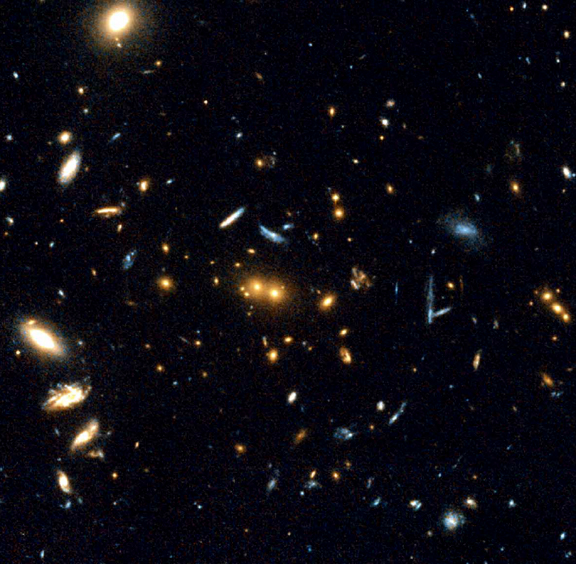
HST Optical Image of RDCS 1252.9-2927
(Credit: NASA/ESA/J.Blakeslee (JHU)/M.Postman (STScI)/P.Rosati (ESO))
Related Images
RDCS 1252.9-2927:
A Distant Galaxy Cluster
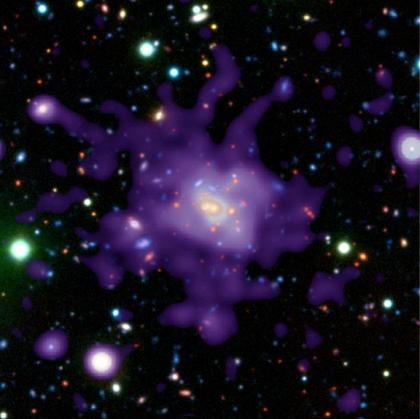
Credit: X-ray: NASA/CXC/ESO/P.Rosati et al.; Optical: ESO/VLT/P.Rosati et al.

A Distant Galaxy Cluster
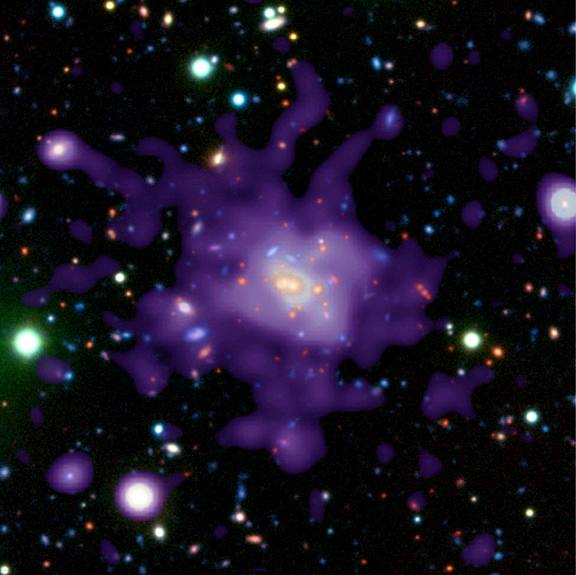
Credit: X-ray: NASA/CXC/ESO/P.Rosati et al.; Optical: ESO/VLT/P.Rosati et al.
Visual Description:
A color composite image of the galaxy cluster RDCS 1252.9-2927 shows the X-ray (purple) light from 70-million-degree Celsius gas in the cluster, and the optical (red, yellow and green) light from the galaxies in the cluster. X-ray data from Chandra and the XMM-Newton Observatory show that this cluster was fully formed more than 8 billion years ago, and has a mass at least 200 trillion times that of the Sun. At a distance of 8.5 billion light years, it is the most massive cluster ever observed at such an early stage in the evolution of the universe.
Even though the cluster is seen as it was only 5 billion years after the Big Bang, it has an abundance of elements such as silicon, sulfur, and iron similar to that of clusters observed at more recent epochs. The cluster gas must have been enriched by heavy elements synthesized in stars and ultimately ejected from the galaxies. The relative abundances of these heavy elements are indicators of the star formation history of the galaxies. The observations of RDCS 1252.9-2927 are consistent with the theory that most of the heavy elements were produced by massive stars some 11 billion years ago.
The large mass of the cluster is also significant. The currently favored theory for the formation of clusters is that they are formed from the merger of many sub-clusters in a universe dominated by cold dark matter - hypothetical subatomic particles left over from the dense early universe. Cold dark matter gets its name from the assumption that these dark matter particles were moving slowly when galaxies and galaxy clusters began to form.
Because the merging process takes time, there is a limit to how fast a cluster can grow and therefore how massive it can be at early epochs. The existence of one cluster as massive as RDCS 1252.9-2927 is consistent with the cold dark matter hypothesis, but the discovery of more such massive galaxy clusters would pose a serious challenge. A major test will come as astronomers search for evolutionary links between RDCS 1252.9-2927 and the recently discovered proto-clusters such as 4C41.17 and 3C294 that were forming 12 billion years ago.
|
||||||||||||||||||||||||||||
Visual Description:
This is an X-ray and optical image of a distant galaxy cluster known as RDCS 1252.9-2927. It appears to be made up of many different colored dots all over the image and with a large irregular purple splotch over most of it. The X-ray light is colored in purple, and shows the 70-million-degree Celsius gas in the cluster. The optical (in the red, yellow, blue and green) light shows the galaxies and sources in the field of view. X-ray data from Chandra and the XMM-Newton Observatory (the latter is not pictured) show that this cluster was fully formed more than 8 billion years ago, and has a mass at least 200 trillion times that of the Sun. At a distance of 8.5 billion light years, it is the most massive cluster ever observed at such an early stage in the evolution of the universe at the time of observation.


Revised: October 07, 2026