





CXC Home | Search | Help | Image Use Policy | Latest Images | Privacy | Accessibility | Glossary | Q&A
Download Image
More Information
More Images
Animation & Video
Related Images

4C41.17:
New View of Biggest Construction Sites in Universe

New View of Biggest Construction Sites in Universe
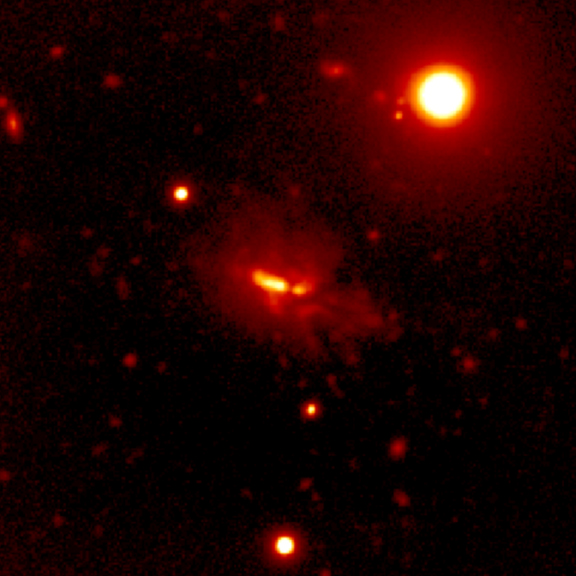
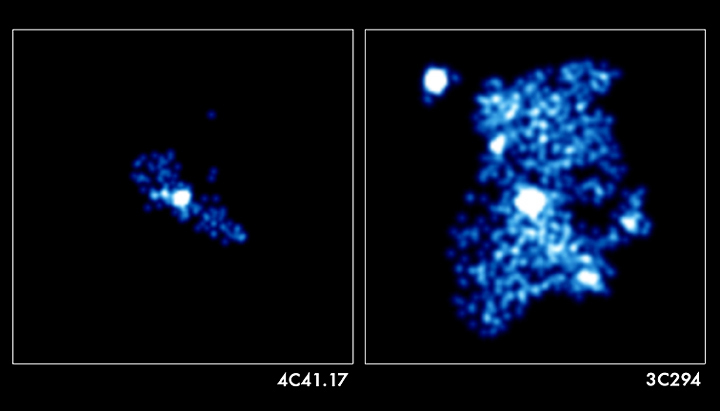
Chandra's images of two distant massive galaxies show that they are enveloped by vast clouds of high-energy particles that are evidence for past explosive activity. In both galaxies radio and X-ray jets allow this activity to be traced back to central supermassive black holes. The jets are heating gas outside the galaxies in regions hundreds of thousands of light years across.
The Chandra data will help scientists understand how nature imposes a weight limit on the growth of the most massive galaxies in the universe. These galaxies reside in regions of space that contain an unusually large concentration of galaxies, gas and dark matter.
A massive galaxy and its central black hole grow through cannibalization of nearby galaxies and through accumulation of gas from intergalactic space. Eventually however, the infall of matter into the central supermassive black hole will produce an energetic jet, which will heat the surrounding gas and stop the growth of the galaxy at a few dozen times the mass of our Galaxy.
Another implication of this research is that a massive galaxy does not grow steadily, but in fits and starts. In the beginning of a growth cycle, the galaxy and its central black hole are accumulating matter. The energy generated by the jets that accompany the growth of the supermassive black hole eventually brings the infall of matter and the growth of the galaxy to a halt. The activity around the central black hole then ceases because of the lack of a steady supply of matter, and the jets disappear. Millions of years later the hot gas around the galaxy cools and resumes falling into the galaxy, initiating a new season of growth.
|
||||||||||||||||||||||||
|
||||||||||||||||||||||||||
Visual Description:
Two images from the Chandra X-ray Observatory showcase the massive young galaxies called 4C41.17 (on the left side) and 3C294 (on the right side). The dominant colors of the image are blue and white on a background of solid black. The key structures are the textured blue and white areas forming a slim but blobby jet on the left, and a chunkier, blobbier image with a less perceptible jet-like feature cutting through the center on the right. Chandra's images of these two distant massive galaxies show that they are enveloped by vast clouds of high-energy particles that are evidence for past explosive activity. In both galaxies, radio and X-ray jets allow this activity to be traced back to central supermassive black holes. The jets are heating gas outside the galaxies in regions hundreds of thousands of light years across.


Revised: September 05, 2025