







CXC Home | Search | Help | Image Use Policy | Latest Images | Privacy | Accessibility | Glossary | Q&A
Download Image
More Information
More Images
Animation & Video
More Releases
Related Images


NGC 6240:
Never Before Seen: Two Supermassive Black Holes in Same Galaxy

Never Before Seen: Two Supermassive Black Holes in Same Galaxy
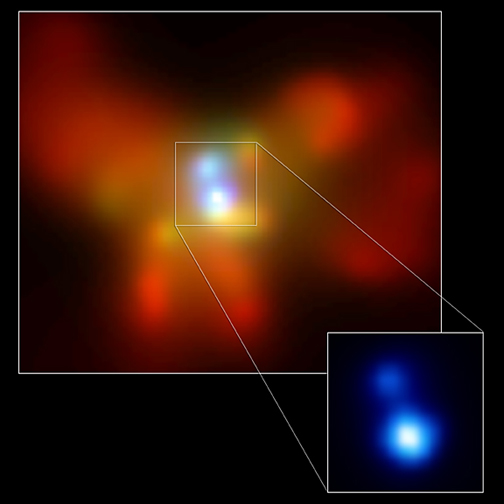
The Chandra image of NGC 6240, a butterfly-shaped galaxy that is the product of the collision of two smaller galaxies, revealed that the central region of the galaxy (inset) contains not one, but two active giant black holes.
Previous X-ray observatories had shown that the central region was an X-ray source, but astronomers did not know what was producing the X-rays. Radio, infrared, and optical observations had detected two bright nuclei, but their exact nature also remained a mystery.
Chandra was able to show that the X-rays were coming from the two nuclei, and determine their X-ray spectra. These cosmic fingerprints revealed features that are characteristic of supermassive black holes - an excess of high-energy photons from gas swirling around a black hole, and X-rays from fluorescing iron atoms in gas near black holes.
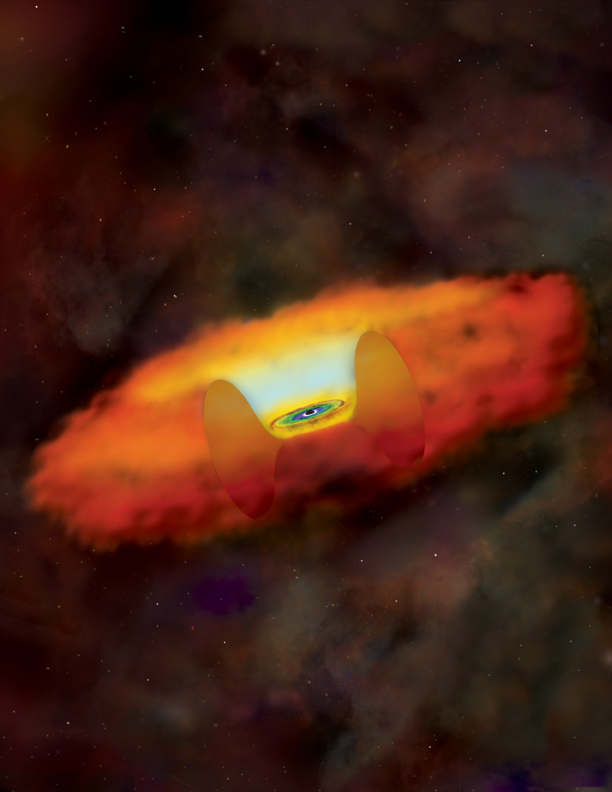
Over the course of the next few hundred million years, the two supermassive black holes, which are about 3000 light years apart, will drift toward one another and merge to form one larger supermassive black hole. This detection of a binary black hole supports the idea that black holes grow to enormous masses in the centers of galaxies by merging with other black holes.
NGC 6240 is a prime example of a "starburst" galaxy in which stars are forming, evolving, and exploding at an exceptionally rapid rate due to a relatively recent merger (30 million years ago). Heat generated by this activity created the extensive multimillion degree Celsius gas seen in this image.
Note on Cosmic Look-Back Time: The finite speed of light means that we must always be out of date, no matter how hard we strive to keep up with the times. Thus, the seemingly simple question - what is happening right now on the Sun? - cannot be answered by an observer on Earth, because it takes light 8 minutes to reach Earth from the Sun. For distant galaxies, the light travel times are even longer, so our information about the galaxy NGC 6240, which is 400 million light years away, is 400 million years out of date! One consolation is that if astronomers on NGC 6240 are observing our Milky Way galaxy, they are likewise 400 million years behind the times - our times, that is. As Albert Einstein said, "The past, present and future are only illusions, even if stubborn ones." more
|
||||||||||||||||||||||||||||
Visual Description:
This Chandra X-ray Observatory image features a galaxy named NGC 6240. This galaxy is predominantly orange and blue in color, with some green and yellow areas scattered around the core of the image. The Chandra image shows a butterfly-shaped galaxy that is the product of the collision of two smaller galaxies, and reveals that the central region of the galaxy (shown in an inset) contains not one, but two active giant black holes. The inset shows two blue blobby sources almost touching with the smaller dimmer source at the top at 11 o'clock, and the larger brighter source below it at 5 o'clock. Over the course of the next few hundred million years, the two supermassive black holes, which are about 3000 light years apart, will drift toward one another and merge to form one larger supermassive black hole.


Revised: October 07, 2026