






CXC Home | Search | Help | Image Use Policy | Latest Images | Privacy | Accessibility | Glossary | Q&A
1
Optical & X-ray Comparison of NGC
6240
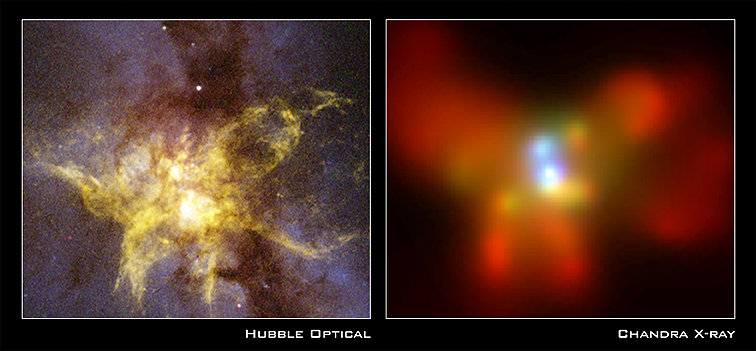
The image on the left shows the galaxy NGC 6240 in optical wavelengths taken by the Wide-Field Planetary Camera 2 aboard the Hubble Space Telescope. The Chandra image on the right covers the same field of view of the galaxy's central region. The colors in the X-ray image show the intensity of the low (red), medium (green) and high (blue) energy X-rays. For the first time, Chandra has clearly revealed two supermassive black holes in the core of the galaxy.
Scale: Each panel is .35 x .3 arcmin.
(Credit: X-ray: NASA/CXC/MPE/S.Komossa et al.; Optical: NASA/STScI/R.P.van der Marel & J.Gerssen)
The image on the left shows the galaxy NGC 6240 in optical wavelengths taken by the Wide-Field Planetary Camera 2 aboard the Hubble Space Telescope. The Chandra image on the right covers the same field of view of the galaxy's central region. The colors in the X-ray image show the intensity of the low (red), medium (green) and high (blue) energy X-rays. For the first time, Chandra has clearly revealed two supermassive black holes in the core of the galaxy.
Scale: Each panel is .35 x .3 arcmin.
(Credit: X-ray: NASA/CXC/MPE/S.Komossa et al.; Optical: NASA/STScI/R.P.van der Marel & J.Gerssen)
2
Illustration of Black Hole with Accretion
Disk and Torus
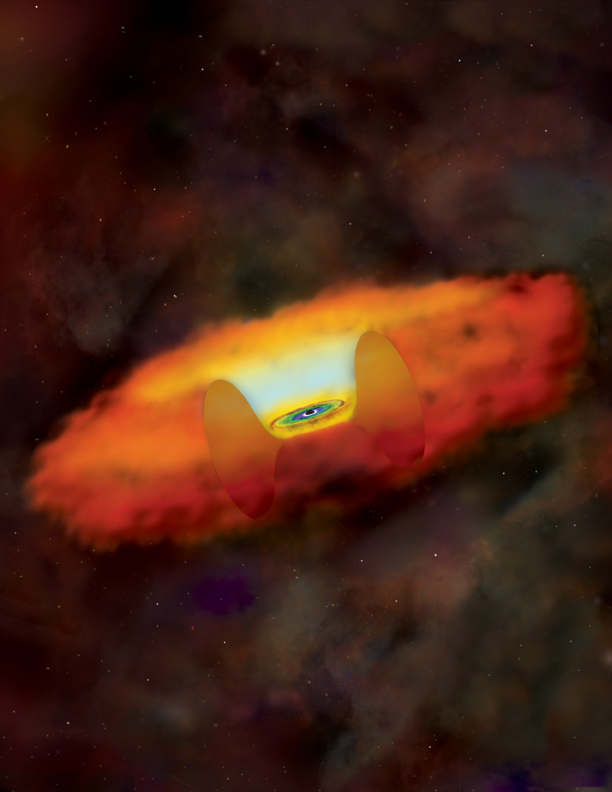
An artist's conception shows a black hole surrounded by a disk of hot gas, and a large doughnut or torus of cooler gas and dust. The light blue ring on the back of the torus is due to the fluorescence of iron atoms excited by X-rays from the hot gas disk.
(Illustration: CXC/M.Weiss)
An artist's conception shows a black hole surrounded by a disk of hot gas, and a large doughnut or torus of cooler gas and dust. The light blue ring on the back of the torus is due to the fluorescence of iron atoms excited by X-rays from the hot gas disk.
(Illustration: CXC/M.Weiss)
3
X-ray Spectrum of NGC 6240's Southern
Nucleus
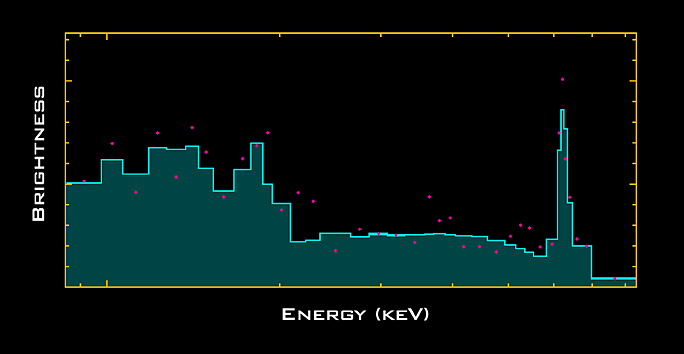
The distribution of X-rays with energy, or spectrum, of the southern nucleus shows distinctive features characteristic of gas around a supermassive black hole. These features are the broad plateau (extending from the middle toward the right of the spectrum) produced by hot gas in the vicinity of the black hole, and the sharp peak (on the right side) due to the fluorescence of iron atoms in cool gas excited by X-rays from near the black hole. The broad peaks on the left portion of the spectrum are due to multimillion degree gas in the galaxy that is projected onto the nucleus. The solid blue line represents the theoretical model that best fits the data (pink dots).
(Credit: NASA/CXC/MPE/S.Komossa et al.)
The distribution of X-rays with energy, or spectrum, of the southern nucleus shows distinctive features characteristic of gas around a supermassive black hole. These features are the broad plateau (extending from the middle toward the right of the spectrum) produced by hot gas in the vicinity of the black hole, and the sharp peak (on the right side) due to the fluorescence of iron atoms in cool gas excited by X-rays from near the black hole. The broad peaks on the left portion of the spectrum are due to multimillion degree gas in the galaxy that is projected onto the nucleus. The solid blue line represents the theoretical model that best fits the data (pink dots).
(Credit: NASA/CXC/MPE/S.Komossa et al.)
4
Full-Field
Chandra Image of NGC 6240 (3-color)
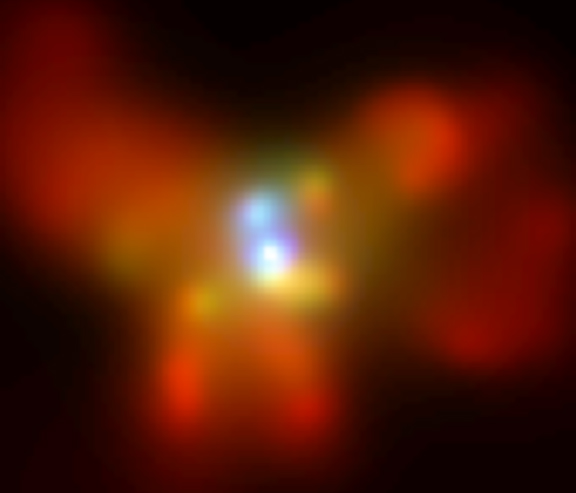
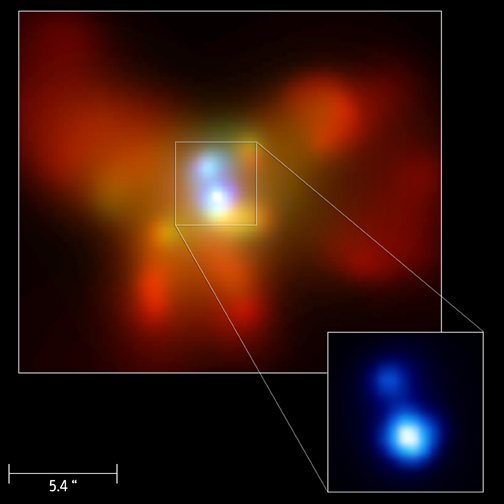
Chandra has revealed that the nucleus of an extraordinarily bright galaxy contains not one, but two active giant black holes. In this full-field image, the colors show the intensity of the low (red), medium (green) and high (blue) energy X-rays
Scale: Full Field: .7 x .5 arcmin (= 40 x 30 arcsec); Zoom In: Image is .35 x .3 arcmin.
(Credit: NASA/CXC/S.Komossa et al.)
Chandra has revealed that the nucleus of an extraordinarily bright galaxy contains not one, but two active giant black holes. In this full-field image, the colors show the intensity of the low (red), medium (green) and high (blue) energy X-rays
Scale: Full Field: .7 x .5 arcmin (= 40 x 30 arcsec); Zoom In: Image is .35 x .3 arcmin.
(Credit: NASA/CXC/S.Komossa et al.)
5
Chandra
Image of NGC 6240 (High, Low & Medium
Energy)
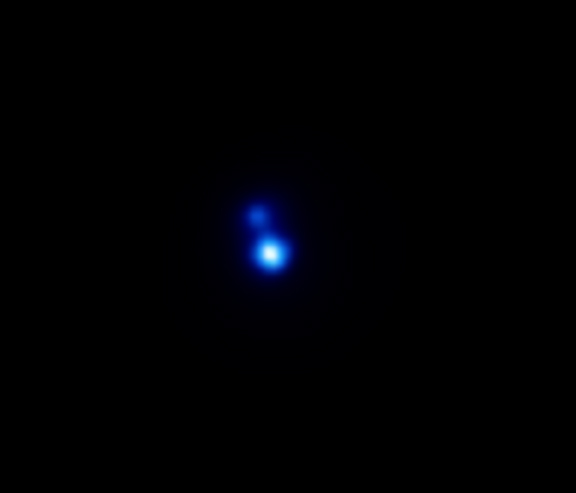
Chandra has revealed that the nucleus of an extraordinarily bright galaxy contains not one, but two active giant black holes. The first image shows only the highest-energy X-rays (5-8 keV) detected by Chandra, which come from gas around the two black holes in the center of the galaxy. The second image shows the medium-energy X-rays (1.5-5keV) and the third image shows the low-energy X-rays (0.5-1.5keV) detected by Chandra.
Scale: Image is .35 x .3 arcmin.
(Credit: NASA/CXC/MPE/S.Komossa et al.)
Chandra has revealed that the nucleus of an extraordinarily bright galaxy contains not one, but two active giant black holes. The first image shows only the highest-energy X-rays (5-8 keV) detected by Chandra, which come from gas around the two black holes in the center of the galaxy. The second image shows the medium-energy X-rays (1.5-5keV) and the third image shows the low-energy X-rays (0.5-1.5keV) detected by Chandra.
Scale: Image is .35 x .3 arcmin.
(Credit: NASA/CXC/MPE/S.Komossa et al.)
6
Composite of Optical & X-ray
Images
This image shows a composite of the Optical and X-ray data of the galaxy NGC 6240. The optical data (in yellow and blue) were taken by the Wide-Field Planetary Camera 2 aboard the Hubble Space Telescope. The Chandra data covers the same field of view of the galaxy's central region. The colors in the X-ray image show the intensity of the low (red), medium (green) and high (blue) energy X-rays. For the first time, Chandra has clearly revealed two supermassive black holes in the core of the galaxy.
Scale: Image is .35 x .3 arcmin.
(Credit: X-ray: NASA/CXC/MPE/S.Komossa et al.; Optical: NASA/STScI/R.P.van der Marel & J.Gerssen)
This image shows a composite of the Optical and X-ray data of the galaxy NGC 6240. The optical data (in yellow and blue) were taken by the Wide-Field Planetary Camera 2 aboard the Hubble Space Telescope. The Chandra data covers the same field of view of the galaxy's central region. The colors in the X-ray image show the intensity of the low (red), medium (green) and high (blue) energy X-rays. For the first time, Chandra has clearly revealed two supermassive black holes in the core of the galaxy.
Scale: Image is .35 x .3 arcmin.
(Credit: X-ray: NASA/CXC/MPE/S.Komossa et al.; Optical: NASA/STScI/R.P.van der Marel & J.Gerssen)
7
Composite
of Optical & High Energy X-ray Images
This image shows a composite of the Optical and X-ray data of the galaxy NGC 6240. The optical data (in yellow, red and green) were taken by the Wide-Field Planetary Camera 2 aboard the Hubble Space Telescope. The Chandra data covers the same field of view of the galaxy's central region. The X-ray image (blue) shows the high X-rays from the two supermassive black holes in the center of the galaxy.
Scale: Image is .35 x .3 arcmin.
(Credit: X-ray: NASA/CXC/MPE/S.Komossa et al.; Optical: NASA/STScI/R.P.van der Marel & J.Gerssen)
This image shows a composite of the Optical and X-ray data of the galaxy NGC 6240. The optical data (in yellow, red and green) were taken by the Wide-Field Planetary Camera 2 aboard the Hubble Space Telescope. The Chandra data covers the same field of view of the galaxy's central region. The X-ray image (blue) shows the high X-rays from the two supermassive black holes in the center of the galaxy.
Scale: Image is .35 x .3 arcmin.
(Credit: X-ray: NASA/CXC/MPE/S.Komossa et al.; Optical: NASA/STScI/R.P.van der Marel & J.Gerssen)
8
Optical Image of NGC 6240
This image shows the central region of the galaxy NGC 6240 in optical wavelengths taken by the Wide-Field Planetary Camera 2 aboard the Hubble Space Telescope.
(Credit: NASA/STScI/R.P.van der Marel & J.Gerssen)
This image shows the central region of the galaxy NGC 6240 in optical wavelengths taken by the Wide-Field Planetary Camera 2 aboard the Hubble Space Telescope.
(Credit: NASA/STScI/R.P.van der Marel & J.Gerssen)
9
Wide Field Optical Image of NGC
6240
This image shows the wide field view of the galaxy NGC 6240 in optical wavelengths taken by the Wide-Field Planetary Camera 2 aboard the Hubble Space Telescope.
(Credit: NASA/STScI/R.P.van der Marel & J.Gerssen)
This image shows the wide field view of the galaxy NGC 6240 in optical wavelengths taken by the Wide-Field Planetary Camera 2 aboard the Hubble Space Telescope.
(Credit: NASA/STScI/R.P.van der Marel & J.Gerssen)
10
Return to NGC 6240 (19 Nov 02)



Revised: July 09, 2008