


CXC Home | Search | Help | Image Use Policy | Latest Images | Privacy | Accessibility | Glossary | Q&A
Download Image
More Information
More Images
Chandra X-ray Images of the Arches Cluster
(Credit: NASA/CXC/Northwestern
/F.Zadeh et al.)
/F.Zadeh et al.)
Related Images


Arches Cluster:
Star Factory Near Galactic Center Bathed In High-Energy X-Rays
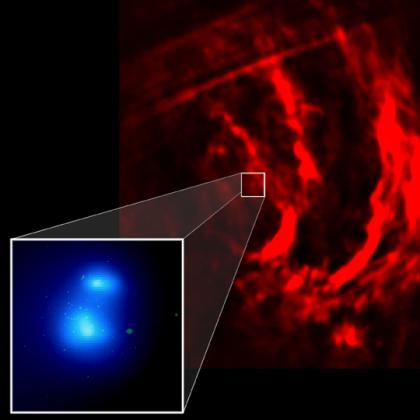
Credit: X-ray: NASA/CXC/Northwestern/F.Zadeh et al., IR: NASA/HST/NICMOS, Radio: NRAO/VLA/C.Lang

Star Factory Near Galactic Center Bathed In High-Energy X-Rays
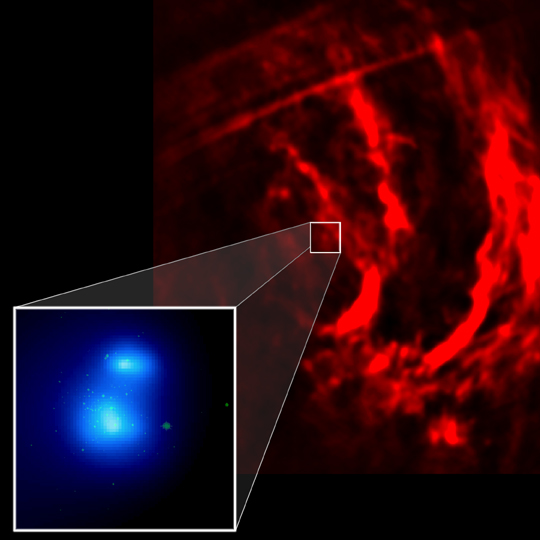
Credit: X-ray: NASA/CXC/Northwestern/F.Zadeh et al., IR: NASA/HST/NICMOS, Radio: NRAO/VLA/C.Lang
Visual Description:
This composite image shows an envelope of 60-million-degree gas around a young cluster of stars, known as the Arches cluster. The Chandra data, shown as the diffuse blue emission in the inset box, overlays a Hubble Space Telescope infrared image of the same region, in which some of the individual stars in the cluster can be seen as point-like sources. Both the X-ray and infrared observations are shown in context of the spectacular filamentary structures that appear in radio wavelengths displayed in red. Radio observations were obtained using the Very Large Array (VLA) of radio telescopes.
The Arches cluster contains about 150 hot, young stars concentrated within a radius of about one light year, making it the most compact cluster of stars in our Galaxy. Many of these stars are 20 times as massive as the Sun and live short, furious lives that last only a few million years. During this period, gas evaporates from these stars in the form of intense stellar winds. The envelope of hot gas observed by Chandra is thought to be due to collisions of the winds from numerous stars.
Studies of the Arches cluster, located about 26,000 light years from Earth, can be used to learn more about the environments of "starburst" galaxies millions of light years away where this phenomenon may be occurring on a much larger scale.
|
||||||||||||||||||||
Visual Description:
The image shows part of a cluster of young stars, with X-ray, infrared (IR), and radio views of the star cluster. The pullout on the lower left of the image shows two bright blue X-ray areas of a small portion of the cluster, surrounded by much smaller, dimmer green dots from the infrared data. The X-rays, detected by the Chandra X-ray Observatory, are emitted from the hot gas in the cluster, which is heated by the intense ultraviolet radiation emitted by the young stars. A much larger field of view in radio light provides context for the X-ray and infrared inset, with spectacular filamentary structures arching like a claw and displayed in bright red. Overall, the image provides a multi-wavelength view of the Arches Cluster, which is located in the constellation Sagittarius. The combination of X-ray, IR, and radio views allows astronomers to study the cluster's structure, the properties of the young stars within it, and the role of magnetic fields in shaping the cluster's environment.


Revised: September 09, 2025