



CXC Home | Search | Help | Image Use Policy | Latest Images | Privacy | Accessibility | Glossary | Q&A
Download Image
More Information
More Images
Related Images
M17:
"X-ray Champagne Flow" Uncorked in Horseshoe Nebula

"X-ray Champagne Flow" Uncorked in Horseshoe Nebula
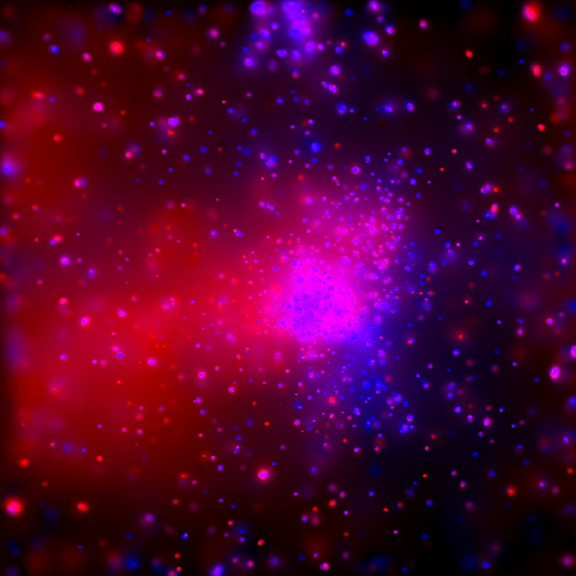
The Chandra image reveals hot gas flowing away from massive young stars in the center of the Horseshoe Nebula, a.k.a. M17, a.k.a. the Omega Nebula. The gas temperatures range from 1.5 million degrees Celsius (2.7 million degrees Fahrenheit) to about 7 million degrees Celsius (13 million degrees F).
A group of massive young stars responsible for the activity in the nebula is located in the bright pink region near the center of the image. Chandra's resolving power enabled astronomers to separate the contribution from these and other stars in the nebula from the diffuse emission.
An infrared image of the Horseshoe Nebula reveals a cloud of much cooler gas and dust shaped like a horseshoe that gives the nebula its name. The hot gas shown by the Chandra image fits inside the cool gas cloud, and appears to have formed the horseshoe shape by carving a cavity in the cool gas. This activity could lead to the formation of new stars in the Horseshoe.
The stars in the Horseshoe Nebula are only about a million years old, so the nebula is too young for one of its stars to have exploded as a supernova and heated the gas. Collisions between high-speed winds of particles flowing away from the massive stars could heat the gas, or the hot gas could be produced as these winds collide with cool clouds to form bubbles of hot gas. This hot gas appears to be flowing out of the Horseshoe like champagne flows out of a bottle when the cork is removed, so it has been termed an "X-ray champagne flow."
A comparison with other young star clusters confirms that massive young stars are responsible for hot gas clouds like the one seen in the Horseshoe Nebula. The Arches cluster, which contains many massive young stars shows this type of cloud, whereas the central regions of the Orion Nebula, which has few massive young stars, does not.
|
||||||||||||||||||||||||||||||
Visual Description:
The image is a Chandra X-ray Observatory image of nebula M17, also known as the Horseshoe Nebula or the Omega Nebula. The colors in the image are predominantly hot pink and purple, with some dark blue dots scattered throughout the image. The Chandra image reveals hot gas flowing away from massive young stars in the center of the nebula. The gas temperatures range from 1.5 million degrees Celsius (2.7 million degrees Fahrenheit) to about 7 million degrees Celsius (13 million degrees F). A group of massive young stars responsible for the activity in the nebula is located in a bulbous bright pink region near the center of the image. Chandra's resolving power enabled astronomers to separate the contribution from these and other stars in the nebula from the diffuse emission.


Revised: September 05, 2025