




CXC Home | Search | Help | Image Use Policy | Latest Images | Privacy | Accessibility | Glossary | Q&A
Download Image
More Information
More Images
X-ray, Radio Composite
(Credit: X-ray: NASA/UMD/A.Wilson et al.; Radio: NRAO/AUI/NSF)
More Releases

Related Images


Pictor A:
Spectacular X-ray Jet Points Toward Cosmic Energy Booster

Spectacular X-ray Jet Points Toward Cosmic Energy Booster
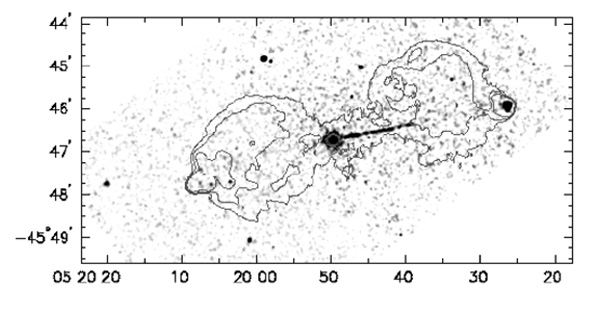
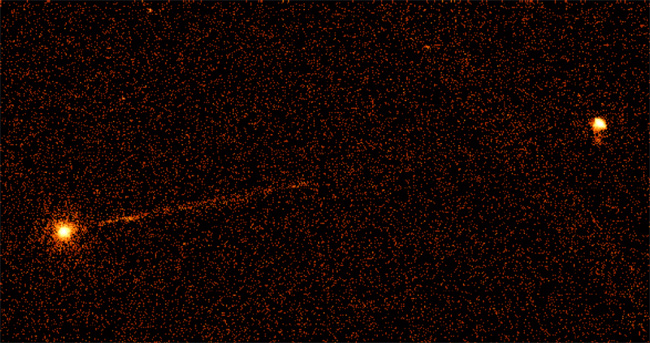
Radio Galaxy Pictor A. The Chandra X-ray image of Pictor A shows a spectacular jet that emanates from the center of the galaxy (left) and extends across 360 thousand light years toward a brilliant hot spot. The hot spot is at least 800 thousand light years (8 times the diameter of our Milky Way galaxy) away from where the jet originates. The hot spot is thought to represent the advancing head of the jet, which brightens conspicuously where it plows into the tenuous gas of intergalactic space.
One possible explanation for the X rays is that shock waves along the side and head of the X-ray jet are boosting electrons and possibly protons to speeds close to that of light. Jets are thought to be produced by the powerful electromagnetic forces created by magnetized gas swirling toward a black hole. Although most of the material falls into the black hole, some can be ejected at extremely high speeds. Magnetic fields spun out by these forces can extend over vast distances and may help explain the narrowness of the jet.
|
||||||||||||||||||||||||||
Visual Description:
The Chandra X-ray Observatory image features a galaxy called Pictor A. The image is dominated by black, brown and orange colors, with tiny orange dots visible in the background. In the center of the image, there is a bright light that appears to be emanating from the galaxy. Pictor A is a type of galaxy known as a radio galaxy, which is characterized by its strong radio emissions. These emissions are produced by supermassive black holes at the center of the galaxy, where matter is being accreted and heated to extremely high temperatures. The image of Pictor A shows a spectacular jet that emanates from the center of the galaxy (left) and extends across 360,000 light years toward a brilliant hot spot. The hot spot is at least 800,000 light years (8 times the diameter of our Milky Way galaxy) away from where the jet originates. The hot spot is thought to represent the advancing head of the jet, which brightens conspicuously where it plows into the tenuous gas of intergalactic space.


Revised: September 10, 2025