



CXC Home | Search | Help | Image Use Policy | Latest Images | Privacy | Accessibility | Glossary | Q&A
Download Image
More Information
More Images
Related Images

Cygnus X-3:
Chandra Shows New Way to Measure Cosmic Distances

Chandra Shows New Way to Measure Cosmic Distances
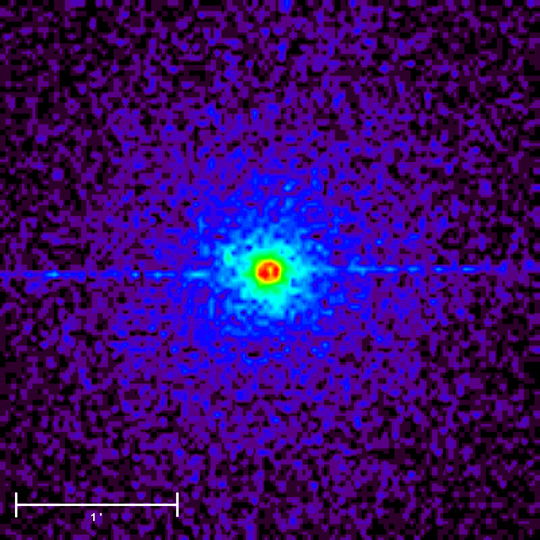
A team of scientists have used Chandra to observe a halo around the X-ray source Cygnus X-3. The halo (beyond the yellow ring in the center) is due to scattering by interstellar dust grains along the line of sight to the source. The sharp horizontal line is an instrumental effect.
The X-ray emission from Cygnus X-3 is due to matter falling from a normal star onto a nearby neutron star or black hole. Its X-ray emission varies regularly with a 4.8 hour period, as the compact star circles a companion star.
The radiation from the halo is delayed and smeared out, so the variations are damped. By observing the delays and smearing at different parts of the halo, the distance to the X-ray source is found to be 30,000 light years.
|
||||||||||||||||||||||||||||
Visual Description:
The image is an X-ray astronomical image of the binary X-ray source Cygnus X-3, which is a compact binary system composed of a black hole and a white dwarf star. The image is dominated by shades of blue and purple, with a bright yellow and red spot in the center. The observation shows a halo around the X-ray source Cygnus X-3. The halo (beyond the yellow ring in the center) is due to scattering by interstellar dust grains along the line of sight to the source. The sharp horizontal line is an instrumental effect. The X-ray emission from Cygnus X-3 is due to matter falling from a normal star onto a nearby neutron star or black hole. Its X-ray emission varies regularly with a 4.8 hour period, as the compact star circles a companion star. The radiation from the halo is delayed and smeared out, so the variations are damped. By observing the delays and smearing at different parts of the halo, the distance to the X-ray source is found to be 30,000 light years.


Revised: September 10, 2025