




CXC Home | Search | Help | Image Use Policy | Latest Images | Privacy | Accessibility | Glossary | Q&A
Download Image
More Information
More Images
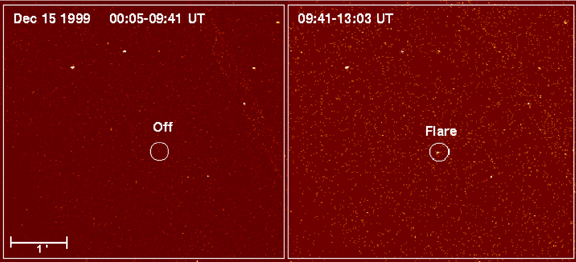
Chandra X-ray Image with Scale Bar
(Credit: NASA/UCB/ Caltech/R.Rutledge et al.)
Related Images

Brown Dwarf LP 944-20:
The Mouse That Roared - Chandra Captures Flare From Brown Dwarf

The Mouse That Roared - Chandra Captures Flare From Brown Dwarf
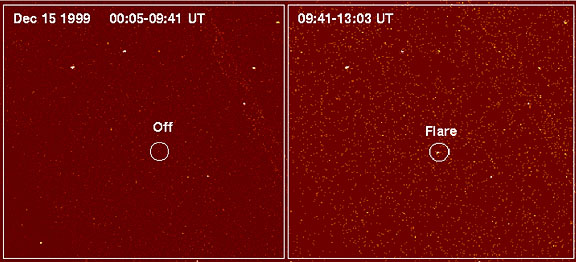
X-ray image of LP 944-20 before flare and during flare. For the first 9 hr 36 min of Chandra's observation, no X-rays were detected from the brown dwarf (left panel). Then the brown dwarf turned on with a bright X-ray flare (right panel) that gradually diminished over the last few hours of the observation. The grainy appearance of the image on the right is due to a shorter exposure time. The bright dots in the background are other X-ray sources, 7 of which have been identified as stars.
This is the first flare at any wavelength detected from a brown dwarf. The energy emitted in the flare was comparable to a small solar flare, and was a billion times greater than observed X-ray flares from Jupiter. The flaring energy is thought to be produced by a twisted magnetic field.
Brown dwarfs have too little mass to sustain significant nuclear reactions in their cores. Their primary source of energy is the release of gravitational energy as they slowly contract. Located in the constellation Fornax in the southern skies, LP 944-20 is one of the best studied brown dwarfs because it is only 16 light years from Earth. It is about 500 million years old and has a mass that is about 60 times that of Jupiter, or 6 percent of the Sun's mass. The brown dwarf's diameter is about one-tenth that of the Sun and it has a rotation period of less than five hours.
|
||||||||||||||||||||||||||||
Visual Description:
The Chandra X-ray Observatory images of the brown dwarf LP 944-20 shows the source before and during the flare in a 2 panel image. For the first 9 hr 36 min of Chandra's observation, no X-rays were detected from the brown dwarf (left panel - no tiny white dot). Then the brown dwarf turned on with a bright X-ray flare (right panel - tiny white dot) that gradually diminished over the last few hours of the observation. The grainier appearance of the image on the right is due to a shorter exposure time. The bright dots in the background are other X-ray sources, 7 of which have been identified as stars.


Revised: September 10, 2025