

CXC Home | Search | Help | Image Use Policy | Latest Images | Privacy | Accessibility | Glossary | Q&A
1. Banking X-ray Data for the Future
QuicktimeMPEG Audio Only
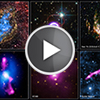
Archives, in their many forms, save information from today that people will want to access and study in the future. This is a critical function of all archives, but it is especially important when it comes to storing data from today's modern telescopes.
NASA's Chandra X-ray Observatory has collected data for over sixteen years on thousands of different objects throughout the Universe. The science team has immediate access to the data, and then a year after observation all of the data goes into a public archive where it can be folded into later studies.
To celebrate October being American Archive Month a collection of images from the Chandra archive is being released. Some of these objects may be familiar to readers, while others may be unknown. None of these images, in the exact form, has been released before.
By combining data from different observation dates, new perspectives of cosmic objects can be created. With archives like those from Chandra and other major observatories, such vistas will be available for future exploration.
[Runtime: 01:27]
(NASA/CXC/A. Hobart)
Related Chandra Images:
QuicktimeMPEG Audio Only
- Audio (1.1 MB)
Archives, in their many forms, save information from today that people will want to access and study in the future. This is a critical function of all archives, but it is especially important when it comes to storing data from today's modern telescopes.
NASA's Chandra X-ray Observatory has collected data for over sixteen years on thousands of different objects throughout the Universe. The science team has immediate access to the data, and then a year after observation all of the data goes into a public archive where it can be folded into later studies.
To celebrate October being American Archive Month a collection of images from the Chandra archive is being released. Some of these objects may be familiar to readers, while others may be unknown. None of these images, in the exact form, has been released before.
By combining data from different observation dates, new perspectives of cosmic objects can be created. With archives like those from Chandra and other major observatories, such vistas will be available for future exploration.
[Runtime: 01:27]
(NASA/CXC/A. Hobart)
Related Chandra Images:
- Photo Album: Chandra Archive Collection
2. Chandra's Archives Come to Life
QuicktimeMPEG Audio Only
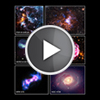
Every year, NASA's Chandra X-ray Observatory looks at hundreds of objects throughout space to help expand our understanding of the Universe. Ultimately, these data are stored in the Chandra Data Archive, an electronic repository that provides access to these unique X-ray findings for anyone who would like to explore them. With the passing of Chandra's 15th anniversary, in operation since August 26, 1999, the archive continues to grow as each successive year adds to the enormous and invaluable dataset.
To celebrate Chandra's decade and a half in space, and to honor October as American Archive Month, a variety of objects have been selected from Chandra's archive. Each of the new images we have produced combines Chandra data with those from other telescopes. This technique of creating "multiwavelength" images allows scientists and the public to see how X-rays fit with data of other types of light, such as optical, radio, and infrared. As scientists continue to make new discoveries with the telescope, the burgeoning archive will allow us to see the high-energy Universe as only Chandra can.
[Runtime: 01:27]
(NASA/CXC/A. Hobart)
Related Chandra Images:
QuicktimeMPEG Audio Only
- Audio (1.2 MB)
Every year, NASA's Chandra X-ray Observatory looks at hundreds of objects throughout space to help expand our understanding of the Universe. Ultimately, these data are stored in the Chandra Data Archive, an electronic repository that provides access to these unique X-ray findings for anyone who would like to explore them. With the passing of Chandra's 15th anniversary, in operation since August 26, 1999, the archive continues to grow as each successive year adds to the enormous and invaluable dataset.
To celebrate Chandra's decade and a half in space, and to honor October as American Archive Month, a variety of objects have been selected from Chandra's archive. Each of the new images we have produced combines Chandra data with those from other telescopes. This technique of creating "multiwavelength" images allows scientists and the public to see how X-rays fit with data of other types of light, such as optical, radio, and infrared. As scientists continue to make new discoveries with the telescope, the burgeoning archive will allow us to see the high-energy Universe as only Chandra can.
[Runtime: 01:27]
(NASA/CXC/A. Hobart)
Related Chandra Images:
- Photo Album: Chandra Archive Collection
3. NASA's Chandra X-ray Observatory Celebrates 15th Anniversary
QuicktimeMPEG Audio Only
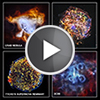
To celebrate the 15th anniversary of NASA's Chandra X-ray Observatory, we have released four new images of supernova remnants. These show Chandra's ability to study the remains of supernova explosions, using images that are the sharpest available in X-ray astronomy. The images of the Tycho and G292.0+1.8 supernova remnants show how Chandra can trace the expanding debris of an exploded star. The images show shock waves, similar to sonic booms from a supersonic plane, that travel through space at speeds of millions of miles per hour. The images of the Crab Nebula and 3C58 show the effects of very dense, rapidly spinning neutron stars created when a massive star explodes. These neutron stars can create clouds of high-energy particles that glow brightly in X-rays. The image for G292 shows oxygen (yellow and orange), and other elements such as magnesium (green) and silicon and sulfur (blue) that were forged in the star before it exploded. For the other images, the lower energy X-rays are shown in red and green and the highest energy X-rays are shown in blue.
[Runtime: 01:42]
(NASA/CXC/April Jubett)
Related Chandra Images:
QuicktimeMPEG Audio Only
- Audio (1.4 MB)
To celebrate the 15th anniversary of NASA's Chandra X-ray Observatory, we have released four new images of supernova remnants. These show Chandra's ability to study the remains of supernova explosions, using images that are the sharpest available in X-ray astronomy. The images of the Tycho and G292.0+1.8 supernova remnants show how Chandra can trace the expanding debris of an exploded star. The images show shock waves, similar to sonic booms from a supersonic plane, that travel through space at speeds of millions of miles per hour. The images of the Crab Nebula and 3C58 show the effects of very dense, rapidly spinning neutron stars created when a massive star explodes. These neutron stars can create clouds of high-energy particles that glow brightly in X-rays. The image for G292 shows oxygen (yellow and orange), and other elements such as magnesium (green) and silicon and sulfur (blue) that were forged in the star before it exploded. For the other images, the lower energy X-rays are shown in red and green and the highest energy X-rays are shown in blue.
[Runtime: 01:42]
(NASA/CXC/April Jubett)
Related Chandra Images:
- Photo Album: 3C 58

4. The Space Olympics
QuicktimeMPEG Audio Only
Nothing in space stays still. In fact, most stars are like long-distance marathon runners, as they are constantly moving in space throughout their lifetimes. However, astronomers have recently spotted a star (shown in this new space photo as a green smudge in the box) that is better at sprint running.
To work out the speed of this star, astronomers had to figure out how far it has travelled since it started its race and how long this took. Astronomers think the star began its race at the center of the purple cloud of gas and dust in the photo. That's because this is a special type of star that rotates very quickly, which is called a pulsar. And the pulsar was ejected during the explosion that created the cloud of gas and dust.
Based on their estimates, the astronomers think the pulsar is moving at an incredible speed of between 5 million and 7 million miles per hour! This could make it the fastest moving pulsar ever known! But there is a competitor for the title, as another pulsar has previously been estimated to be moving between 3 and 6 million miles per hour.
It's a pity astronomers can't enter these two stars into a 'Space Olympics' to determine which one is the fastest sprinter. Instead, they need to work it out the hard way and fine-tune their results.
[Runtime: 01:48]
(NASA/CXC/April Jubett)
Related Chandra Images:
QuicktimeMPEG Audio Only
- Audio (1.2 MB)
Nothing in space stays still. In fact, most stars are like long-distance marathon runners, as they are constantly moving in space throughout their lifetimes. However, astronomers have recently spotted a star (shown in this new space photo as a green smudge in the box) that is better at sprint running.
To work out the speed of this star, astronomers had to figure out how far it has travelled since it started its race and how long this took. Astronomers think the star began its race at the center of the purple cloud of gas and dust in the photo. That's because this is a special type of star that rotates very quickly, which is called a pulsar. And the pulsar was ejected during the explosion that created the cloud of gas and dust.
Based on their estimates, the astronomers think the pulsar is moving at an incredible speed of between 5 million and 7 million miles per hour! This could make it the fastest moving pulsar ever known! But there is a competitor for the title, as another pulsar has previously been estimated to be moving between 3 and 6 million miles per hour.
It's a pity astronomers can't enter these two stars into a 'Space Olympics' to determine which one is the fastest sprinter. Instead, they need to work it out the hard way and fine-tune their results.
[Runtime: 01:48]
(NASA/CXC/April Jubett)
Related Chandra Images:
- Photo Album: IGR J11014-6103

5. Vela Pulsar Jet Timelapse
QuicktimeMPEG The Chandra data set contains 7 images obtained between June and September 2010, and suggests that the pulsar may be slowly wobbling, or precessing, as it spins. The shape and the motion of the Vela jet look strikingly like a rotating helix, a shape that is naturally explained by precession, as shown in this animation. If the evidence for precession of the Vela pulsar is confirmed, it would be the first time that a jet from a neutron star has been found to be wobbling, or precessing, in this way.
[Runtime: 01:00]
(NASA/CXC/Univ of Toronto/M.Durant et al)
Related Chandra Images:
QuicktimeMPEG The Chandra data set contains 7 images obtained between June and September 2010, and suggests that the pulsar may be slowly wobbling, or precessing, as it spins. The shape and the motion of the Vela jet look strikingly like a rotating helix, a shape that is naturally explained by precession, as shown in this animation. If the evidence for precession of the Vela pulsar is confirmed, it would be the first time that a jet from a neutron star has been found to be wobbling, or precessing, in this way.
[Runtime: 01:00]
(NASA/CXC/Univ of Toronto/M.Durant et al)
Related Chandra Images:
- Photo Album: Vela Pulsar Jet
6. Chandra Motion Sequence of Crab Nebula
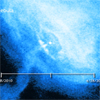
QuicktimeMPEG A new movie from NASA's Chandra X-ray Observatory shows a sequence of Chandra images of the Crab Nebula, taken over an interval of seven months. Dramatic variations are seen, including the expansion of a ring of X-ray emission around the pulsar (white dot near center) and changes in the knots within this ring. Chandra began observing the Crab on monthly intervals beginning six days after the discovery of the gamma-ray flare in September 2010. This established a baseline of seven images of the nebula before the superflare was seen just last month. When scientists saw that more flaring activity was beginning in April 2011, a pre-planned set of five Chandra observations was initiated. Two of these observations were made when strong gamma-ray flares occurred, but no clear evidence was seen for correlated flares in the Chandra images. The movie shows the April observations in "slow motion" to focus on the time when the gamma-ray superflares occurred. The movie shows three loops through the sequence of images, along with a timeline near the bottom.
[Runtime: 0.12]
View Stills
(NASA/CXC/MSFC/M.Weisskopf et al & A.Hobart)
Related Chandra Images:
QuicktimeMPEG A new movie from NASA's Chandra X-ray Observatory shows a sequence of Chandra images of the Crab Nebula, taken over an interval of seven months. Dramatic variations are seen, including the expansion of a ring of X-ray emission around the pulsar (white dot near center) and changes in the knots within this ring. Chandra began observing the Crab on monthly intervals beginning six days after the discovery of the gamma-ray flare in September 2010. This established a baseline of seven images of the nebula before the superflare was seen just last month. When scientists saw that more flaring activity was beginning in April 2011, a pre-planned set of five Chandra observations was initiated. Two of these observations were made when strong gamma-ray flares occurred, but no clear evidence was seen for correlated flares in the Chandra images. The movie shows the April observations in "slow motion" to focus on the time when the gamma-ray superflares occurred. The movie shows three loops through the sequence of images, along with a timeline near the bottom.
[Runtime: 0.12]
View Stills
(NASA/CXC/MSFC/M.Weisskopf et al & A.Hobart)
Related Chandra Images:
- Photo Album: Crab Nebula
7. GRS 1915's "Heartbeat" X-ray Variation
QuicktimeMPEG The heartbeat variation of GRS 1915 is shown here in a repeated cycle to emphasize the similarity between the X-ray light curve and an electrocardiogram. The period has been sped up by a factor of 40.
[Runtime: 0.20]
(NASA/CXC/Harvard/J.Neilsen et al)
Related Chandra Images:
QuicktimeMPEG The heartbeat variation of GRS 1915 is shown here in a repeated cycle to emphasize the similarity between the X-ray light curve and an electrocardiogram. The period has been sped up by a factor of 40.
[Runtime: 0.20]
(NASA/CXC/Harvard/J.Neilsen et al)
Related Chandra Images:
- Photo Album: GRS 1915+105
8. Simulation of GRS 1915's "Heartbeat"
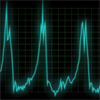
QuicktimeMPEG This movie shows a simulation of the heartbeat variation of GRS 1915. It shows an X-ray point source varying with time, based on an average X-ray light curve of GRS 1915 obtained with RXTE. The period of the heartbeat variation has been sped up by a factor of 10 and four cycles of the variation are shown.
[Runtime: 0.20]
(NASA/CXC/Harvard/J.Neilsen & A.Hobart)
Related Chandra Images:
QuicktimeMPEG This movie shows a simulation of the heartbeat variation of GRS 1915. It shows an X-ray point source varying with time, based on an average X-ray light curve of GRS 1915 obtained with RXTE. The period of the heartbeat variation has been sped up by a factor of 10 and four cycles of the variation are shown.
[Runtime: 0.20]
(NASA/CXC/Harvard/J.Neilsen & A.Hobart)
Related Chandra Images:
- Photo Album: GRS 1915+105
9. Animation of Jet and Wind around GRS 1915+105
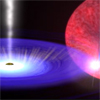
QuicktimeMPEG This animation shows how radio jets may be suppressed in the micro- quasar GRS 1915. Material is being pulled from a red companion star into a black hole via a blue, rapidly rotating disk. The animation begins with a jet blowing material away from the black hole. Later, when the disk is heated by powerful radiation from close to the black hole, a wind is driven off the disk. As the wind strengthens, the jet apparently is shut down because the wind deprives the jet of material that would otherwise have fueled it.
[Runtime: 0.25]
View Stills
(NASA/CXC/A.Hobart)
Related Chandra Images:
QuicktimeMPEG This animation shows how radio jets may be suppressed in the micro- quasar GRS 1915. Material is being pulled from a red companion star into a black hole via a blue, rapidly rotating disk. The animation begins with a jet blowing material away from the black hole. Later, when the disk is heated by powerful radiation from close to the black hole, a wind is driven off the disk. As the wind strengthens, the jet apparently is shut down because the wind deprives the jet of material that would otherwise have fueled it.
[Runtime: 0.25]
View Stills
(NASA/CXC/A.Hobart)
Related Chandra Images:
- Photo Album: GRS 1915+105
10. Images of Cosmic Cannonball
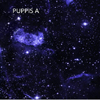
QuicktimeMPEG This sequence begins with a wide-field CTIO optical image which then combines with an X-ray image from the ROSAT observatory of Puppis A, the debris field created when a massive star exploded at the end of its life. The next image from Chandra shows the close-up view of the small, dense object, known as a "neutron star", left behind after the explosion. Chandra observations from 1999 and 2005 clearly show that the neutron star has moved over a period of five years. Astronomers calculate this neutron star is traveling at about 3 million miles per hour and is destined to exit the Galaxy million of years from now.
[Runtime: 0:12]
(Chandra: NASA/CXC/Middlebury College/F.Winkler et al.; ROSAT: NASA/GSFC/S.Snowden et al.; Optical: NOAO/AURA/NSF/Middlebury College/F.Winkler et al.)
Related Chandra Images:
QuicktimeMPEG This sequence begins with a wide-field CTIO optical image which then combines with an X-ray image from the ROSAT observatory of Puppis A, the debris field created when a massive star exploded at the end of its life. The next image from Chandra shows the close-up view of the small, dense object, known as a "neutron star", left behind after the explosion. Chandra observations from 1999 and 2005 clearly show that the neutron star has moved over a period of five years. Astronomers calculate this neutron star is traveling at about 3 million miles per hour and is destined to exit the Galaxy million of years from now.
[Runtime: 0:12]
(Chandra: NASA/CXC/Middlebury College/F.Winkler et al.; ROSAT: NASA/GSFC/S.Snowden et al.; Optical: NOAO/AURA/NSF/Middlebury College/F.Winkler et al.)
Related Chandra Images:
- Photo Album: RX J0822-4300 in Puppis A


Revised: October 09, 2026