

CXC Home | Search | Help | Image Use Policy | Latest Images | Privacy | Accessibility | Glossary | Q&A

1. Multi-wavelength Views of the Chandra Deep Field South
QuicktimeMPEG This sequence of images begins with a large optical image of the southern sky. The view zooms into the 4-million-second exposure of the Chandra Deep Field South, and then an optical and infrared image from the Hubble Space Telescope is overlaid. The Chandra sources are blue in this composite image. After further zooming in, yellow circles appear to mark the positions of very distant galaxies that existed when the Universe was less than about 950 million years old. The two small Chandra sources on the right show that all of the low and high energy X-rays that have been added up at the positions of these galaxies. This provides evidence that growing black holes have been detected in 30% to 100% of the distant galaxies.
[Runtime: 0.27]
(X-ray: NASA/CXC/U. Hawaii/E. Treister et al; Infrared: NASA/STScI/UC Santa Cruz/G. Illingworth et al; Optical: Wide-field: Akira Fujii; Close-up: NASA/STScI/S. Beckwith et al)
Related Chandra Images:
QuicktimeMPEG This sequence of images begins with a large optical image of the southern sky. The view zooms into the 4-million-second exposure of the Chandra Deep Field South, and then an optical and infrared image from the Hubble Space Telescope is overlaid. The Chandra sources are blue in this composite image. After further zooming in, yellow circles appear to mark the positions of very distant galaxies that existed when the Universe was less than about 950 million years old. The two small Chandra sources on the right show that all of the low and high energy X-rays that have been added up at the positions of these galaxies. This provides evidence that growing black holes have been detected in 30% to 100% of the distant galaxies.
[Runtime: 0.27]
(X-ray: NASA/CXC/U. Hawaii/E. Treister et al; Infrared: NASA/STScI/UC Santa Cruz/G. Illingworth et al; Optical: Wide-field: Akira Fujii; Close-up: NASA/STScI/S. Beckwith et al)
Related Chandra Images:
- Photo Album: Chandra Deep Field South
2. Animation of Hidden Baby Black Hole
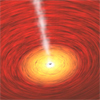
QuicktimeMPEG This animation shows an artist's impression of a distant galaxy and its hidden black hole found in an epoch when the Universe was less than one billion years old. The galaxy contains regions of active star formation (blue) and large amounts of gas and dust (red). The view zooms into the galaxy, and a glowing disk of hot gas falling onto massive central object is seen. At the center of the disk is a supermassive black hole. Many types of radiation emitted from the disk are blocked by the veil of dust and gas, but very energetic X-rays are able to escape. Scientists found many of these black holes in the early Universe using the new Chandra Deep Field South.
[Runtime: 0.20]
View Stills
(NASA/CXC/A. Hobart)
Related Chandra Images:
QuicktimeMPEG This animation shows an artist's impression of a distant galaxy and its hidden black hole found in an epoch when the Universe was less than one billion years old. The galaxy contains regions of active star formation (blue) and large amounts of gas and dust (red). The view zooms into the galaxy, and a glowing disk of hot gas falling onto massive central object is seen. At the center of the disk is a supermassive black hole. Many types of radiation emitted from the disk are blocked by the veil of dust and gas, but very energetic X-rays are able to escape. Scientists found many of these black holes in the early Universe using the new Chandra Deep Field South.
[Runtime: 0.20]
View Stills
(NASA/CXC/A. Hobart)
Related Chandra Images:
- Photo Album: Chandra Deep Field South
3. Animation of a Blob
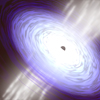
QuicktimeMPEG This animation of a blob begins with a close-up view of a supermassive black hole in the center of a galaxy. Material falls into the black hole via a hot, rotating disk, and powers an outflow that pushes out into the galaxy. The view pulls back to show the galaxy hosting the black hole, as the outflow travels away from the galaxy and heats up surrounding gas. Several other outflows powered by the black hole are seen. The view pulls back even further to show the full extent of the gas in the blob containing the galaxy.
[Runtime: 0.30]
(NASA/CXC/A.Hobart)
Related Chandra Images:
QuicktimeMPEG This animation of a blob begins with a close-up view of a supermassive black hole in the center of a galaxy. Material falls into the black hole via a hot, rotating disk, and powers an outflow that pushes out into the galaxy. The view pulls back to show the galaxy hosting the black hole, as the outflow travels away from the galaxy and heats up surrounding gas. Several other outflows powered by the black hole are seen. The view pulls back even further to show the full extent of the gas in the blob containing the galaxy.
[Runtime: 0.30]
(NASA/CXC/A.Hobart)
Related Chandra Images:
- Photo Album: Lyman Alpha Blobs
4. Chandra/Hubble Comparison Animation
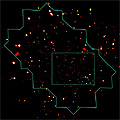
QuicktimeMPEG This video compares the large area in the northern GOODS Chandra Deep Fields field, observed with the Chandra X-ray Observatory, with the smaller region viewed with Hubble's Advanced Camera for Surveys. The video begins with the Chandra field, which is over half the size of the full moon, and then zooms into the field to show several supermassive black holes [the red blobs], before dissolving to the Hubble image. Astronomers discovered that the positions of the black holes matched the location of the galaxies in the Hubble image.
[Runtime: 0:10]
(NASA and G. Bacon (STScI))
Related Chandra Images:
QuicktimeMPEG This video compares the large area in the northern GOODS Chandra Deep Fields field, observed with the Chandra X-ray Observatory, with the smaller region viewed with Hubble's Advanced Camera for Surveys. The video begins with the Chandra field, which is over half the size of the full moon, and then zooms into the field to show several supermassive black holes [the red blobs], before dissolving to the Hubble image. Astronomers discovered that the positions of the black holes matched the location of the galaxies in the Hubble image.
[Runtime: 0:10]
(NASA and G. Bacon (STScI))
Related Chandra Images:
- Photo Album: GOODS Chandra Deep Field-North
5. Chandra Deep Field South Animation
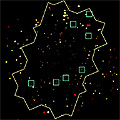
QuicktimeMPEG This video sequence pinpoints the seven X-ray sources [supermassive black holes] discovered in the southern field with the Chandra X-ray Observatory that cannot be seen in the Hubble view. The sequence begins with a view of the full Chandra field. Small boxes appear which pinpoint the black holes [the red blobs]. The video then zooms into the Chandra field to show close-ups of two black holes, which disappear in the Hubble image. These black holes are the most distant ever detected, or the galaxies in which they reside are so dusty that they cannot be seen.
[Runtime: 0:28]
(NASA and G. Bacon (STScI))
Related Chandra Images:
QuicktimeMPEG This video sequence pinpoints the seven X-ray sources [supermassive black holes] discovered in the southern field with the Chandra X-ray Observatory that cannot be seen in the Hubble view. The sequence begins with a view of the full Chandra field. Small boxes appear which pinpoint the black holes [the red blobs]. The video then zooms into the Chandra field to show close-ups of two black holes, which disappear in the Hubble image. These black holes are the most distant ever detected, or the galaxies in which they reside are so dusty that they cannot be seen.
[Runtime: 0:28]
(NASA and G. Bacon (STScI))
Related Chandra Images:
- Photo Album: GOODS Chandra Deep Field-North
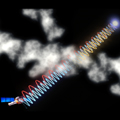
6. Animation of Absorption by Intergalactic Gas
QuicktimeMPEG In this animation, X-rays from a distant quasar traveling toward Earth and the Chandra X-ray Observatory are shown as waves of colored light. As they pass through a cloud of intergalactic gas, which appears as the white, filamentary structure, some of the X-rays are absorbed. Chandra can measure the amount of dimming in the X-rays due to oxygen ions in the cloud. This allows astronomers to estimate the temperature, density, and mass of the absorbing gas, which is part of an intergalactic web of hot gas and dark matter that contains most of the material in the universe.
[Runtime: 0:19]
(NASA/CXC/A.Hobart)
Related Chandra Images:
QuicktimeMPEG In this animation, X-rays from a distant quasar traveling toward Earth and the Chandra X-ray Observatory are shown as waves of colored light. As they pass through a cloud of intergalactic gas, which appears as the white, filamentary structure, some of the X-rays are absorbed. Chandra can measure the amount of dimming in the X-rays due to oxygen ions in the cloud. This allows astronomers to estimate the temperature, density, and mass of the absorbing gas, which is part of an intergalactic web of hot gas and dark matter that contains most of the material in the universe.
[Runtime: 0:19]
(NASA/CXC/A.Hobart)
Related Chandra Images:
- Photo Album: Hot Intergalactic Gas
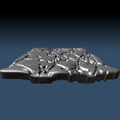
7. Animation of Rivers of Gravity
QuicktimeMPEG Over the course of billions of years, dark matter and gas collapse to produce vast channels in the geometry of space. This animation illustrates how this process resembles erosion patterns created by rivers. Most galaxies and galaxy clusters lie at the junction of these channels, whereas the hot gas lies like a fog over the dark matter in the entire channel system.
[Runtime: 0:24]
(CXC/D.Berry)
Related Chandra Images:
QuicktimeMPEG Over the course of billions of years, dark matter and gas collapse to produce vast channels in the geometry of space. This animation illustrates how this process resembles erosion patterns created by rivers. Most galaxies and galaxy clusters lie at the junction of these channels, whereas the hot gas lies like a fog over the dark matter in the entire channel system.
[Runtime: 0:24]
(CXC/D.Berry)
Related Chandra Images:
- Photo Album: Hot Intergalactic Gas
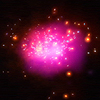
8. Dark Matter
QuicktimeMPEG New clues from NASA's Chandra X-ray Observatory have enabled scientists to constrain the size of dark matter particles in galaxy clusters. Dark matter is the invisible and unknown material that constitutes about 80% of the matter in the Universe. This animation illustrates the three major components of a cluster of galaxies: bright galaxies, hot gas (shown in orange), and the dominant component, dark matter (shown in pink), which is thought to be in the form of a hypothetical elementary particle.
[Runtime: 0:44]
(NASA/SAO/CXC)
Related Chandra Images:
QuicktimeMPEG New clues from NASA's Chandra X-ray Observatory have enabled scientists to constrain the size of dark matter particles in galaxy clusters. Dark matter is the invisible and unknown material that constitutes about 80% of the matter in the Universe. This animation illustrates the three major components of a cluster of galaxies: bright galaxies, hot gas (shown in orange), and the dominant component, dark matter (shown in pink), which is thought to be in the form of a hypothetical elementary particle.
[Runtime: 0:44]
(NASA/SAO/CXC)
Related Chandra Images:
- Photo Album: Abell 2390
- Photo Album: EMSS 1358+6245
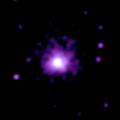
9. Chandra X-ray Images of Six Galaxy Clusters
QuicktimeMPEG A critically important number that sets the expansion rate of the Universe, the so-called Hubble constant, has been independently determined using NASA's Chandra X-ray Observatory. This new value matches recent measurements using other methods and extends their validity to greater distances and thus allows astronomers to probe earlier epochs in the evolution of the Universe. These images show six of the 38 galaxy clusters that scientists observed with Chandra.
[Runtime: 0:16]
(NASA/CXC/MSFC/M.Bonamente et al.)
Related Chandra Images:
QuicktimeMPEG A critically important number that sets the expansion rate of the Universe, the so-called Hubble constant, has been independently determined using NASA's Chandra X-ray Observatory. This new value matches recent measurements using other methods and extends their validity to greater distances and thus allows astronomers to probe earlier epochs in the evolution of the Universe. These images show six of the 38 galaxy clusters that scientists observed with Chandra.
[Runtime: 0:16]
(NASA/CXC/MSFC/M.Bonamente et al.)
Related Chandra Images:
- Photo Album: CL 0016+1609
10. Simulation of a Galaxy Collision
QuicktimeMPEG Broadcast:
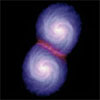
This visualization shows two spiral galaxies - each with supermassive black holes at their center - as they collide. In this simulation, the brightness represents gas density while the color indicates temperature in the gas distribution. The latest Chandra results suggest that such collisions may cause extreme black hole and galaxy growth in the early Universe, setting the stage for the birth of quasars. The time scale shown in the upper left of the simulation represents millions of years.
[Runtime: 0:41]
(Tiziana Di Matteo (MPE/CMU), Volker Springel (MPE) & Lars Hernquist (Harvard))
Related Chandra Images:
QuicktimeMPEG Broadcast:
- QuickTime movie (uncompressed)
- D1 (0.9 pixel aspect ratio)
- 720x486
- 29.97 fps
- file size = (387.3 MB)
This visualization shows two spiral galaxies - each with supermassive black holes at their center - as they collide. In this simulation, the brightness represents gas density while the color indicates temperature in the gas distribution. The latest Chandra results suggest that such collisions may cause extreme black hole and galaxy growth in the early Universe, setting the stage for the birth of quasars. The time scale shown in the upper left of the simulation represents millions of years.
[Runtime: 0:41]
(Tiziana Di Matteo (MPE/CMU), Volker Springel (MPE) & Lars Hernquist (Harvard))
Related Chandra Images:



Revised: December 28, 2022