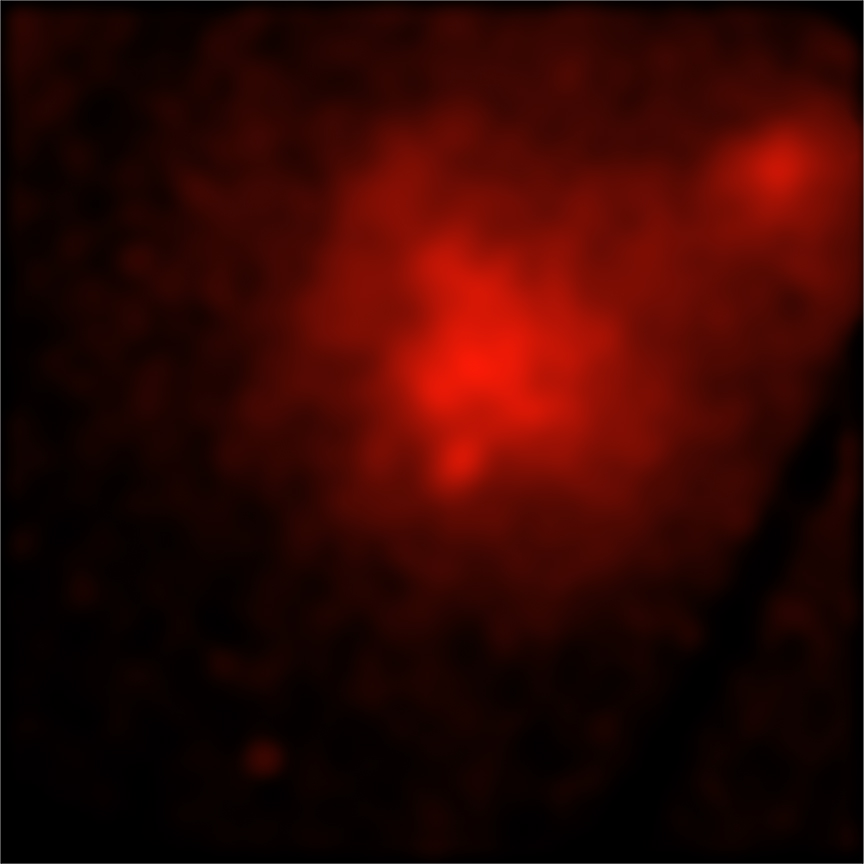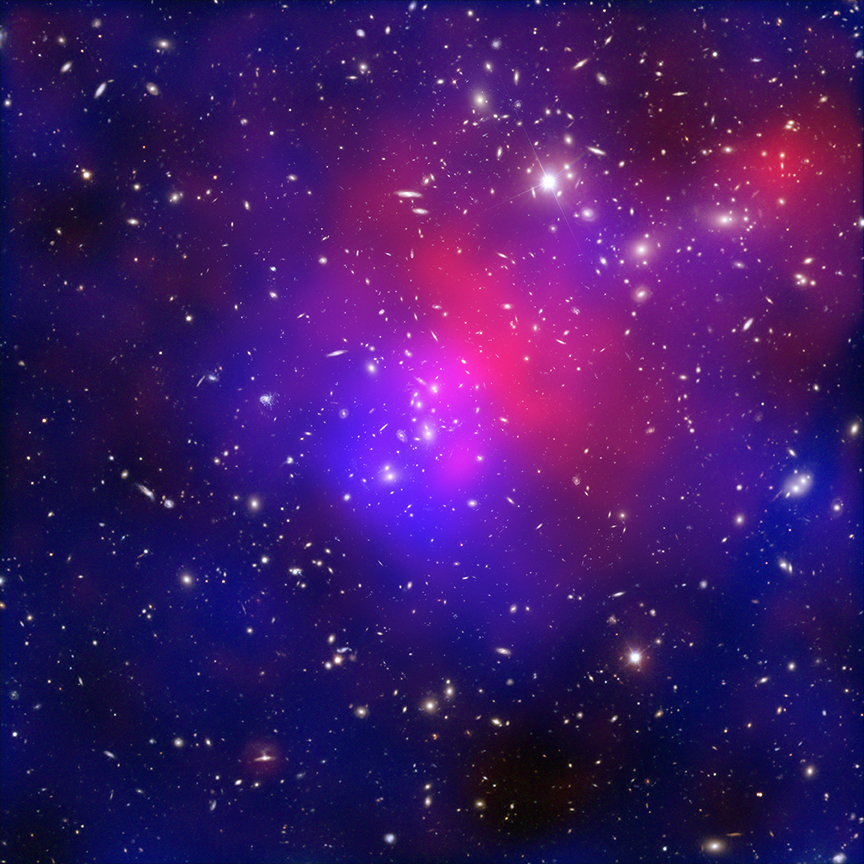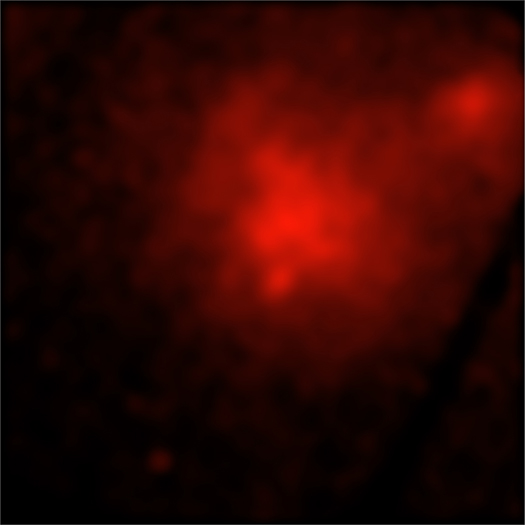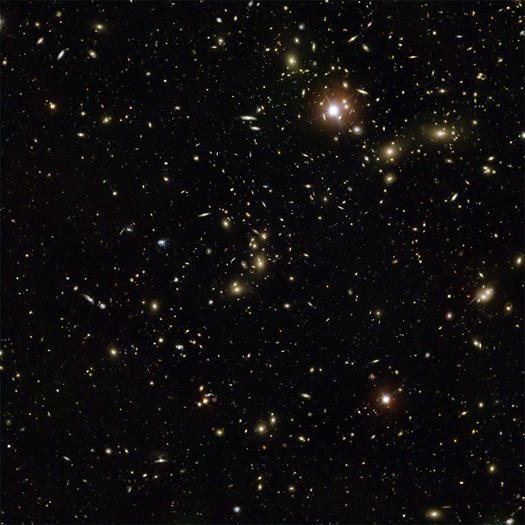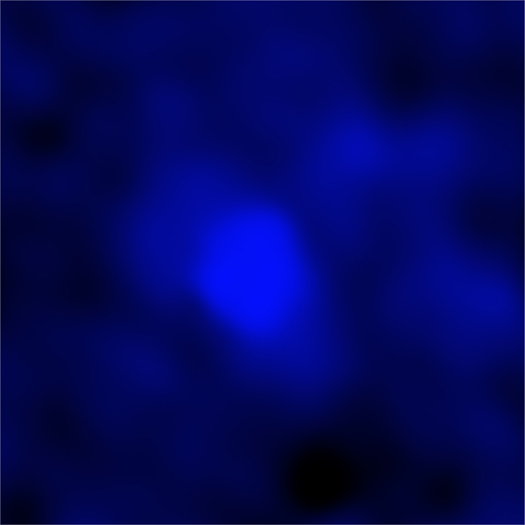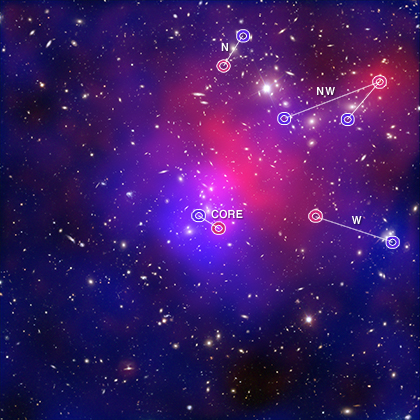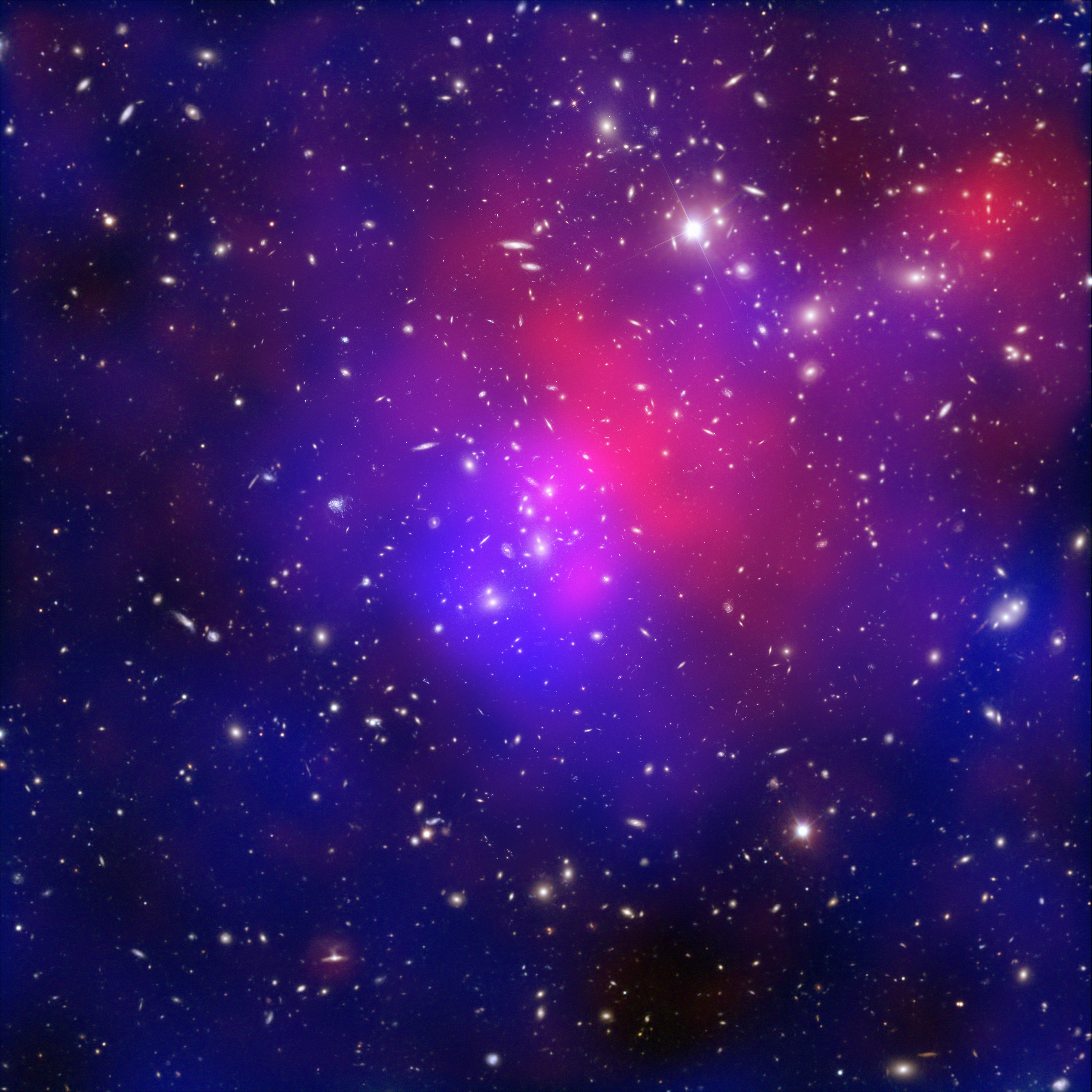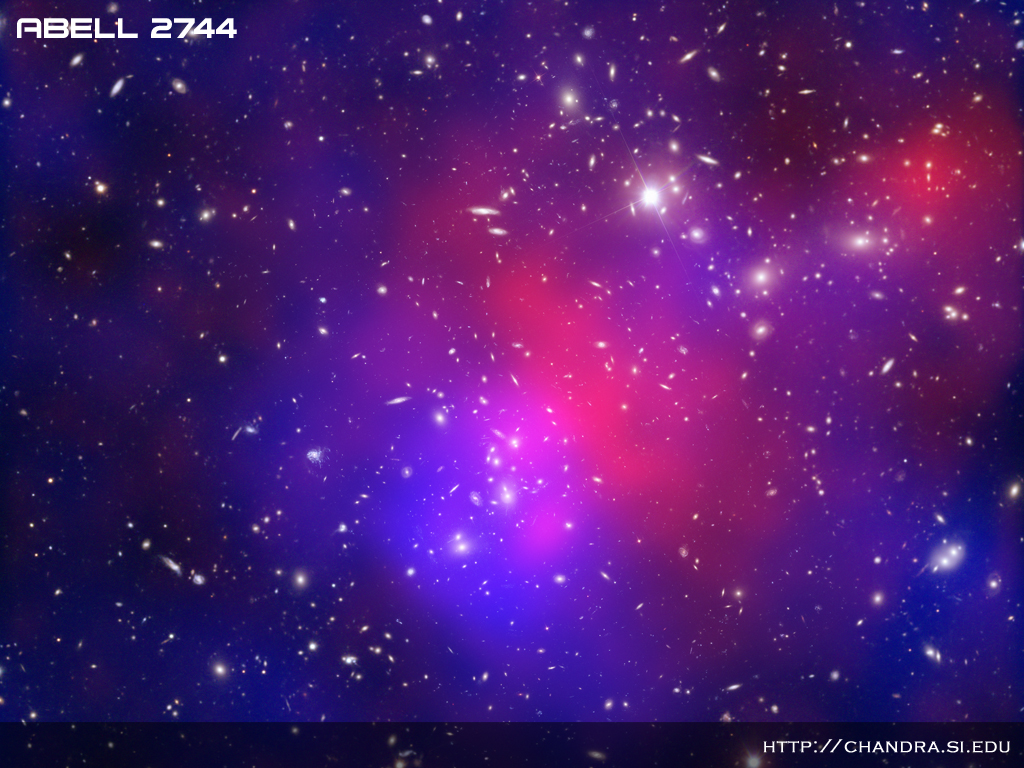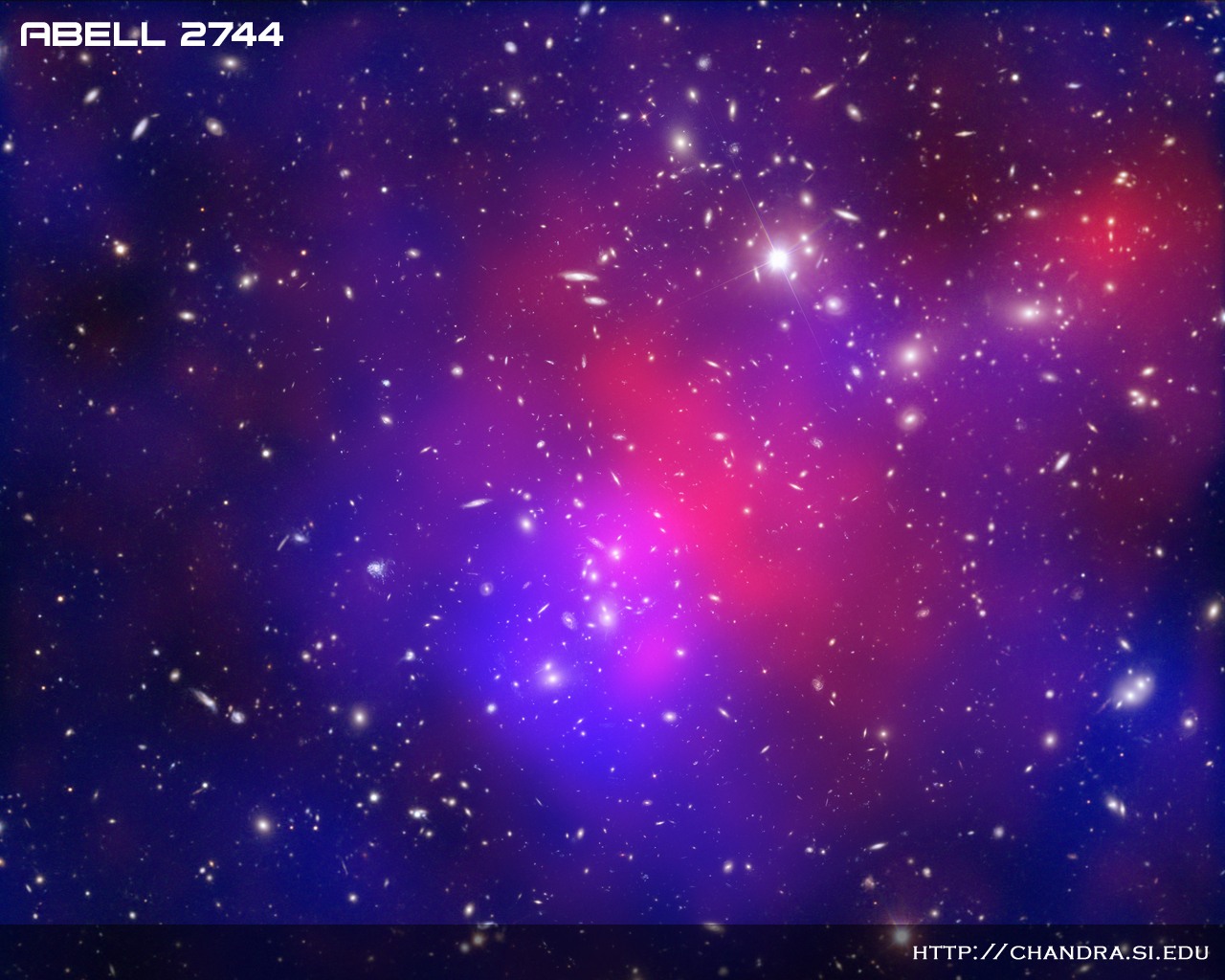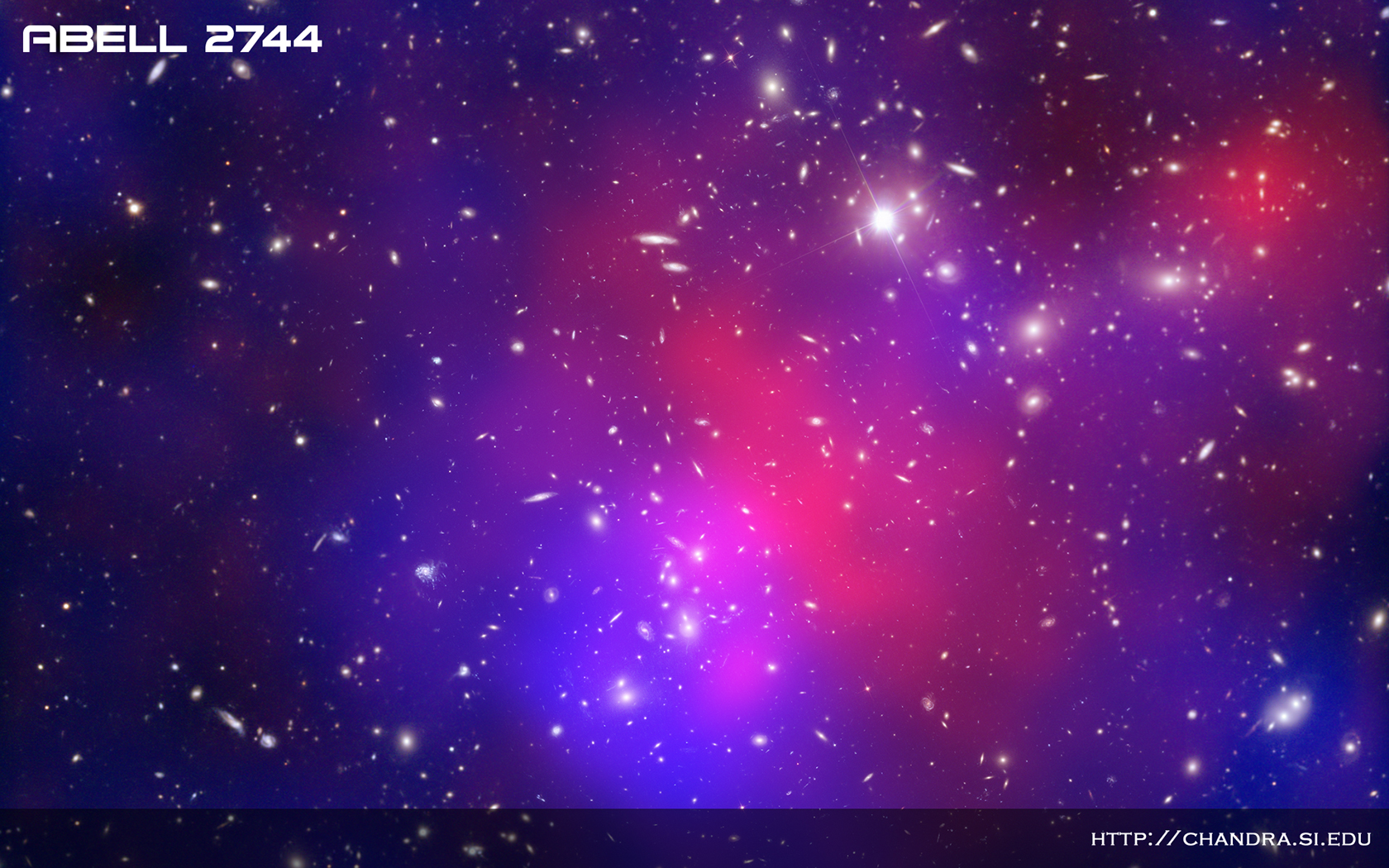

One of the most complicated and dramatic collisions between galaxy clusters ever seen is captured in this new composite image. This collision site, known officially as Abell 2744, has been dubbed "Pandora's Cluster" because of the wide variety of different structures seen. Data from NASA's Chandra X-ray Observatory are colored red, showing gas with temperatures of millions of degrees. In blue is a map showing the total mass concentration (mostly dark matter) based on data from the Hubble Space Telescope (HST), the European Southern Observatory's Very Large Telescope (VLT), and the Japanese Subaru telescope. Optical data from HST and VLT also show the constituent galaxies of the clusters.
The "core" region (rollover mouse for labels) shows a bullet-shaped structure in the X-ray emitting hot gas and a separation between the hot gas and the dark matter. (As a guide, local peaks in the distribution of hot gas and overall matter in the different regions are shown with red and blue circles respectively). This separation occurs because electric forces between colliding particles in the clouds of hot gas create a friction that slows them down, while dark matter is unaffected by such forces.
In the Northwest ("NW") region, a much larger separation is seen between the hot gas and the dark matter. Surprisingly, the hot gas leads the "dark" clump (mostly dark matter) by about 500,000 light years. This unusual configuration may require a slingshot scenario, as suggested previously by scientists, to fling the hot gas ahead of the dark matter during an earlier interaction. In the North ("N") and the West ("W") two additional examples of hot gas separated from dark matter may be visible. The latter appears to exhibit the largest separation seen to date between hot gas and dark matter.
The authors of this study retraced the details of the collision, and deduce that at least four different galaxy clusters coming from a variety of directions were involved. To understand this history, it was crucial to map the positions of all three types of matter in Abell 2744. Although the galaxies are bright, they make up less than 5% of the mass in Abell 2744. The rest is hot gas (around 20%) visible only in X-rays, and dark matter (around 75%), which is completely invisible.
Dark matter is particularly elusive as it does not emit, absorb or reflect light, but only makes itself apparent through its gravitational attraction. To pinpoint the location of this mysterious substance the team used a phenomenon known as gravitational lensing. This is the bending of light rays from distant galaxies as they pass through the gravitational field present in the cluster. The result is a series of telltale distortions in the images of galaxies in the background of optical observations. By carefully plotting the way that these images are distorted, a map is constructed of where the mass -- and hence the dark matter -- actually lies (shown in blue).
Galaxy clusters are the largest gravitationally bound objects in the Universe and have become powerful tools in cosmology studies. Further studies of Abell 2744 may provide a deeper understanding of the way that these important objects grow and provide new insight into the properties of dark matter.
The composite image of galaxy cluster Abell 2744 showcases an array of distant galaxies, hot gas and other celestial objects. The image features a vibrant pink and blue-purple hue, which is prevalent throughout the galaxy cluster, creating a captivating contrast against the dark blue background. At the center of the image, there is a large hot pink gaseous shape, almost like a mottled bird, diving into the more blue-purple nebulous area. The gaseous, nebulous shapes are littered with bright white-yellow pops of light, like too many holiday lights on a tree. This object was created by one of the most complicated and dramatic collisions between galaxy clusters ever seen. It has been dubbed "Pandora's Cluster" because of the wide variety of different structures seen. Data from NASA's Chandra X-ray Observatory are colored pink-red, showing gas with temperatures of millions of degrees. In blue is a map showing the total mass concentration (mostly dark matter) based on data from the Hubble Space Telescope, the Very Large Telescope, and the Japanese Subaru telescope. Optical data also show the constituent galaxies of the clusters. The "core" region shows a slightly bullet shaped structure in the X-ray emitting hot gas (the diving bird) and a separation between the hot gas and the dark matter. This separation occurs because electromagnetic forces between colliding particles in the clouds of hot gas create a friction that slows them down, while dark matter is unaffected by such forces.
|
||||||||||||||||||||||||||||||

| Share This |


|