

On January 9, 2008, NASA's Swift satellite was used to fortuitously observe a very bright X-ray outburst in the spiral galaxy NGC 2770, located 90 million light-years from Earth. In a Nature paper, astronomers show that the properties of the X-ray outburst are consistent with a shock wave bursting through the surface of a massive star that has just collapsed, the first time such an event has been seen. This outburst marked the very early stages of a supernova explosion called SN 2008D.
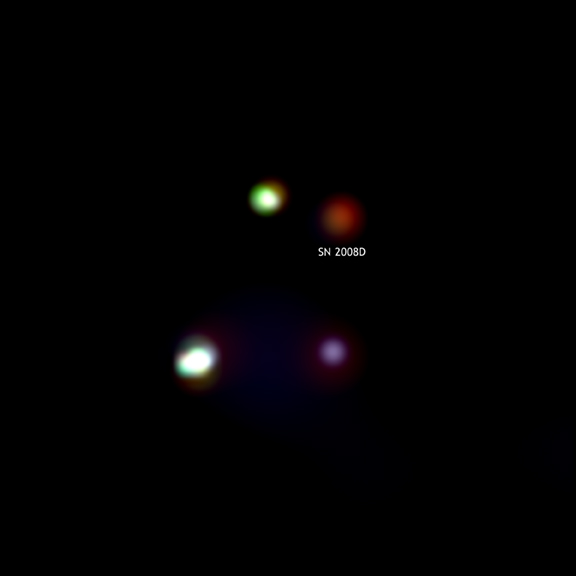
This discovery triggered a large international collaboration, using a fleet of space-based observatories and ground-based telescopes. Shown here is a Chandra X-ray Observatory image of the region around SN 2008D, obtained about 10 days after the supernova explosion. The lowest energy X-rays are shown in red, intermediate energy X-rays in green and high energies in blue. The faint red source in the upper right is SN 2008D. The other 3 X-ray sources are unrelated to this supernova.
The Chandra observations helped show that this was a normal supernova rather than one associated with a gamma ray burst. They were also used to help calculate the variation of the supernova's X-ray emission with time, allowing estimates to be made of the radius of the star that exploded and the mass-loss rate just before the explosion.
The X-ray image of the supernova SN 2008D features four bright multicolored dots in a black sky, arranged in a loose trapezoid shape. The Chandra X-ray Observatory image was obtained about 10 days after the supernova explosion occurred. The lowest energy X-rays are shown in red, intermediate energy X-rays in green and high energies in blue. The faint red source in the upper right is SN 2008D and marked with a label. The other 3 X-ray sources are unrelated to this supernova. The labelled source was observed as a very bright X-ray outburst in the spiral galaxy NGC 2770, located 90 million light-years from Earth. This outburst marked the very early stages of a supernova explosion called SN 2008D.
|
||||||||||||||||||||||||||||||


