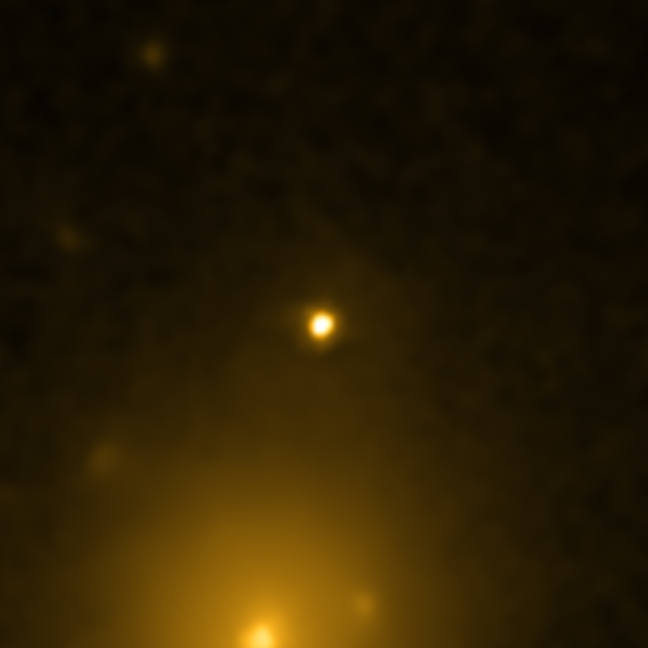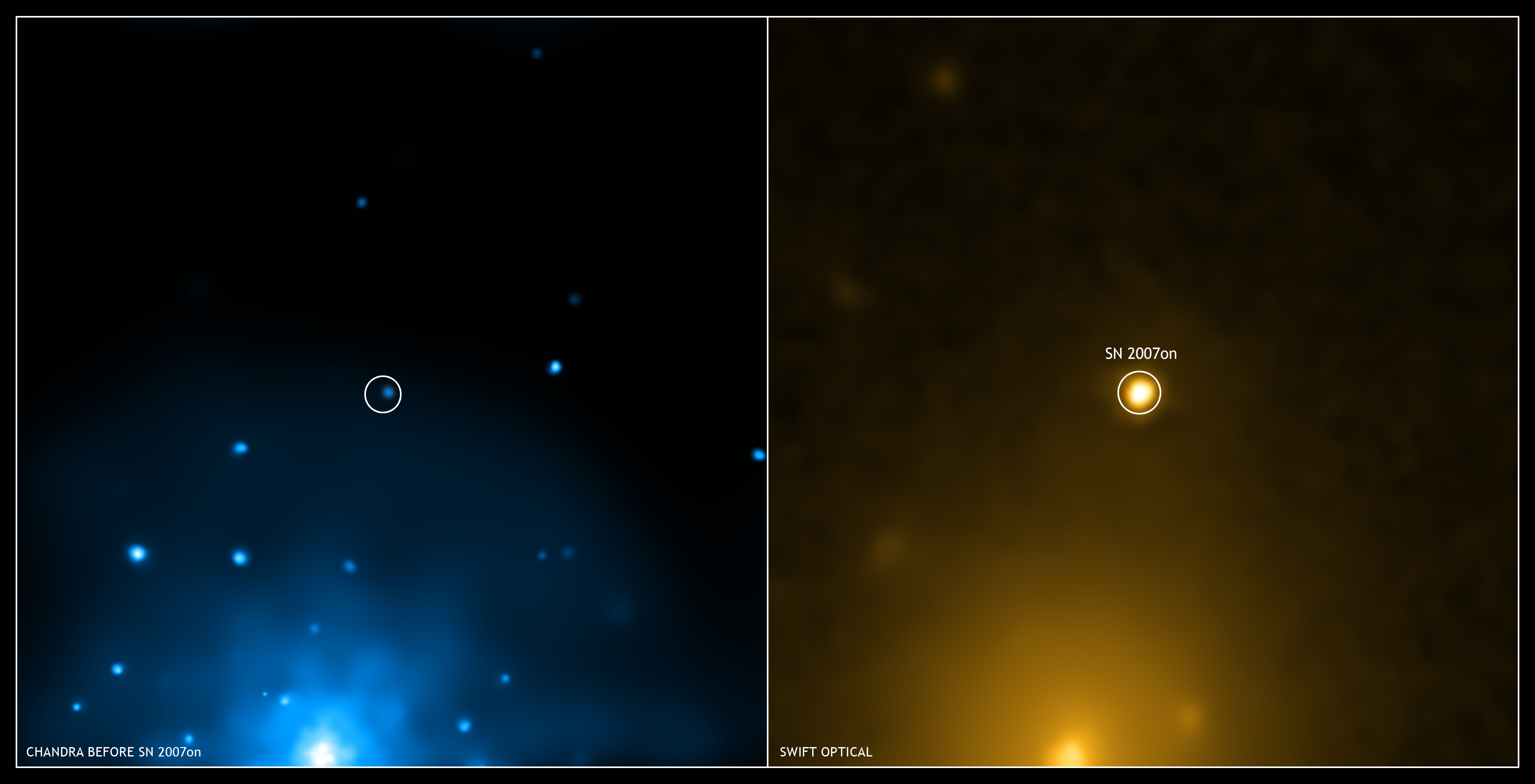

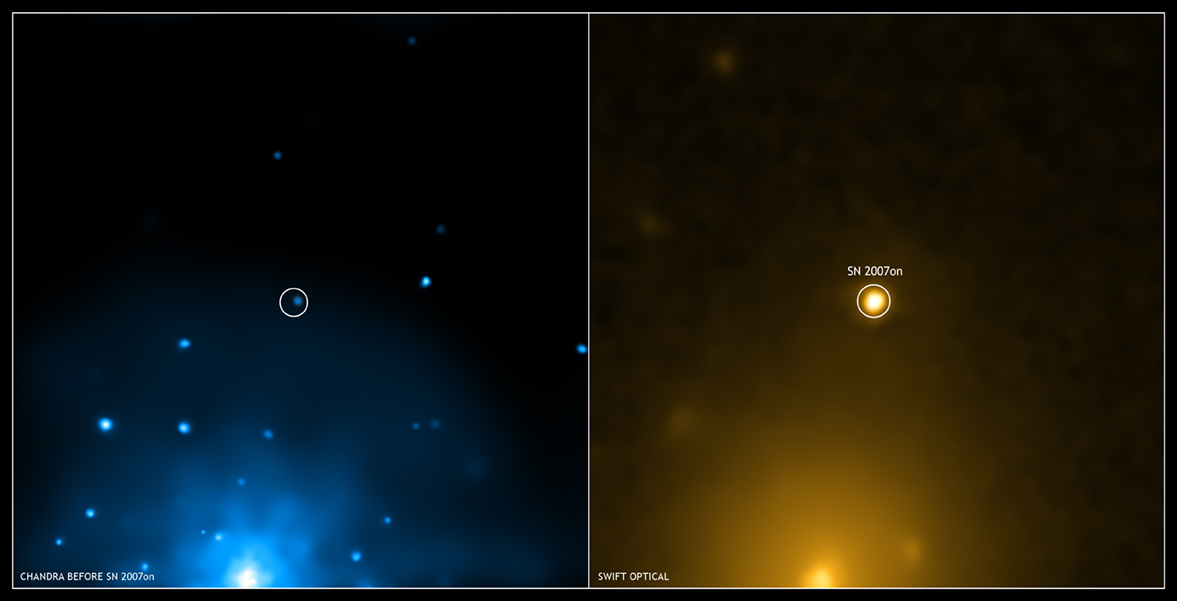
These images show evidence for the possible detection of a binary star system that was later destroyed in a supernova explosion. The right panel shows a SWIFT image, obtained with the optical/UV monitor, of the elliptical galaxy NGC 1404. At the center of the image is the supernova SN 2007on, originally discovered by the 0.25-m robotic telescope TAROT at La Silla in November, 2007. The left panel shows a Chandra X-ray Observatory image of the same field taken 4 years before the supernova was detected.
The position of SN 2007on in the Chandra image is shown with a white circle, plotted with a radius that is much larger than the uncertainty in the supernova's position. The initial search for the progenitor of SN 2007on, reported in Nature, argued that the X-ray source lying inside the circle is the likely progenitor for the supernova. This claim was based on two main pieces of evidence: (1) the chance of a source being so close by coincidence is small, and (2) the X-ray source has similar properties to those expected for a particular type of progenitor predicted by theoretical work.
However, this study included a relatively large uncertainty in the position of the supernova. Follow-up studies, yet to be published, used higher-quality optical images to better determine the supernova's position. This work showed there is a small, but significant difference in the measured positions of the supernova and the X-ray source, suggesting the source may not be the progenitor. This difference is visible in the left panel as the offset between the X-ray source and the center of the white circle.
SN 2007on was a Type Ia supernova, an important class of object used to measure the expansion of the Universe. They are generally agreed to be produced by the explosion of a white dwarf star in a binary star system. The progenitor to a Type Ia supernova has never been detected, but promises to answer important questions about the exact configuration and trigger for these explosions. Is the explosion caused by a collision between two white dwarfs, or because a white dwarf became unstable by pulling too much material off a companion star? If the latter possibility is correct, fusion of material on the surface of the star should heat it and produce a strong source of X-rays before the explosion. Once the supernova explosion occurs, the white dwarf is expected to be completely destroyed and then would be undetectable in X-rays.
Follow-up Chandra observations hint that the X-ray object has indeed disappeared, but further observations are needed to finally decide whether the source was the progenitor or not. Another possible explanation is that the nearby X-ray source is completely unrelated to the supernova.
This is a 2-panel image of supernova SN 2007on in the elliptical galaxy NGC 1404. The elliptical galaxy appears to be peaking up just partially from the bottom of the screen in both panels with the supernova circled towards the edge of the galaxy, in the middle of the frame. The left panel contains X-ray data, colored in bright blue, looking lit up in the galaxy center, surrounded by some blue dots. The right panel is optical data of the same field of view, colored in bright gold, also looking lit up in the galaxy center, but a bit fuzzier and dimmer. These images show evidence for the possible detection of a binary star system that was later destroyed in a supernova explosion. The right panel shows the SWIFT image, obtained with the optical/UV monitor. At the center of the images is the supernova SN 2007on, originally discovered by the 0.25-m robotic telescope TAROT at La Silla in November 2007. The left panel shows the Chandra X-ray Observatory image of the same field taken 4 years before the supernova was detected. SN 2007on was a Type Ia supernova, an important class of object used to measure the expansion of the Universe. They are generally agreed to be produced by the explosion of a white dwarf star in a binary star system.
|
||||||||||||||||||||||||||||||