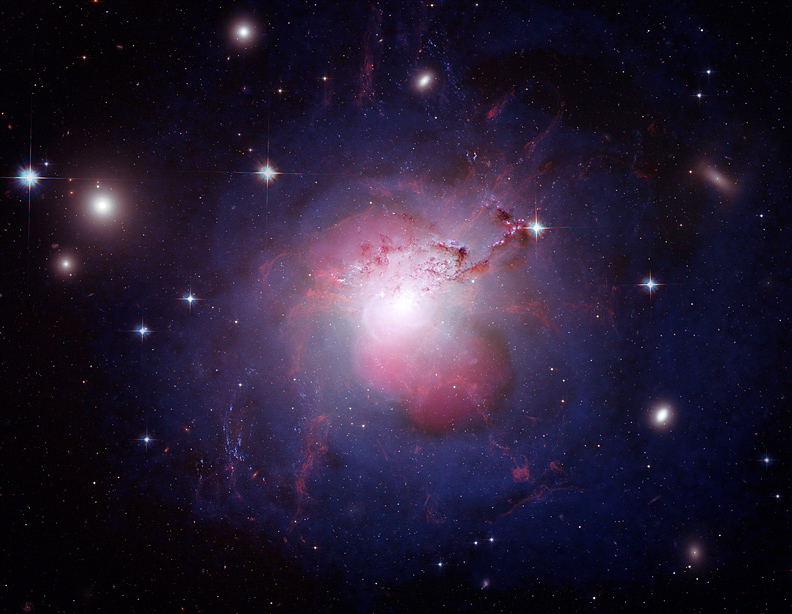
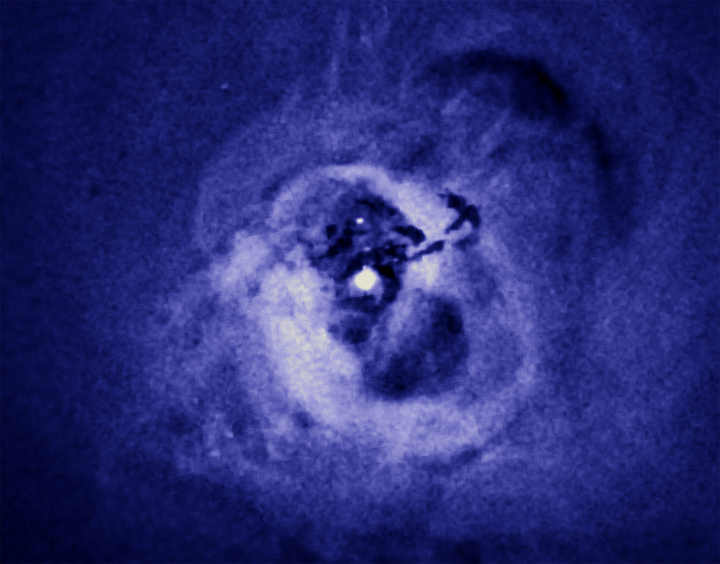
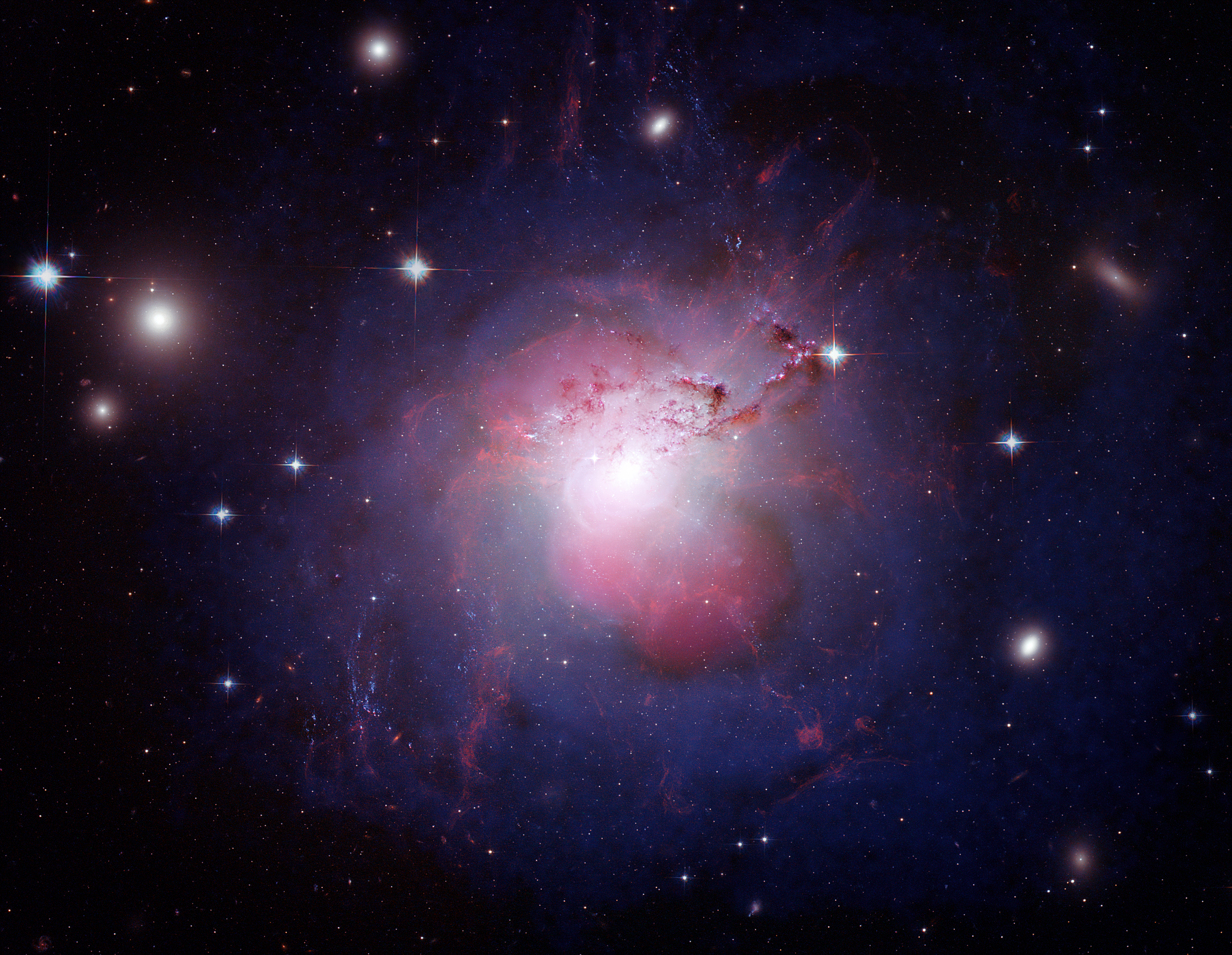
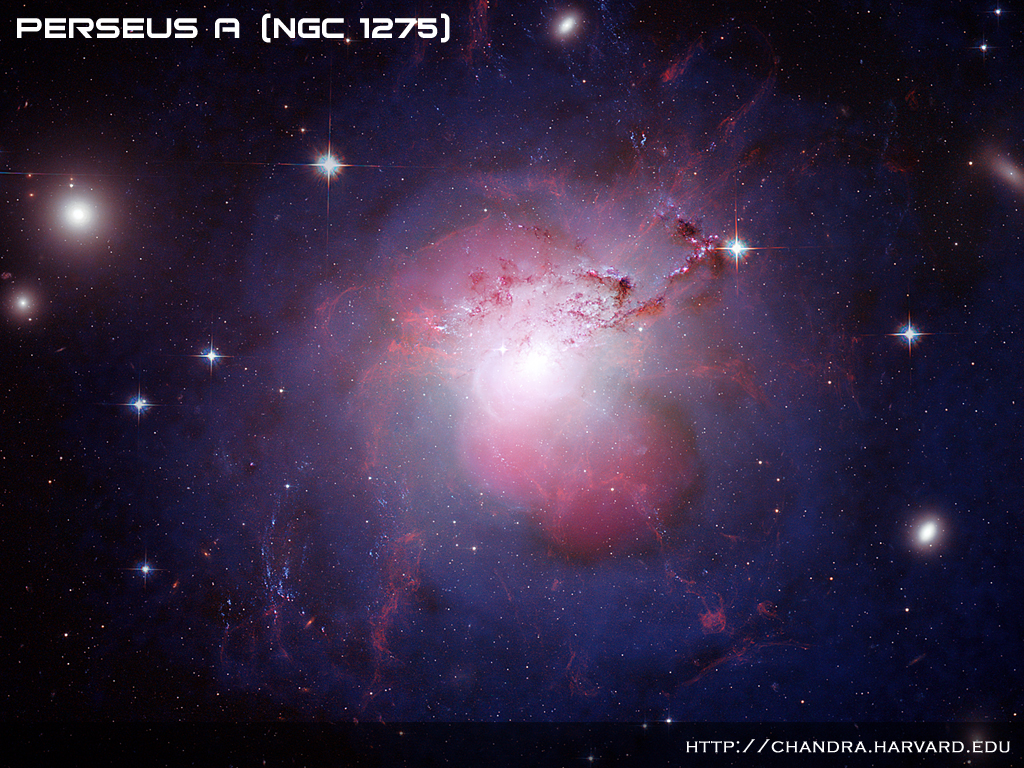
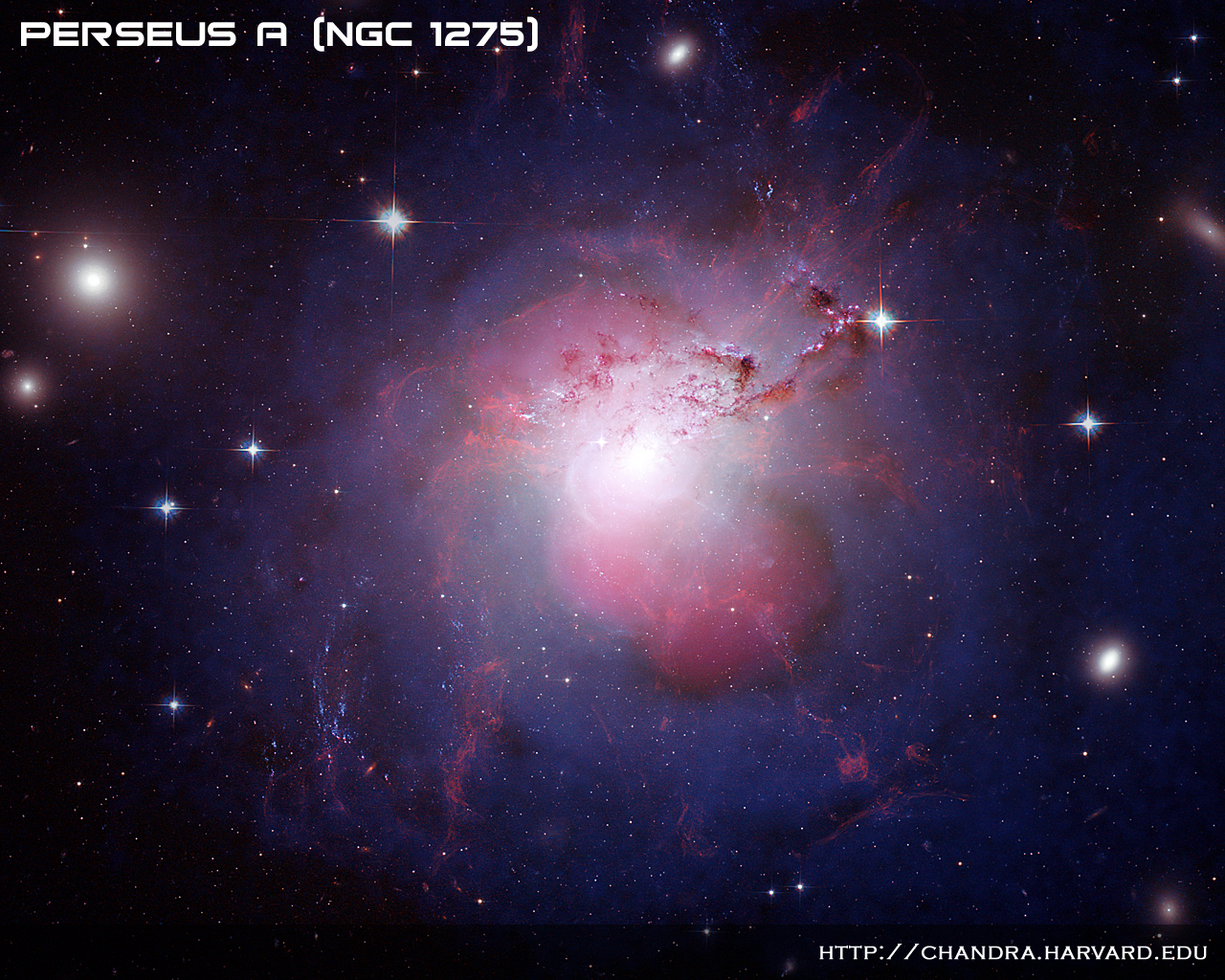
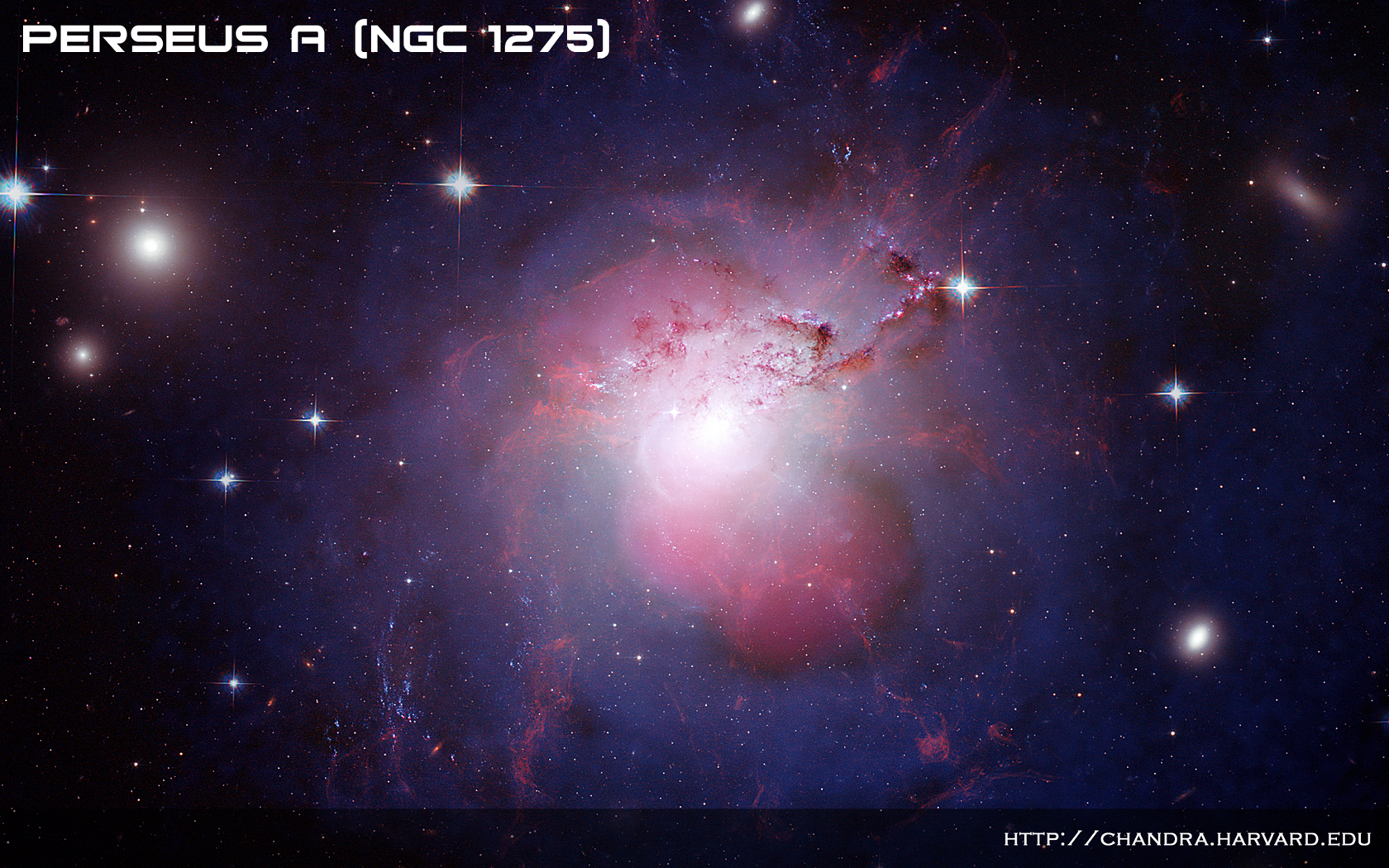
The active galaxy NGC 1275 is also a well-known radio source (Perseus A) and a strong emitter of X-rays due to the presence of a black hole in the center of the galaxy. The behemoth also lies at the center of the cluster of galaxies known as the Perseus Cluster. By combining multi-wavelength images into a single composite, the dynamics of the galaxy are more easily visible. Detail and structure from x-ray, optical and radio wavelengths combine for an aesthetically pleasing, but nonetheless violent depiction of events going on at the heart of the galaxy.
Chandra data from the Advanced CCD Imaging Spectrometer (ACIS) covers X-ray energies from 0.3-7keV. Hubble data from the Advanced Camera for Surveys covers optical wavelengths in the red, green and blue. Radio data from NRAO's Very Large Array at 328 MHz was also used. In the composite image, the X-ray data contribute to the soft violet shells around the outside of the center. The pinkish lobes toward the center of the galaxy are from radio frequencies. The radio emission, tracing jets from the black hole, fills the X-ray cavities. Dust lanes, star-forming regions, hydrogen filaments, foreground stars, and background galaxies are contributions from the Hubble optical data.
Visual Description:
This image features a multiwavelength view of the galaxy cluster called the Perseus Cluster. In the center is a bright source (called Perseus A). This inner region is a strong emitter of X-rays due to the presence of a black hole in the center of the galaxy. The cluster of galaxies appears as a bright, glowing and tempestuous object, surrounded by bright sources scattered sparsely around the edges. The colors are predominantly blue-purple around the perimeter and pinkish-purple to white towards the center. The edges of the image appear much darker, with the core of the image very bright. The galaxy cluster itself has a distinctive swirly, gaseous shape like a giant clump of fireworks going off. Chandra data is in the blue-purple and covers broadband X-ray energies. Hubble data covers optical wavelengths in softer red-pink, green and blue. Radio data from NRAO's Very Large Array in bright red is also included. The X-ray data contribute to soft violet shells around the outside of the center. Pinkish lobes toward the center of the galaxy are from radio frequencies. The radio emission, tracing jets from the black hole, fills the X-ray cavities. Dust lanes, star-forming regions, hydrogen filaments, foreground stars, and background galaxies are contributions from the Hubble optical data.
| Fast Facts for Perseus A: |
| Credit |
X-ray: NASA/CXC/IoA/A.Fabian et al.; Radio: NRAO/VLA/G. Taylor; Optical: NASA/ESA/Hubble Heritage (STScI/AURA) & Univ. of Cambridge/IoA/A. Fabian
|
| Release Date |
August 20, 2008 |
| Scale |
Image is 3.87 arcmin across. |
| Category |
Groups & Clusters of Galaxies |
| Coordinates (J2000) |
RA 03h 19m 48.10s | Dec +41° 30´ 42" |
| Constellation |
Perseus |
| Observation Date |
August 08 & 10, 2002
|
| Observation Time |
54 hours |
| Obs. ID |
3209, 4289
|
| Instrument |
ACIS
|
| Also Known As | NGC 1275 | | References | A. Fabian et al. Astro-ph/0510476 |
| Color Code |
Energy (X-ray: Violet; Radio: Pink; Optical: Red, Green, Blue) |
| Distance Estimate |
About 250 million light years
|
|