



CXC Home | Search | Help | Image Use Policy | Latest Images | Privacy | Accessibility | Glossary | Q&A
Download Image
More Information
More Releases

Related Images
3C273:
Black Hole Spills a Kaleidoscope of Color

Black Hole Spills a Kaleidoscope of Color
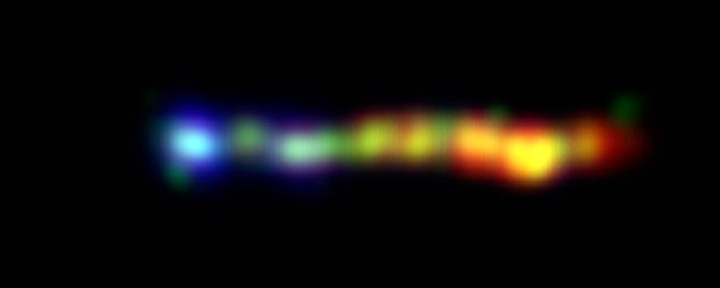
This image from NASA's Hubble, Chandra and Spitzer space telescopes shows a giant jet of particles that has been shot out from the vicinity of a type of supermassive black hole called a quasar. The jet is enormous, stretching across more than 100,000 light-years of space - a size comparable to our own Milky Way galaxy.
Quasars are among the brightest objects in the universe. They consist of supermassive black holes surrounded by turbulent material, which is being heated up as it is dragged toward the black hole. This hot material glows brilliantly, and some of it gets blown off into space in the form of powerful jets.
The jet pictured here is streaming out from the first known quasar, called 3C273, discovered in 1963. A kaleidoscope of colors represents the jet's assorted light waves. X-rays, detected by Chandra, are the highest-energy light in the image are seen at far left in blue (the black hole itself is well to the left of the image). Moving from left to right, the light diminishes in energy, and wavelengths increase in size. Visible light recorded by Hubble is displayed in green, and infrared light caught by Spitzer is red. Areas where visible and infrared light overlap appear as yellow.
Astronomers were able to use these data to help solve the mystery of how light is produced in quasar jets. Light is created in a few very different ways. For example, the Sun generates most of its light via a process called fusion, in which hydrogen atoms are combined, causing an explosion of light. In the case of this jet, even the most energetic light was unexpectedly found to be the result of charged particles spiraling through a magnetic field, a process known as synchrotron radiation.
|
||||||||||||||||||||||||||
Visual Description:
This image shows a multiwavelength view of quasar 3C 273 and its enormous jet, resembling a colorful, slightly bulbous worm stretching across a long black background. A kaleidoscope of colors represents the jet's assorted light waves. X-rays, detected by NASA's Chandra X-ray Observatory, are the highest-energy light in the image and are seen at far left, colored in blue. The black hole itself is well to the left of the image. Moving from left to right, the light diminishes in energy, and wavelengths increase in size. Visible light recorded by the Hubble Space Telescope is displayed in green, and infrared light caught by Spitzer is red. Areas where visible and infrared light overlap appear as yellow.


Revised: September 11, 2025