






CXC Home | Search | Help | Image Use Policy | Latest Images | Privacy | Accessibility | Glossary | Q&A
Download Image
More Information
More Images
Animation & Video
More Releases


Related Images


Sagittarius A*:
Stars Surprisingly Form in Extreme Environment Around Milky Way's Black Hole
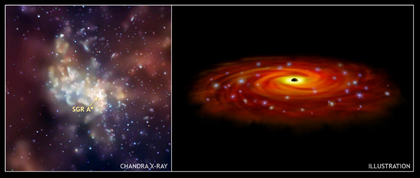
Credit: X-ray: NASA/CXC/MIT/F.K.Baganoff et al.; Illustration: NASA/CXC/M.Weiss

Stars Surprisingly Form in Extreme Environment Around Milky Way's Black Hole
Credit: X-ray: NASA/CXC/MIT/F.K.Baganoff et al.; Illustration: NASA/CXC/M.Weiss
Visual Description:
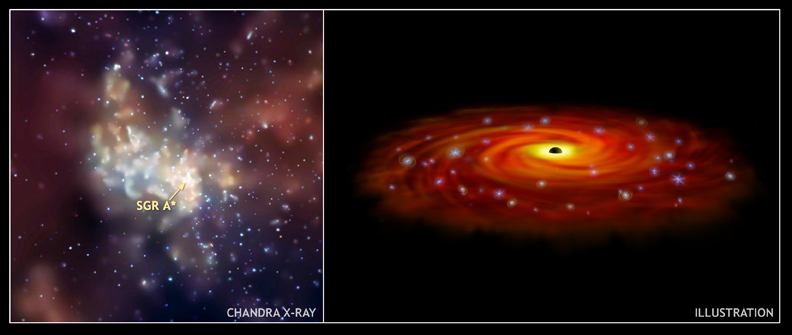
Chandra's image of the Galactic Center (left) has provided evidence for a new and unexpected way for stars to form. A combination of infrared and X-ray observations indicates that a surplus of massive stars has formed from a large disk of gas around Sagittarius A*, the Milky Way's central black hole (illustration on right).
According to the standard model for star formation, gas clouds from which stars form should have been ripped apart by tidal forces from the supermassive black hole. Evidently, the gravity of a dense disk of gas around Sagittarius A* offsets the tidal forces and allows stars to form. The tug-of-war between the black hole's tidal forces and the gravity of the disk has also favored the formation of a much higher proportion of massive stars than normal.
This novel mode of star formation may solve several mysteries about supermassive black holes that reside at the centers of nearly all galaxies. When the massive stars explode as supernovas, they will enrich the central region's galaxies with heavy elements such as oxygen and iron. This may explain the large amounts of such elements observed in the disks of supermassive black holes.
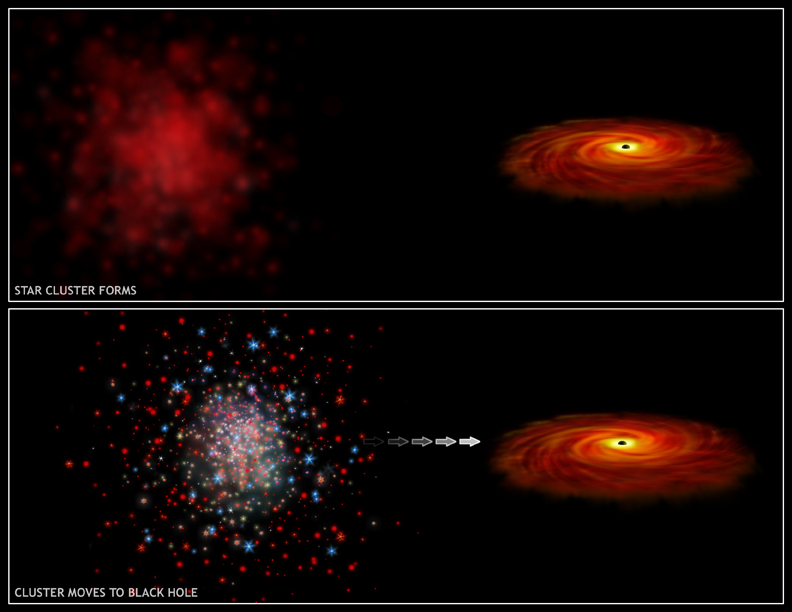
Another possibility is that the massive stars around Sagittarius A* could have formed in a cluster far away from the black hole and migrated inward. A large number of low-mass stars would be expected to form in association with the massive stars - the migration model predicts that about a million low-mass stars should have migrated to the Galactic Center along with the massive stars.
Chandra observations of the Galactic Center show that the expected low-mass stars are not there. The conclusion is that the massive stars must have formed where we see them now - around the black hole.
|
||||||||||||||||||||||||||||||
Visual Description:
Chandra's X-ray image of Sagittarius A* (left) has provided evidence for a new and unexpected way for stars to form. Sagittarius A*, the Milky Way's central black hole, is depicted in an illustration on the right. At the center of the illustration, there is a dark dot surrounded by a bright, circular object that resembles a doughnut. This ring-shaped structure, known as an accretion disk, is composed of gas and dust particles that orbit around the black hole due to its immense gravitational pull. The color of the accretion disk is predominantly red and orange with bright yellow towards the center. According to the standard model for star formation, gas clouds from which stars form should have been ripped apart by tidal forces from the supermassive black hole. Evidently, the gravity of a dense disk of gas around Sagittarius A* offsets the tidal forces and allows stars to form. The tug-of-war between the black hole's tidal forces and the gravity of the disk has also favored the formation of a much higher proportion of massive stars than normal.


Revised: October 07, 2026