



CXC Home | Search | Help | Image Use Policy | Latest Images | Privacy | Accessibility | Glossary | Q&A
October 13, 2005
RELEASE: 05-344
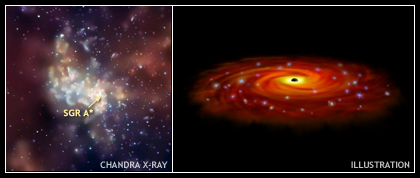
The supermassive black hole at the center of the Milky Way has surprisingly helped spawn a new generation of stars, according to observations from NASA's Chandra X-ray Observatory. This novel mode of star formation may solve several mysteries about the supermassive black holes that reside at the centers of nearly all galaxies.
"Massive black holes are usually known for violence and destruction," said Sergei Nayakshin of the University of Leicester, United Kingdom, and coauthor of a paper on this research in an upcoming issue of the Monthly Notices of the Royal Astronomical Society. "So it's remarkable that this black hole helped create new stars, not just destroy them."
Black holes have earned their fearsome reputation because any material -- including stars -- that falls within the so-called event horizon is never seen again. However, these new results indicate that the immense disks of gas known to orbit many black holes at a "safe" distance from the event horizon can help nurture the formation of new stars.
This conclusion came from new clues that could only be revealed in X-rays. Until the latest Chandra results, astronomers have disagreed about the origin of a mysterious group of massive stars discovered by infrared astronomers to be orbiting less than a light year from the Milky Way's central black hole, a.k.a. Sagittarius A*, or Sgr A*. At such close distances to Sgr A*, the standard model for star formation predicts that gas clouds from which stars form should have been ripped apart by tidal forces from the black hole.
Two models to explain this puzzle have been proposed. In the disk model, the gravity of a dense disk of gas around Sgr A* offsets the tidal forces and allows stars to form; in the migration model, the stars formed in a star cluster far away from the black hole and migrated in to form the ring of massive stars. The migration scenario predicts about a million low mass, sun-like stars in and around the ring, whereas in the disk model, the number of low mass stars could be much less.
Nayakshin and his coauthor, Rashid Sunyaev of the Max Plank Institute for Physics in Garching, Germany, used Chandra observations to compare the X-ray glow from the region around Sgr A* to the X-ray emission from thousands of young stars in the Orion Nebula star cluster. They found that the Sgr A* star cluster contains only about 10,000 low mass stars, thereby ruling out the migration model.
"We can now say that the stars around Sgr A* were not deposited there by some passing star cluster, rather they were born there," said Sunyaev . "There have been theories that this was possible, but this is the first real evidence. Many scientists are going to be very surprised by these results."
Because the Galactic Center is shrouded in dust and gas, it has not been possible to look for the low-mass stars in optical observations. In contrast, X-ray data have allowed astronomers to penetrate the veil of gas and dust and look for these low mass stars.
"In one of the most inhospitable places in our Galaxy, stars have prevailed," said Nayakshin. "It appears that star formation is much more tenacious than we previously believed."
The results suggest that the "rules" of star formation change when stars form in the disk of a giant black hole. Because this environment is very different from typical star formation regions, there is a change in the proportion of stars that form. For example, there is a much higher percentage of massive stars in the disks around black holes.
And, when these massive stars explode as supernovae, they will "fertilize" the region with heavy elements such as oxygen. This may explain the large amounts of such elements observed in the disks of young supermassive black holes.
NASA's Marshall Space Flight Center, Huntsville, Ala., manages the Chandra program for the agency's Science Mission Directorate. The Smithsonian Astrophysical Observatory controls science and flight operations from the Chandra X-ray Center in Cambridge, Mass.
Additional information and images are available at:
MEDIA CONTACTS
George Deutsch/Erica Hupp
Headquarters, Washington
Phone: 202-358-1237
Steve Roy
Marshall Space Flight Center, Huntsville, Ala.
Phone: 256-544-6535
Megan Watzke
Chandra X-ray Center, Cambridge, Mass.
Phone: 617-496-7998


Revised: March 27, 2008