





CXC Home | Search | Help | Image Use Policy | Latest Images | Privacy | Accessibility | Glossary | Q&A
Download Image
More Information
More Images
Animation & Video
Related Images
RX J0806.3+1527:
Orbiting Stars Flooding Space with Gravitational Waves
Credit: Light curve: NASA/CXC/GSFC/T. Strohmayer; Illustration: GSFC/D. Berry


Orbiting Stars Flooding Space with Gravitational Waves
Credit: Light curve: NASA/CXC/GSFC/T. Strohmayer; Illustration: GSFC/D. Berry
Visual Description:
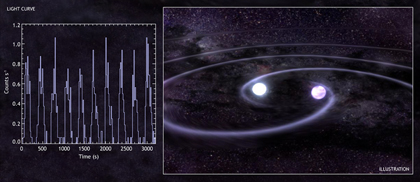
Chandra data (above, graph) from observations of RX J0806.3+1527 (or J0806), show that its X-ray intensity varies with a period of 321.5 seconds. This implies that J0806 is a binary star system where two white dwarf stars are orbiting each other (above, illustration) approximately every 5 minutes.
The short orbital period implies that the stars are only about 50,000 miles apart, a fifth of the distance from the Earth to the Moon, and are moving in excess of a million miles per hour. According to Einstein's General Theory of Relativity, such a system should produce gravitational waves -ripples in space-time - that carry energy away from the system at the speed of light.
Energy loss by gravitational waves will cause the stars to move closer together. X-ray and optical observations indicate that the orbital period of this system is decreasing by 1.2 milliseconds every year, which means that the stars are moving closer together at a rate of about 2 feet per day.
|
||||||||||||||||||||||||||
Visual Description:
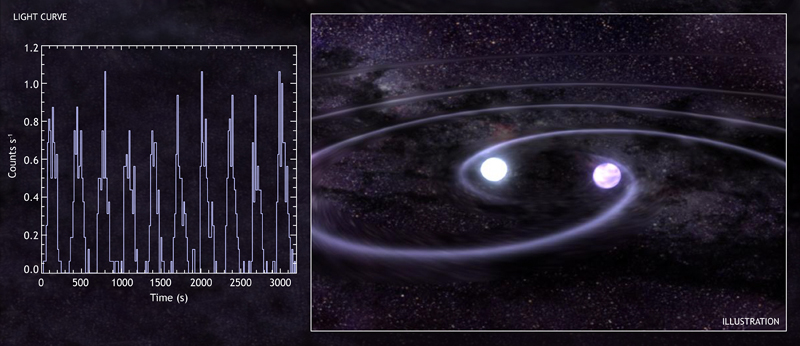
An illustration of a binary star system, RX J0806.3+1527 (J0806), is displayed on the right with spectral information on the left. The drawing shows two bright stars in the galaxy, which are orbiting each other and with lines of motion around them. The dominant colors in the image are dark purple and white. Chandra data on the left graph, or spectrum, on J0806 show that its X-rays vary with a period of 321.5 seconds, or slightly more than five minutes. This implies that the X-ray source is a binary star system where two white dwarf stars are orbiting each other only 50,000 miles apart, making it one of the smallest known binary orbits in the Galaxy. Observations indicate that the orbital period of this system is decreasing by 1.2 milliseconds every year, which means that the stars are moving closer at a rate of 2 feet per year.


Revised: September 11, 2025