




CXC Home | Search | Help | Image Use Policy | Latest Images | Privacy | Accessibility | Glossary | Q&A
Download Image
More Information
More Images
Composite X-ray/Optical
Image of the Crescent Nebula
Image of the Crescent Nebula
(Credit: X-ray: NASA/UIUC/Y. Chu & R. Gruendl et al. Optical: SDSU/MLO/Y. Chu et al.)
Related Images


Crescent Nebula:
Live Fast, Blow Hard and Die Young
Credit: X-ray: NASA/UIUC/Y. Chu & R. Gruendl et al. Optical: SDSU/MLO/Y. Chu et al.

Live Fast, Blow Hard and Die Young
Credit: X-ray: NASA/UIUC/Y. Chu & R. Gruendl et al. Optical: SDSU/MLO/Y. Chu et al.
Visual Description:
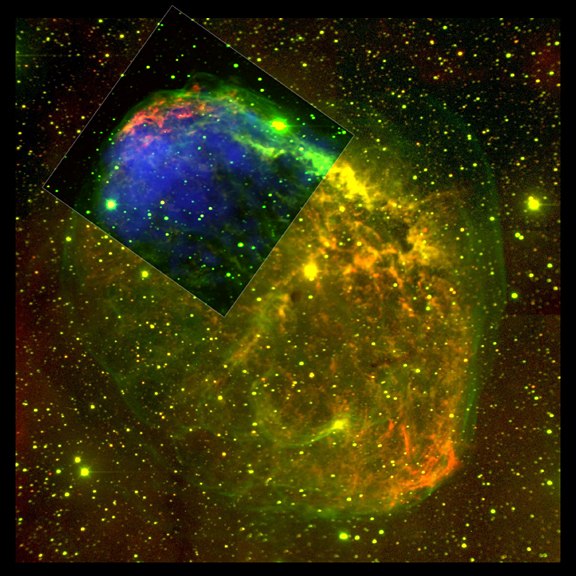
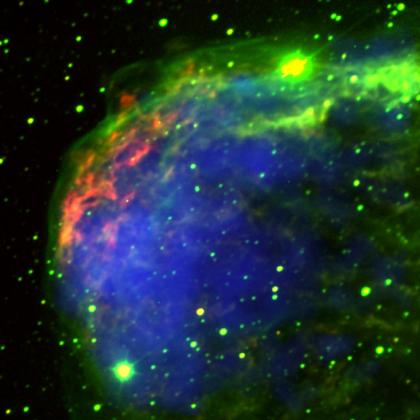
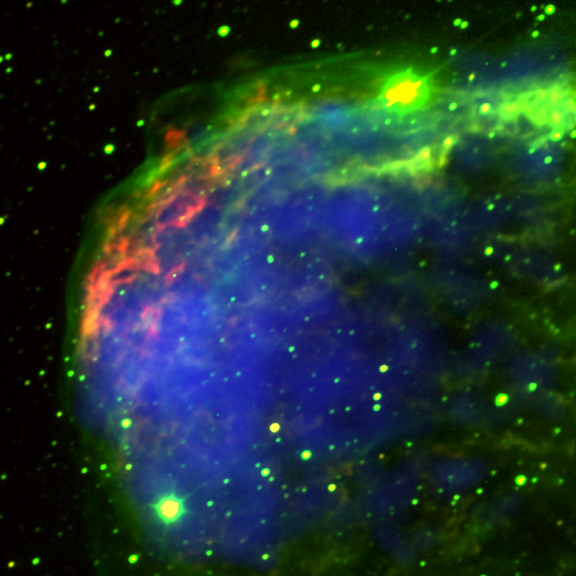
Massive stars lead short, spectacular lives. This composite X-ray (blue)/optical (red and green) image reveals dramatic details of a portion of the Crescent Nebula, a giant gaseous shell created by powerful winds blowing from the massive star HD 192163 (a.k.a. WR 136, the star is out of the field of view to the lower right).
After only 4.5 million years (one-thousandth the age of the Sun), HD 192163 began its headlong rush toward a supernova catastrophe. First it expanded enormously to become a red giant and ejected its outer layers at about 20,000 miles per hour. Two hundred thousand years later - a blink of the eye in the life of a normal star - the intense radiation from the exposed hot, inner layer of the star began pushing gas away at speeds in excess of 3 million miles per hour!
When this high speed "stellar wind" rammed into the slower red giant wind, a dense shell was formed. In the image, a portion of the shell is shown in red. The force of the collision created two shock waves: one that moved outward from the dense shell to create the green filamentary structure, and one that moved inward to produce a bubble of million degree Celsius X-ray emitting gas (blue). The brightest X-ray emission is near the densest part of the compressed shell of gas, indicating that the hot gas is evaporating matter from the shell. The massive star HD 192183 that has produced the nebula appears as the bright dot at the center of the full-field image.
HD 192163 will likely explode as a supernova in about a hundred thousand years. This image enables astronomers to determine the mass, energy, and composition of the gaseous shell around this pre-supernova star. An understanding of such environments provides important data for interpreting observations of supernovas and their remnants.
|
||||||||||||||||||||||||||
Visual Description:
A colorful composite X-ray and optical image of the Crescent Nebula (NGC 6888) is displayed. The image features bright blue and green hues, with a wispy red curving around it. The main structure of the nebula appears to be shaped like a crescent moon, hence its name, and populated with bright sources. The Crescent Nebula is a giant gaseous shell created by powerful winds blowing from a massive star called HD 192163. The collision of winds compressed gas into a dense shell (red), and produced two shock waves: an outward-moving shock that is visible at optical wavelengths (green), and an inward-moving shock wave that created a bubble of two million degree X-ray emitting gas (blue). HD 192163 will likely explode as a supernova in about a hundred thousand years. Because massive stars explode as supernovas, knowledge of the environment around this star will help astronomers better understand supernovas and their remnants.


Revised: October 07, 2026