






CXC Home | Search | Help | Image Use Policy | Latest Images | Privacy | Accessibility | Glossary | Q&A
Download Image
More Information
More Images
Animation & Video
More Releases


Related Images
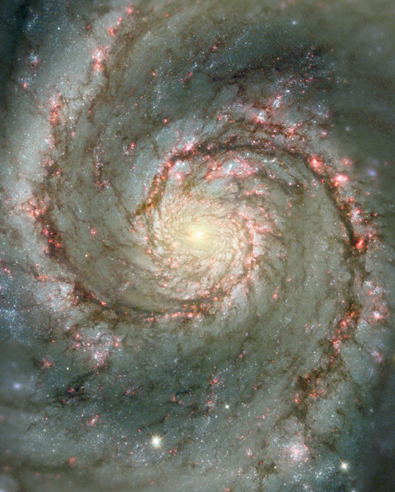
Whirlpool Galaxy:
High-Energy Activity Heats Up the Whirlpool

High-Energy Activity Heats Up the Whirlpool
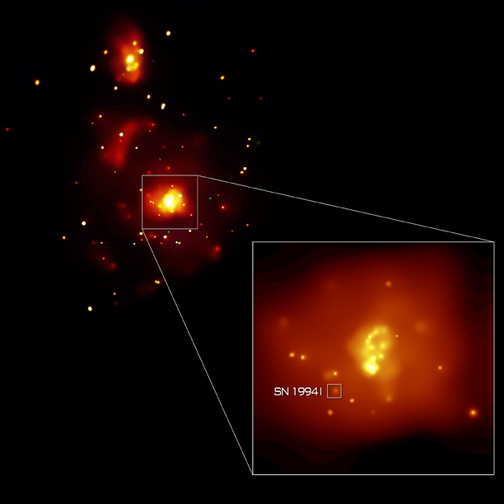
X-rays from a rare type of supernova in the Whirpool Galaxy were recently observed, thanks to the fine resolution of NASA's Chandra X-ray Observatory. The team of researchers also detected a large number of point-like X-ray sources due to black holes and neutron stars in binary star systems.
Chandra's image highlights the energetic central regions of the two interacting galaxies, NGC 5194 (center) and its smaller companion (upper left) NGC 5195, that are collectively called the Whirlpool Galaxy.
The inset contains an expanded image of the central region of NGC 5194. Extending to the north and south of the bright nucleus are clouds of multimillion-degree gas, with diameters of about 1500 light years and 500 light years, respectively. The similarity of these features with ones observed at radio wavelengths suggests that the gas is heated by high-velocity jets produced near a supermassive black hole in the nucleus of the galaxy.
On the lower left of the inset image is a faint source identified with a supernova discovered in 1994 by amateur astronomers in Georgia, and subsequently determined to be an unusual Type Ic supernova. The massive stars responsible for these supernovas are thought to have lost their outer layers of hydrogen and helium gas thousands of years before the explosion, either through evaporation or transfer to a companion.
In the millennia before a doomed star explodes into a supernova, it loses mass. X-ray observations of the supernova shock wave provide a method to sensitively probe into this process. The Chandra data from SN 1994I and its surrounding area indicate that the progenitor star evaporated material into a cloud around the star that has a diameter at least 0.2 light years. Further monitoring over the years will tell just how large the cloud is, and how long the star was losing mass before it exploded.
Andrew Wilson of the University of Maryland, in College Park, was the principal investigator for the Chandra observations of M51. Other scientists involved in the research were Yuichi Terashima of the University of Maryland, and Stefan Immler of the University of Massachusetts, Amherst.
|
||||||||||||||||||||||||||||||
Visual Description:
The Whirlpool Galaxy (M51) is provided in X-rays from the Chandra X-ray Observatory, showing a pair of interacting galaxies with supermassive black holes at their centers. Chandra's image in bright orange and red hues highlights the energetic central regions of the two interacting galaxies, NGC 5194 (center) and its smaller companion (upper left) NGC 5195, that are collectively called the Whirlpool Galaxy. An inset contains an expanded image of the central region of NGC 5194. Extending to the north and south of the bright nucleus are clouds of multimillion-degree gas, with diameters of about 1500 light years and 500 light years, respectively. The similarity of these features with ones observed at radio wavelengths suggests that the gas is heated by high-velocity jets produced near a supermassive black hole in the nucleus of the galaxy. On the lower left of the inset image is a faint source identified with a supernova discovered in 1994, and subsequently determined to be an unusual Type Ic supernova. The massive stars responsible for these supernovas are thought to have lost their outer layers of hydrogen and helium gas thousands of years before the explosion, either through evaporation or transfer to a companion.


Revised: September 08, 2025