





CXC Home | Search | Help | Image Use Policy | Latest Images | Privacy | Accessibility | Glossary | Q&A
Download Image
More Information
More Images
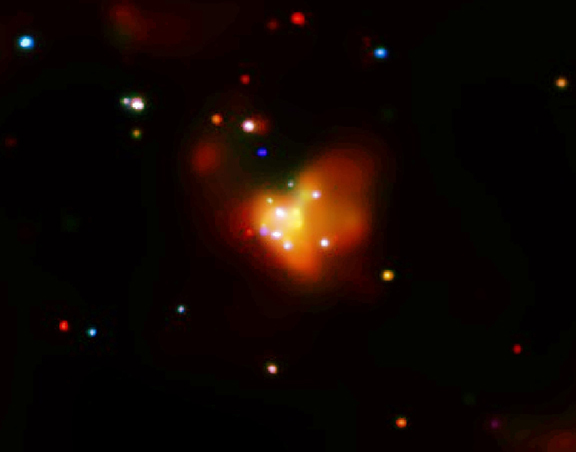
Chandra Close-up
of M83 Nucleus
of M83 Nucleus
(Credit: NASA/CXC/U.Leicester/
U.London/R.Soria & K.Wu)
U.London/R.Soria & K.Wu)
More Releases
Related Images
M83:
X-rays Reveal Nature of Spiral Galaxy's Boisterous Activity

X-rays Reveal Nature of Spiral Galaxy's Boisterous Activity
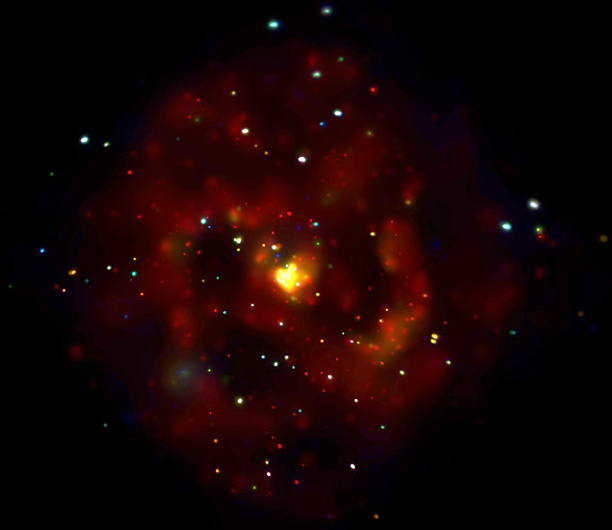
Chandra's image of M83 shows numerous point-like neutron star and black hole X-ray sources scattered throughout the disk of this spiral galaxy. The bright nuclear region of the galaxy glows prominently due to a burst of star formation that is estimated to have begun about 20 million years ago in the galaxy's time frame.
The observation revealed that the nuclear region contains a much higher concentration of neutron stars and black holes than the rest of the galaxy. Also discovered was a cloud of 7 million-degree Celsius gas enveloping the nuclear region.
The picture that emerges is one of enhanced star formation in the nuclear region that has produced more massive stars, leading to more supernova explosions, neutron stars and black holes. This activity could also account for the hot gas cloud which shows evidence for an excess of carbon, neon, magnesium, silicon and sulfur atoms. Mass evaporating from massive stars, and the ejecta from supernovas have enriched the gas with carbon and other elements.
Hot gas with a slightly lower temperature of 4 million degrees was observed along the spiral arms of the galaxy. This suggests that star formation may be occurring at a more sedate rate in the spiral arms, consistent with the observation of proportionately fewer bright point-like sources there compared to the nucleus.
|
||||||||||||||||||||||||||||
Visual Description:
This Chandra X-ray Observatory image features a majestic spiral galaxy called M83. The dominant colors in the image are dark red, yellow, with numerous blue and green dots across it. The key structures in this image are the spiral arms of the galaxy, which can be seen as chunky curved arcs emanating from the center of the galaxy. The spiral arms are made up of stars, gas, and dust, all of which contribute to the galaxy's overall structure. The numerous point-like sources are mostly neutron stars and black holes scattered throughout the disk of this spiral galaxy. There is a bright core region in the center of the galaxy, colored yellow, that glows prominently due to a burst of star formation that is estimated to have begun about 20 million years ago in the galaxy's time frame. Also discovered in this image was a cloud of 7-million-degree Celsius gas enveloping the nuclear region, seen as the fuzzy material in darker reds. The picture that emerges is one of enhanced star formation in the central region of M83 that has produced more massive stars, leading to more supernova explosions, neutron stars and black holes. This activity could also account for the hot gas cloud which shows evidence for an excess of carbon, neon, magnesium, silicon and sulfur atoms.


Revised: October 07, 2026