






CXC Home | Search | Help | Image Use Policy | Latest Images | Privacy | Accessibility | Glossary | Q&A
Download Image
More Information
More Images
Animation & Video
More Releases

Related Images
NGC 4697:
Black Holes in Elliptical Galaxy Point to Wild Youth

Black Holes in Elliptical Galaxy Point to Wild Youth
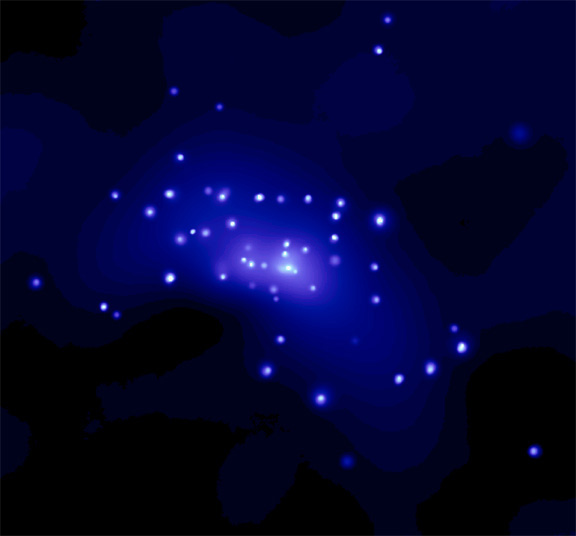
Chandra's image of the elliptical galaxy NGC 4697 reveals diffuse hot gas dotted with many point-like sources. As in the elliptical galaxies, NGC 4649 and NGC 1553, the point-like sources are due to black holes and neutron stars in binary star systems. Material pulled off a normal star is heated and emits X-radiation as it falls toward its black hole or neutron star companion.
Black holes and neutron stars are the end state of the brightest and most massive stars. Chandra's detection of numerous neutron stars and black holes in this and other elliptical galaxies shows that these galaxies once contained many very bright, massive stars, in marked contrast to the present population of low-mass faint stars that now dominate elliptical galaxies.
An unusually large number of the binary star X-ray sources in NGC 4697 are in "globular star clusters," round balls of stars in the galaxy that contain about one million stars in a volume where typically only one would be found. This suggests that the extraordinarily dense environment of globular clusters may be a good place for black holes or neutron stars to capture a companion star.
The origin of the hot gas cloud enveloping the galaxy is not known. One possibility is that the gas lost by evaporation from normal stars- so-called stellar winds - is heated by these winds and by supernova explosions.
|
||||||||||||||||||||||||||||
Visual Description:
The Chandra X-ray Observatory image of the elliptical galaxy NGC 4697 features a bright, blue blue with little spots of light scattered across it like a string of lights in a garden. The galaxy's shape is reminiscent of an oval or an ellipse, with its long axis oriented horizontally, though tilted up on the right in the image. The blue color of the galaxy stands out against the black background. X-ray data from Chandra reveals diffuse hot gas dotted with many point-like sources. The point-like sources are due to black holes and neutron stars in binary star systems. Material pulled off a normal star is heated and emits X-radiation as it falls toward its black hole or neutron star companion. The origin of the hot gas cloud enveloping the galaxy is unclear. One possibility is that the gas lost by evaporation from normal stars (so-called stellar winds) is heated by these winds and by supernova explosions.


Revised: October 07, 2026