




CXC Home | Search | Help | Image Use Policy | Latest Images | Privacy | Accessibility | Glossary | Q&A
Download Image
More Information
More Images
Related Images


1E 1207.4-5209:
X-rays Probe Gravitational Field Of A Neutron Star

X-rays Probe Gravitational Field Of A Neutron Star
This artist's conception illustrates 1E 1207.4-5209, a neutron star with a polar hot spot and a strong magnetic field (purple lines). The neutron star is about 7,000 light years from Earth.
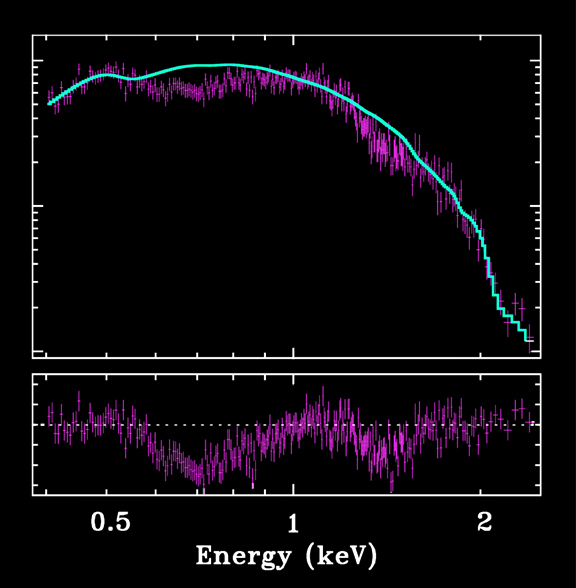
The graph in the box to the right of the star shows the expected (dashed blue line) and the observed (solid green line) spectra of the X-radiation from the hot spot. The dips in the observed spectrum are absorption features due to gas in the atmosphere of the neutron star.
According to the team of scientists that made the Chandra observation of 1E 1207, the most likely explanation for the dips in the spectrum is absorption by helium ions in a magnetic field about a hundred trillion times more intense than the Earth's magnetic field. This interpretation implies that the strong gravity of the neutron star has reduced the energy of the photons by 17 percent. The reduction of photon energy, known as the gravitational redshift, enables astronomers to relate the mass to the radius of the star. This information can then be used to help determine whether the collapsed star is composed mostly of neutrons, or contains large amounts of sub-nuclear particles called pions, kaons, or free quarks.
|
||||||||||||||||||||||
Visual Description:
1E 1207.4-5209 is a neutron star, which is depicted in an illustration at the upper left, and with an inset of an X-ray spectrum from Chandra at bottom right. The spectrum is a simple graph with two lines that provides information about the energy released by the neutron star. The neutron star appears to be spinning or rotating rapidly, which contributes to the release of energy. The shape of the neutron star is reminiscent of a sphere, but it is much smaller and denser than a typical planet or star. It is one of the most dense objects in the universe, with a mass comparable to that of the sun, but occupying only a tiny fraction of its volume. An artist's concept illustrates the neutron star with a polar hot spot and a strong magnetic field (shown with looping purple lines). The graph in the box to the lower right of the star shows expected (dashed blue line) and observed (solid green line) spectra of the X-radiation from the hot spot. The dips in the observed spectrum are absorption features due to gas in the atmosphere of the neutron star. The neutron star 1E 1207.4-5209 is about 7,000 light years from Earth.


Revised: October 07, 2026