|
|
3C58 in Context
Cosmic X-rays May Reveal New Form of Matter
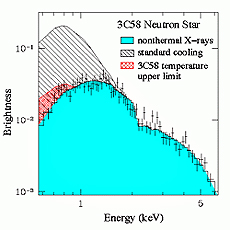
Plot of expected X-ray spectrum (X-ray brightness versus energy of X-rays) for different models.
Credit: NASA/SAO/CXC/P.Slane et al.
|
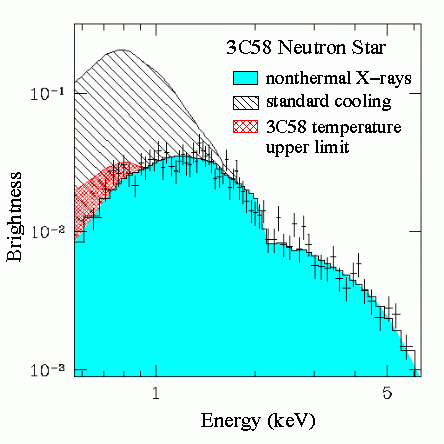
The graph on the right shows that the X-rays from the center of 3C58 are well described by the synchrotron model. The expected thermal emission from the hot surface of a standard neutron star model
with an age of 820 years is indicated by the black hatched region, and is clearly not observed. The red crosshatched region corresponds to X-ray emission expected at a temperature of about a million
degrees. This, too, falls above the observed data. The temperature of the neutron star must be less than 1.1 million degrees Celsius.
The interior of a neutron star cools rapidly soon after birth as neutrinos produced by collisions between neutrons and other subatomic particles carry away energy from the hot interior. The cooling
due to neutrino energy loss depends critically on the density and composition of the interior of the star, so measurement of the temperature of a neutron star provide a means for probing its
interior.
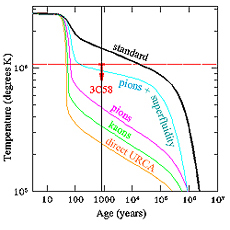
The predicted variation of the surface temperature of a neutron star with time.Standard refers to a neutron star composed mostly of neutrons. Pions and kaons are subnuclear particles that may be
stable at the high densities inside neutron stars. The Direct URCA process involves the direct decay of neutrons into protons at high densities.
Credit: NASA/SAO/CXC/P.Slane et al. |
The predicted decline of temperature with time is shown in the accompanying graph for standard models. Also shown are predictions for more rapid neutrino production rates associated with exotic
particles and other processes.
The unexpectedly cool temperature of the surface of the pulsar in 3C58 indicates that a form of matter that transcends normal nuclear material - material containing subnuclear particles such as
pions - must be present to enhance the cooling.
Return to RX J1856.5-3754 / 3C58
|
|