|
|
3C58 in Context:
Cosmic X-rays May Reveal New Form of Matter
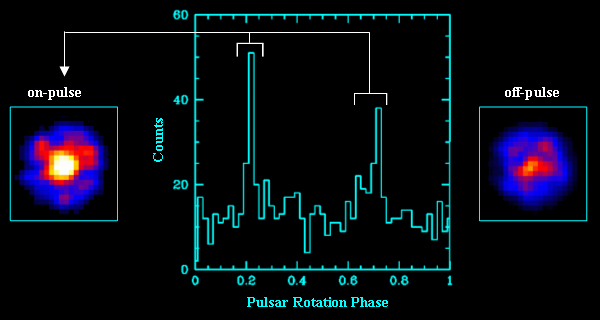
These synchrotron X-rays are pulsed; as the neutron star rotates 15 times a second, the poles of its magnetic field sweep past the line of sight to Earth, causing pulsed emission. A plot of the brightness of the X-radiation from the 3C58 pulsar (below, center) clearly shows the pulses.
Pulsar Rotation Phase
Credit: NASA/SAO/CXC/P.Slane et al.
|
The image on the left (above) shows the bright core of the inner nebula, as observed during times of the pulsar peaks.
The image at the right (above) shows the same core region using only times outside of the sharp pulses. Much fainter emission is seen. Even if all of this unpulsed emission comes from X-radiation
from the neutron star surface, it is much fainter than expected, meaning that the temperature of the surface is much cooler than predicted by standard models.
Return to RX J1856.5-3754 / 3C58
|
|