





CXC Home | Search | Help | Image Use Policy | Latest Images | Privacy | Accessibility | Glossary | Q&A
Download Image
More Information
More Images
Related Images


"Black" Black Holes:
Chandra Uncovers New Evidence For Event Horizons Surrounding Black Holes

Chandra Uncovers New Evidence For Event Horizons Surrounding Black Holes
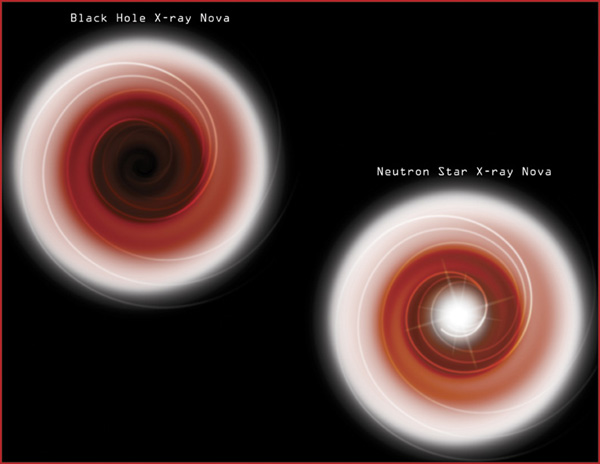
Top: This illustration shows gas from the companion star is drawn by gravity onto the black hole in a swirling pattern. As the gas nears the event horizon, a strong gravitational redshift makes it appear redder and dimmer. When the gas finally crosses the event horizon, it disappears from view. Because a black hole has no surface, the central region is black.
Bottom: As above, gas from the companion star flows down onto the collapsed star--in this case a neutron star instead of a black hole. As the gas approaches the neutron star, a similar gravitational redshift makes the gas appear redder and dimmer. However, when the gas strikes the solid surface of the neutron star, it glows brightly.
Visual Description:
Astronomers used the Chandra X-ray Observatory to study some of the darkest black holes yet observed. Their work strongly confirms the reality of the "event horizon," the one-way membrane around black holes predicted by Einstein's theory of relativity. The Illustration of this story is an artist's concept of a black hole event horizon depicting two black holes, each with a white circle in the center. The first black hole at top left has a black center, while the second black hole at bottom right has a white center. The top illustration shows gas from the companion star is drawn by gravity onto the black hole in a swirling pattern. As the gas nears the event horizon, a strong gravitational redshift makes it appear redder and dimmer. When the gas finally crosses the event horizon, it disappears from view. Because a black hole has no surface, the central region is black. The bottom illustration shows that as above, gas from the companion star flows down onto the collapsed star--in this case a neutron star instead of a black hole. As the gas approaches the neutron star, a similar gravitational redshift makes the gas appear redder and dimmer. However, when the gas strikes the solid surface of the neutron star, it glows brightly.


Revised: September 09, 2025