





CXC Home | Search | Help | Image Use Policy | Latest Images | Privacy | Accessibility | Glossary | Q&A
Download Image
More Information
More Images
More Releases


Related Images


Cygnus X-1, XTE J1650-500, GX 339-4:
"Iron-Clad" Evidence For Spinning Black Hole
Credit: Illustration: NASA/CXC/M.Weiss; Spectra: NASA/CXC/SAO/J.Miller et al.

"Iron-Clad" Evidence For Spinning Black Hole
Credit: Illustration: NASA/CXC/M.Weiss; Spectra: NASA/CXC/SAO/J.Miller et al.
Visual Description:
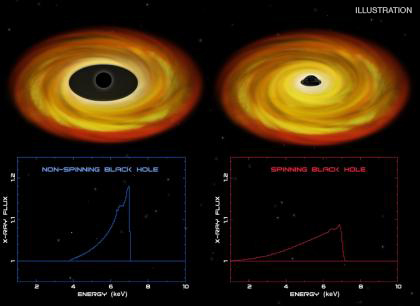
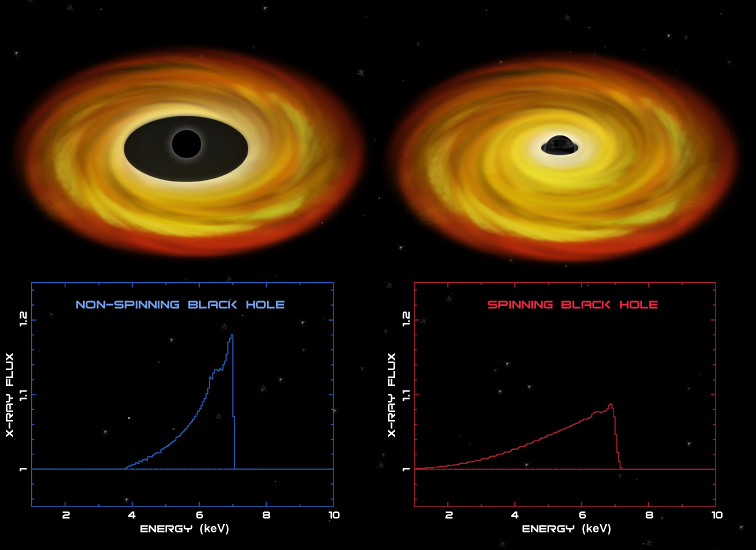
Chandra and XMM-Newton observations of iron atoms in the hot gas orbiting 3 stellar black holes have allowed astronomers to investigate the gravitational effects and spin of these black holes. For example, as shown in the illustration, the gravity of a black hole shifts X-rays from iron atoms to lower energies, producing a strongly skewed X-ray signal.
The orbit of a particle near a black hole depends on the curvature of space around the black hole, which also depends on how fast the black hole is spinning. A spinning black hole drags space around with it and allows atoms to orbit nearer to the black hole than is possible for a non-spinning black hole. The tighter orbit means stronger gravitational effects, which means that more of the X-rays from iron atoms are shifted to lower energies.
The most detailed studies of stellar black holes to date indicate that not all black holes spin at the same rate.
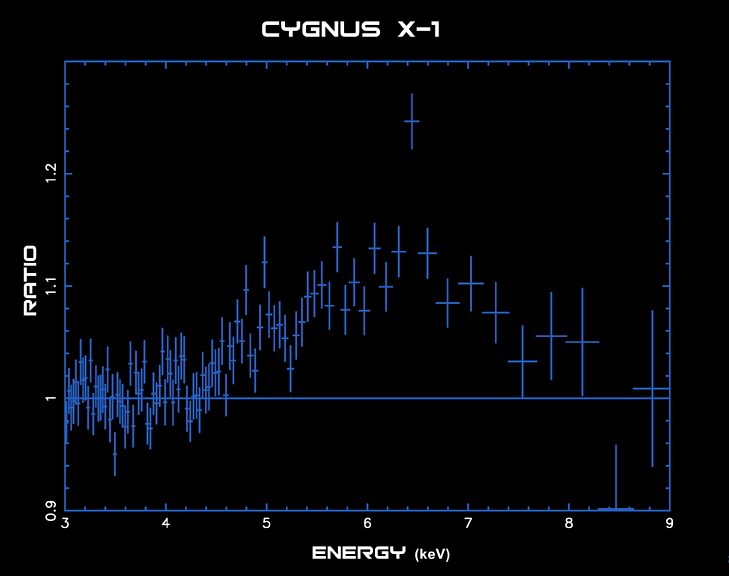
Chandra data on Cygnus X-1 (similar to the lower left panel) show evidence of strong gravitational effects, with some atoms as close as 100 miles from the black hole, but no evidence of spin. XMM-Newton data from XTE J1650-500 are similar to the lower right panel and indicate that some X-rays are coming from as close as 20 miles to the black hole event horizon. This black hole must be spinning rapidly. Chandra observations of a third stellar black hole, GX 339-4, indicate that it is also spinning rapidly.
One possible explanation for the differences in spin among stellar black holes is that they are born spinning at different rates. Another is that the gas flowing into the black hole spins it up. The black holes with relatively long-lived, low-mass companions, such as XTE J1650-500 and GX 339-4, would have had a longer time to spin up than those with massive, short-lived companion stars, such as Cygnus X-1. As the spins of more black holes are measured, it should be possible to test these explanations.
|
||||||||||||||||||||||||
|
||||||||||||||||||||||||
|
||||||||||||
Visual Description:
The image consists of two illustrations up top and two X-ray spectra at bottom to help showcase how astronomers have investigated the gravitational effects and spin of black holes with the Chandra X-ray Observatory. The colors in the image are predominantly shades of red, orange, blue and black. The key structures in the illustrations include an accretion disk, shaped like a swirly pancake in red, orange and white, and the black hole's shadow. The accretion disk is a disk of gas and dust that orbits around the black hole, eventually falling into it due to its immense gravitational pull. The black hole's shadow is created by the intense gravity of the black hole, which causes light to bend around it, appearing as a dark area in the center of the image. As shown in the spectra (a plot of X-ray energy over different wavelengths) , the gravity of a black hole shifts X-rays from iron atoms to lower energies, producing a strongly skewed X-ray signal. One black hole is depicted as not spinning (on the left) with a wider area of black space around the black hole, and a second black hole is depicted as spinning rapidly (on the right), with no blank space around the black hole. One consequence of Einstein's theory of relativity is that spinning black holes drag space with them as they spin, making it possible for particles to orbit nearer to the black hole. A possible explanation for the differences in spin among stellar black holes is that they are born spinning at different rates. Another is that the gas flowing into the black hole spins it up.


Revised: September 05, 2025