




CXC Home | Search | Help | Image Use Policy | Latest Images | Privacy | Accessibility | Glossary | Q&A
Download Image
More Information
More Images
Related Images


GRB 991216:
Chandra Helps Put The Pieces Together On Gamma-Ray Bursts

Chandra Helps Put The Pieces Together On Gamma-Ray Bursts
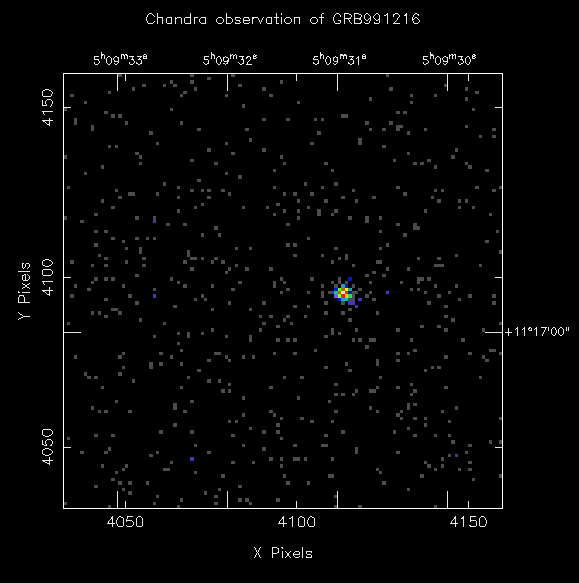
This composite image shows the X-ray spectrum and CCD image of the gamma-ray burst (GRB) known as GRB991216. An international team used Chandra to observe iron emission lines from ejected material surrounding GRB991216, the first time emission lines associated with GRBs have been unambiguously detected and their properties precisely measured at X-ray wavelengths. These data strengthens that GRBs are the result of a "hypernova," a gigantic star collapsing on itself under its own weight.
While GRB afterglows have been studied in the optical, radio, and X-ray regimes for some time, high precision X-ray observations were needed to detect the dense, massive medium that would exist if the scenario of a massive progenitor were true. With Chandra, the scientists believe they are seeing the iron emission that is predicted if the surrounding medium becomes heavily ionized and recombination takes place after being hit with the radiation produced by the GRB and its afterglow.
Chandra observed GRB991216 on December 18, 1999, using the High Energy Grating Spectrometer (HETG) in conjunction with the Advanced CCD Imaging Spectrometer (ACIS) for 3.4 hours.
|
||||||||||||||||||||||
Visual Description:
The image is a Chandra X-ray Observatory image of the gamma-ray burst called GRB 991216, which was detected by the BeppoSAX satellite on December 16, 1999. The X-ray image shows a bright multicolored speckled spot in the center, surrounded by many gray dots or specks. The colors in the image are predominantly grey, black and white, with a few specks of red, blue and green. This image also shows the X-ray spectrum of GRB991216 to the lower left. An international team used Chandra to observe iron emission lines from ejected material surrounding GRB991216, the first time emission lines associated with GRBs have been unambiguously detected and their properties precisely measured at X-ray wavelengths. This data strengthens that GRBs are the result of a "hypernova," a gigantic star collapsing on itself under its own weight.


Revised: September 10, 2025