

Location: Zodiac constellation, visible from both Hemispheres
Coordinates:
Right Ascension: 01h
Declination: +15º
Source: Ancient, Middle East and eastern Mediterranean, also Greek and Roman mythology.
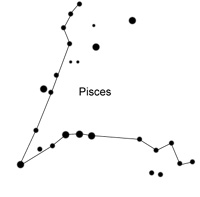
The story behind the name: The constellations that are included in the Zodiac - the 12 constellations recognized by Babylonian astronomers through which our Sun, moon, and planets appeared to travel during the course of a year - are considered to be among the oldest sky patterns recognized by human civilizations. They were thought to have more significance because they were touched by the Sun. The stars in Pisces were associated with a fish (or two fishes) by many ancient Middle East civilizations. The reasons remain obscure.
The Greeks and Romans associated the constellation with a myth involving Aphrodite and her son Eros which takes place during the early power struggles among the mythological beings brought into existence in Greek creation myths. Mother Earth had created the Titans as the first gods, as well as many semi-human races such as the Cyclopes and a race of giants.
The Titans were associated with the planets. One of them, Cronus, was father to the first Olympian gods. His son Zeus ultimately led a great war against his father and the Titans and vanquished the Titans to Tartarus. The Titans' brothers, the giants, were enraged and attacked the Olympian gods. They lost badly.
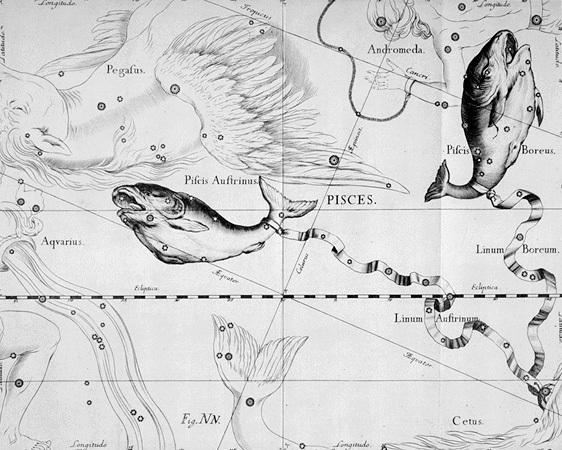
In revenge for the destruction of her children, Mother Earth produced Typhon, said to be the largest, fiercest monster ever born. He was said to be covered in serpents, to have wings which blotted out the Sun, to have a head which touched the stars, and he breathed fire and hurled rocks from his mouth. His attack on Olympus frightened the gods so much that they fled, disguising themselves as animals.
Aphrodite is said to have taken the form of a fish, and in one version of the story, her son Eros accompanied her. So that they did not become separated, they tied themselves together with a string. In the constellation, a bright star midway between the two fishes represents the knot. After several terrible setbacks, the Olympian gods rallied through a combination of stealth and Zeus's might, and chased Typhon to Sicily where Zeus dropped Mount Aetna on him. His remains were said to be the cause of the mountain's rumbling, smoke, and eruptions.
Introduction to Constellations | Constellation Sources | Constellations Index
Objects observed by Chandra in Pisces: