April 17, 2000 :: As Chandra observes more and more galaxies, the evidence builds that the number of powerful black holes in the universe is much greater than optical surveys have led us to believe.
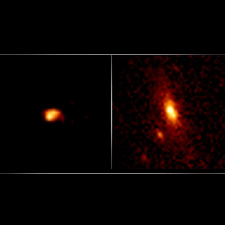
A group led by Andrew Fabian from the Institute of Astronomy in Cambridge, England used Chandra to find the strongest evidence yet for a Type 2 quasar, a.k.a. a veiled black hole. Another team, led by Fabrizio Fiore found yet another one.
What does all this mean for the price of a gallon of gas?
Not much in the short run, but in the long haul it could, in Fabian's words, ". . . change our perspective on what the main sources of power in the universe are."
To an optical telescope the galaxy may appear as a normal Clark Kent-like galaxy.
Indeed Fabian speculates that the increased numbers of black holes means that the total energy emitted by gas as it falls into them can be as much as 50 percent of that emitted by all the stars in
the history of the universe!
According to one popular scenario, a galaxy starts out with a dense cloud of gas and dust around a nucleus which contains a relatively small black hole. The black hole grows by sucking in
surrounding gas and dust, which in turn produces prodigious amounts of visible, ultraviolet, and X-radiation. To an optical telescope the galaxy may appear as a normal Clark Kent-like galaxy, since
the central cloud obscures the superman within. To an X-ray telescope, the galaxy appears as a Type 2 quasar.
Spitzer Space Telescope.
Over a billion years or so, the mass of the giant black hole increases until it equals that of several hundred million Suns. At this extreme mass the power of the accretion process blows away the
surrounding gas and shuts off the black hole's source of fuel.
After that the giant black hole goes into hibernation and remains there until a collision with another galaxy or a rain of intergalactic gas provides the fuel and stimulus for it to burst forth and
reveal its true superpower potential.
The question remains as to whether or not the amount of energy absorbed and re-radiated at infrared wavelengths by the dense clouds around giant black holes will be enough to change the total energy
balance of the universe since the Big Bang. When the 4th of NASA's Great Observatories, the Space Infrared Telescope Facility is launched in 2001, the infrared background should provide the
answer.
Episode 4
April 10, 2000 - During the last few years deep sky surveys with Japan's Advanced Satellite for Cosmology and Astrophysics (ASCA) and the Italian-Dutch BeppoSAX X-ray satellite gave support to the
idea that more than Type 1 quasars are needed to produce the X-ray background glow. Episode 4