
NASA Telescopes Spot Surprisingly Mature Cluster in Early Universe

Protocluster JADES-ID1
More images, videos, and information
Credit: X-ray: NASA/CXC/CfA/Á Bogdán; Infrared (JWST): NASA/ESA/CSA/STScI;
Image Processing: NASA/CXC/SAO/P. Edmonds and L. Frattare
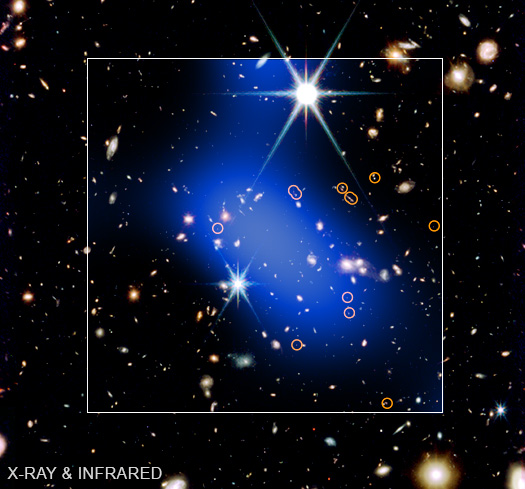
This graphic represents the discovery of what may be the most distant protocluster ever found, as described in our latest press release. By using NASA’s Chandra X-ray Observatory together with the James Webb Space Telescope (JWST), astronomers have netted an important piece in the history of the universe: when galaxy clusters, the largest structures held together by gravity, begin to form.
The main panel contains an infrared image from the JWST Advanced Deep Extragalactic Survey (JADES), a deep infrared imaging project that used more than a month of the telescope’s observing time. The white box outlines X-rays (blue) seen with Chandra.
The newly-discovered protocluster, dubbed JADES-ID1, is located about 12.7 billion light-years from Earth, or just about a billion years after the big bang. It has a mass of about 20 trillion suns and two important characteristics of a protocluster: a large number of galaxies held together by gravity (Webb sees at least 66 potential members) and a huge cloud of hot gas (detected by Chandra). So that only X-rays from the protocluster are included, only X-rays inside the white box are shown. The annotated version of the image shows circles where astronomers find some of the individual galaxies in JADES-ID1.
Credit: X-ray: NASA/CXC/CfA/Á Bogdán; JWST: NASA/ESA/CSA/STScI; Image Processing: NASA/CXC/SAO/P. Edmonds and L. Frattare
Most models of the universe predict that there likely would not be enough time and a large enough density of galaxies for a protocluster of this size to form at this epoch in the early universe. The previous record holder for a protocluster with X-ray emission is seen much later, about three billion years after the big bang. Therefore, the discovery of JADES-ID1 will force scientists to re-examine their ideas for how galaxy clusters — gigantic collections of galaxies, hot gas, and dark matter — first appeared in the universe.
To find JADES-ID1, astronomers combined deep observations from both Chandra and Webb. By design, the JADES field overlaps with the Chandra Deep Field South, the site of the deepest X-ray observation ever conducted. This field is thus one of the few in the entire sky where a discovery such as this could be made. The researchers found five other proto-cluster candidates in the JADES field, but only in JADES-ID1 are the galaxies seen to be embedded in hot gas. Only JADES-ID1 possesses enough mass for an X-ray signal from hot gas to be expected.
A paper describing these results appears in the latest issue of the journal Nature. The authors of the study are Akos Bogdan and Gerritt Schellenberger (Center for Astrophysics | Harvard & Smithsonian) and Qiong Li and Christopher Conselice (University of Manchester in the United Kingdom).
NASA's Marshall Space Flight Center in Huntsville, Alabama, manages the Chandra program. The Smithsonian Astrophysical Observatory's Chandra X-ray Center controls science operations from Cambridge, Massachusetts, and flight operations from Burlington, Massachusetts.