

CXC Home | Search | Help | Image Use Policy | Latest Images | Privacy | Accessibility | Glossary | Q&A
1. X-Ray Astronomy vs. Medical X-Rays
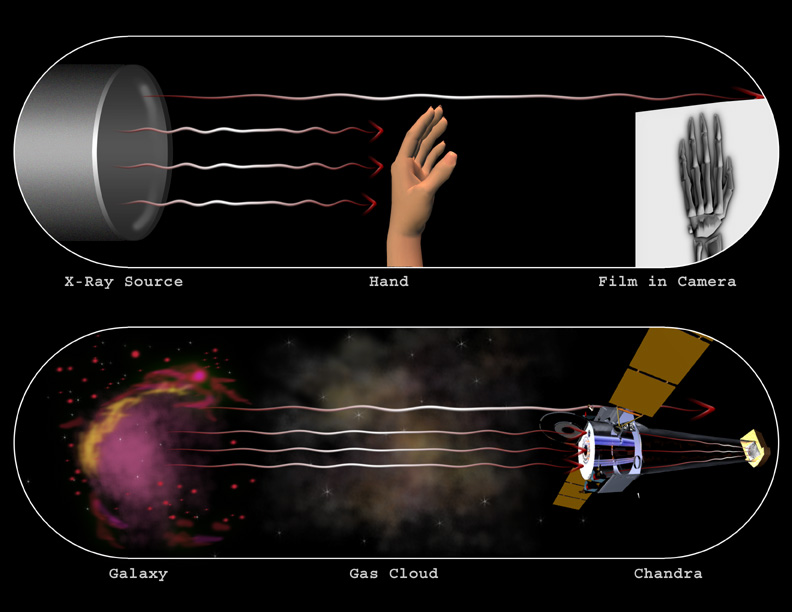
A doctor's x-ray machine consists of two parts: an x-ray source at one end, and a camera at the other. The arm or mouth or other body part to be examined is placed in between these two parts. X-rays from the source shine through the impeding body part, and the camera records the x-rays that reach the photographic film inside. Bone is denser than muscle tissue and skin, so it stops more of the x-rays (and hence fewer x-rays make it to the region of the film that's behind the bone). In the developed film negative, the bone looks lighter than the rest of the picture, since that part of the film was exposed to fewer x-rays.
More Information
(Credit: NASA/CXC/M.Weiss)
A doctor's x-ray machine consists of two parts: an x-ray source at one end, and a camera at the other. The arm or mouth or other body part to be examined is placed in between these two parts. X-rays from the source shine through the impeding body part, and the camera records the x-rays that reach the photographic film inside. Bone is denser than muscle tissue and skin, so it stops more of the x-rays (and hence fewer x-rays make it to the region of the film that's behind the bone). In the developed film negative, the bone looks lighter than the rest of the picture, since that part of the film was exposed to fewer x-rays.
More Information
(Credit: NASA/CXC/M.Weiss)
Download:
2. Illustration of Crab, Titan's Shadow and Chandra
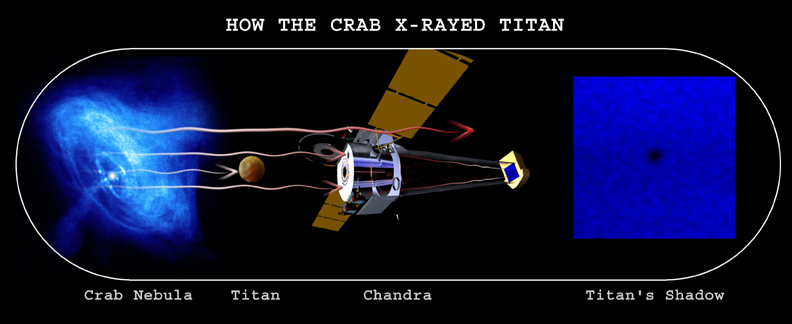
In very rare instances, an object such as a planet or satellite of a planet will move in front of, or transit an extended cosmic X-ray source, such as the Crab Nebula. Under these circumstances, an X-ray shadow of the planet or satellite can be imaged by Chandra. This happened in January of 2003 when Titan - Saturn's largest moon and the only moon in the Solar System with a thick atmosphere - passed directly in front of the Crab Nebula. By using Chandra to capture an image of the X-ray shadow cast by Titan, astronomers were able to make the first X-ray measurement of the extent of its atmosphere.
(Illustration: NASA/CXC/M.Weiss)
In very rare instances, an object such as a planet or satellite of a planet will move in front of, or transit an extended cosmic X-ray source, such as the Crab Nebula. Under these circumstances, an X-ray shadow of the planet or satellite can be imaged by Chandra. This happened in January of 2003 when Titan - Saturn's largest moon and the only moon in the Solar System with a thick atmosphere - passed directly in front of the Crab Nebula. By using Chandra to capture an image of the X-ray shadow cast by Titan, astronomers were able to make the first X-ray measurement of the extent of its atmosphere.
(Illustration: NASA/CXC/M.Weiss)
Download:




Revised: September 03, 2008