

1. Chandra's Archives Come to Life
QuicktimeMPEG Audio Only
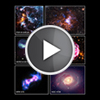
Every year, NASA's Chandra X-ray Observatory looks at hundreds of objects throughout space to help expand our understanding of the Universe. Ultimately, these data are stored in the Chandra Data Archive, an electronic repository that provides access to these unique X-ray findings for anyone who would like to explore them. With the passing of Chandra's 15th anniversary, in operation since August 26, 1999, the archive continues to grow as each successive year adds to the enormous and invaluable dataset.
To celebrate Chandra's decade and a half in space, and to honor October as American Archive Month, a variety of objects have been selected from Chandra's archive. Each of the new images we have produced combines Chandra data with those from other telescopes. This technique of creating "multiwavelength" images allows scientists and the public to see how X-rays fit with data of other types of light, such as optical, radio, and infrared. As scientists continue to make new discoveries with the telescope, the burgeoning archive will allow us to see the high-energy Universe as only Chandra can.
[Runtime: 01:27]
(NASA/CXC/A. Hobart)
Related Chandra Images:
QuicktimeMPEG Audio Only
- Audio (1.2 MB)
Every year, NASA's Chandra X-ray Observatory looks at hundreds of objects throughout space to help expand our understanding of the Universe. Ultimately, these data are stored in the Chandra Data Archive, an electronic repository that provides access to these unique X-ray findings for anyone who would like to explore them. With the passing of Chandra's 15th anniversary, in operation since August 26, 1999, the archive continues to grow as each successive year adds to the enormous and invaluable dataset.
To celebrate Chandra's decade and a half in space, and to honor October as American Archive Month, a variety of objects have been selected from Chandra's archive. Each of the new images we have produced combines Chandra data with those from other telescopes. This technique of creating "multiwavelength" images allows scientists and the public to see how X-rays fit with data of other types of light, such as optical, radio, and infrared. As scientists continue to make new discoveries with the telescope, the burgeoning archive will allow us to see the high-energy Universe as only Chandra can.
[Runtime: 01:27]
(NASA/CXC/A. Hobart)
Related Chandra Images:
- Photo Album: Chandra Archive Collection
2. Learn About Stars
QuicktimeMPEG Audio Only
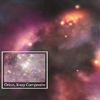
Stars appear to be permanent fixtures of the night sky. However, stars are like people. They are born, live a lifetime, and ultimately die.
Chandra and other X-ray telescopes focus on the high-energy action of stellar drama....
...sudden outbursts on the turbulent surfaces of stars,
...gale-force outflows of gas from hot, luminous stars,
...and awesome shock waves generated by supernova explosions.
See stellar evolution through Chandra's eyes.
[Runtime: 1.31]
(NASA/CXC/A. Hobart)
QuicktimeMPEG Audio Only
- Audio (497.5 kb)
Stars appear to be permanent fixtures of the night sky. However, stars are like people. They are born, live a lifetime, and ultimately die.
Chandra and other X-ray telescopes focus on the high-energy action of stellar drama....
...sudden outbursts on the turbulent surfaces of stars,
...gale-force outflows of gas from hot, luminous stars,
...and awesome shock waves generated by supernova explosions.
See stellar evolution through Chandra's eyes.
[Runtime: 1.31]
(NASA/CXC/A. Hobart)
3. X-ray and Optical Images of CoRoT-2A
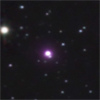
QuicktimeMPEG This sequence shows images of a nearby star named CoRoT-2a. The composite image contains X-rays from Chandra (purple) of CoRoT-2a along with optical and infrared data of the field of view in which the star is found. Not seen in these images -- but still detectable in the data -- is a planet known as CoRoT-2b in an extremely close orbit around the star. The Chandra data indicate that the planet is being blasted by X-rays with such intensity that some 5 million tons of material are being eroded from CoRoT-2a every second.
[Runtime: 00:28]
(NASA/CXC/A. Hobart)
Related Chandra Images:
QuicktimeMPEG This sequence shows images of a nearby star named CoRoT-2a. The composite image contains X-rays from Chandra (purple) of CoRoT-2a along with optical and infrared data of the field of view in which the star is found. Not seen in these images -- but still detectable in the data -- is a planet known as CoRoT-2b in an extremely close orbit around the star. The Chandra data indicate that the planet is being blasted by X-rays with such intensity that some 5 million tons of material are being eroded from CoRoT-2a every second.
[Runtime: 00:28]
(NASA/CXC/A. Hobart)
Related Chandra Images:
- Photo Album: CoRoT-2a
4. Images of J144547-5931 and J144701-5919
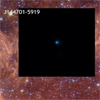
QuicktimeMPEG Data from Chandra and Spitzer of a region near the Galactic plane have been combined to track down some of the Milky Way's heaviest stars, which can be very elusive. The outlined boxes contain darkened Spitzer data and a bright Chandra X-ray source (blue) that coincides with a strong infrared signal. These are giant stars thought to be at least 25 times more massive than the Sun. They are very bright in X-rays because high-speed winds from their surfaces collide with material, creating shock waves that generate temperatures up to 100 million degrees.
[Runtime: 0.23]
(X-ray: NASA/U. of Sydney/G.Anderson et al; IR: NASA/JPL-Caltech)
Related Chandra Images:
QuicktimeMPEG Data from Chandra and Spitzer of a region near the Galactic plane have been combined to track down some of the Milky Way's heaviest stars, which can be very elusive. The outlined boxes contain darkened Spitzer data and a bright Chandra X-ray source (blue) that coincides with a strong infrared signal. These are giant stars thought to be at least 25 times more massive than the Sun. They are very bright in X-rays because high-speed winds from their surfaces collide with material, creating shock waves that generate temperatures up to 100 million degrees.
[Runtime: 0.23]
(X-ray: NASA/U. of Sydney/G.Anderson et al; IR: NASA/JPL-Caltech)
Related Chandra Images:
- Photo Album: J144547-5931
5. Images of Eta Carinae
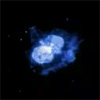
QuicktimeMPEG The sequence begins with the Hubble's optical view of Eta Carinae, showing two lobes of gas and dust most likely ejected from the star in an eruption observed the 1840s. The view then changes to include Chandra's X-ray data in yellow. The X-ray emission shows where material previously ejected by Eta Carinae rams into nearby gas and dust, heating gas to temperatures in excess of a million degrees.
[Runtime: 0:06]
(X-ray: NASA/CXC/GSFC/M.Corcoran et al.; Optical: NASA/STScI)
Related Chandra Images:
QuicktimeMPEG The sequence begins with the Hubble's optical view of Eta Carinae, showing two lobes of gas and dust most likely ejected from the star in an eruption observed the 1840s. The view then changes to include Chandra's X-ray data in yellow. The X-ray emission shows where material previously ejected by Eta Carinae rams into nearby gas and dust, heating gas to temperatures in excess of a million degrees.
[Runtime: 0:06]
(X-ray: NASA/CXC/GSFC/M.Corcoran et al.; Optical: NASA/STScI)
Related Chandra Images:
- Photo Album: Eta Carinae
6. Different Views of the Eagle Nebula (M16)
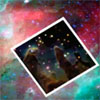
QuicktimeMPEG The Eagle Nebula (aka, the "Pillars of Creation") looks very different when viewed through three of NASA's orbiting observatories. The infrared image from the Spitzer Space Telescope and the famous Hubble Space Telescope image show the gas and dust of this star-forming region. The X-ray image from Chandra allows astronomers to peer through the obscuring material, and shows that the Eagle Nebula may be past its prime in terms of making stars. One young star is found inside the pillars, which scientists estimate to be 4 or 5 times more massive than the Sun.
[Runtime: 0.16]
(X-ray: NASA/CXC/U.Colorado/Linsky et al.; Optical: NASA/ESA/STScI/ASU/J.Hester & P.Scowen; Infrared: NASA/JPL-Caltech/SSC/N.Flagey & A.Noriega-Crespo)
Related Chandra Images:
QuicktimeMPEG The Eagle Nebula (aka, the "Pillars of Creation") looks very different when viewed through three of NASA's orbiting observatories. The infrared image from the Spitzer Space Telescope and the famous Hubble Space Telescope image show the gas and dust of this star-forming region. The X-ray image from Chandra allows astronomers to peer through the obscuring material, and shows that the Eagle Nebula may be past its prime in terms of making stars. One young star is found inside the pillars, which scientists estimate to be 4 or 5 times more massive than the Sun.
[Runtime: 0.16]
(X-ray: NASA/CXC/U.Colorado/Linsky et al.; Optical: NASA/ESA/STScI/ASU/J.Hester & P.Scowen; Infrared: NASA/JPL-Caltech/SSC/N.Flagey & A.Noriega-Crespo)
Related Chandra Images:
- Photo Album: The Eagle Nebula (M16)




Revised: May 26, 2023